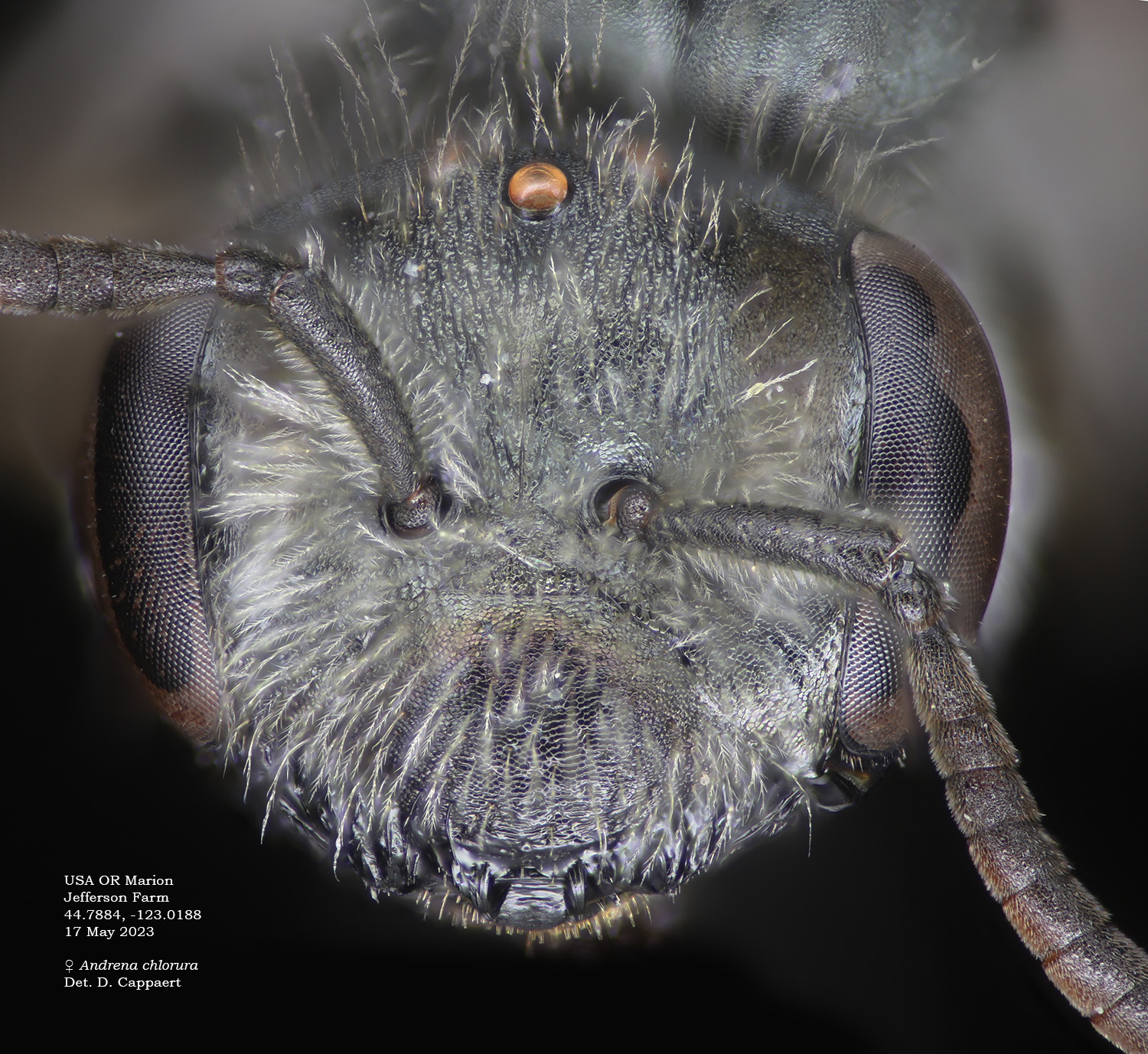
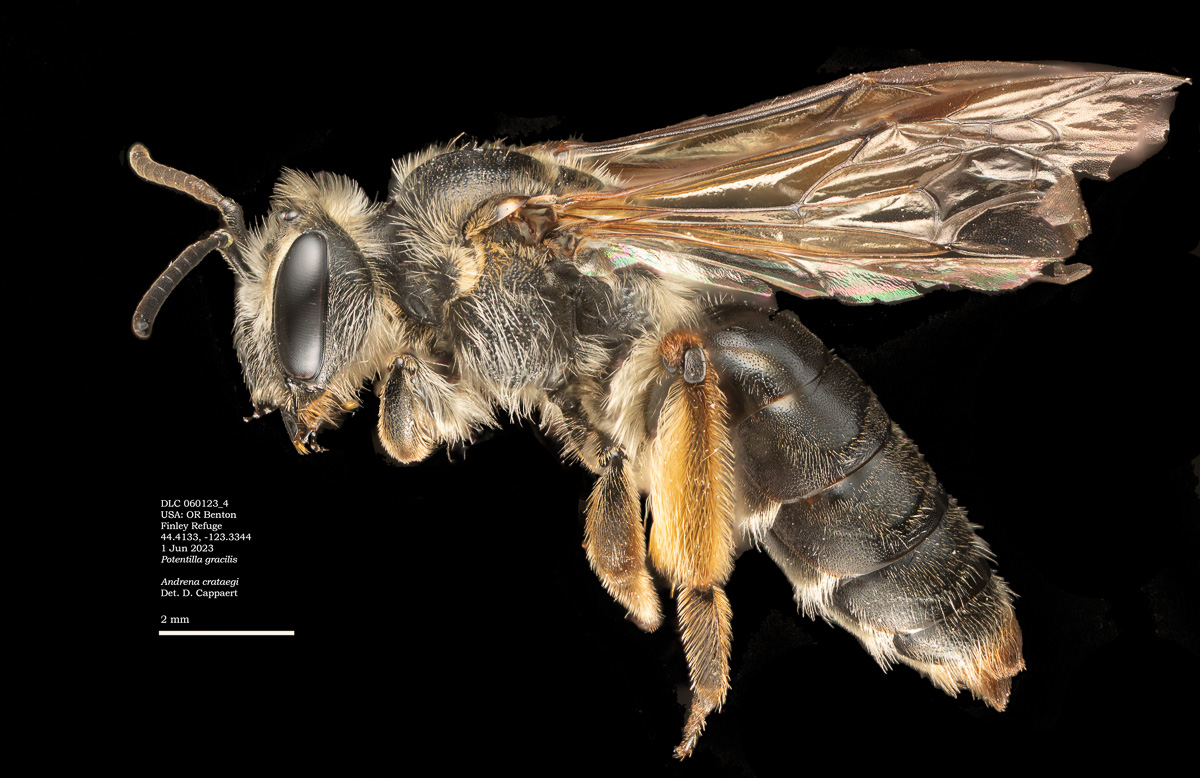
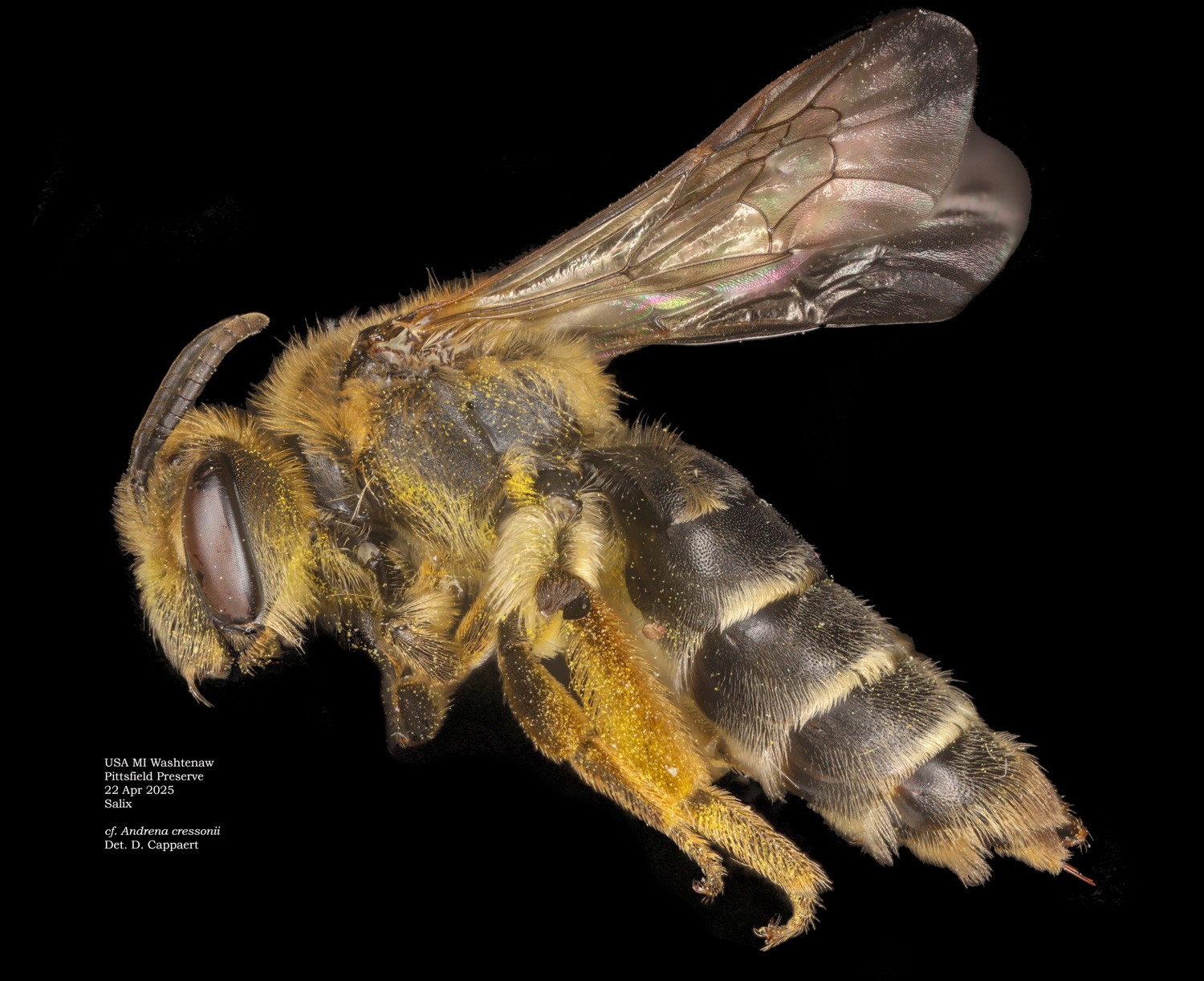
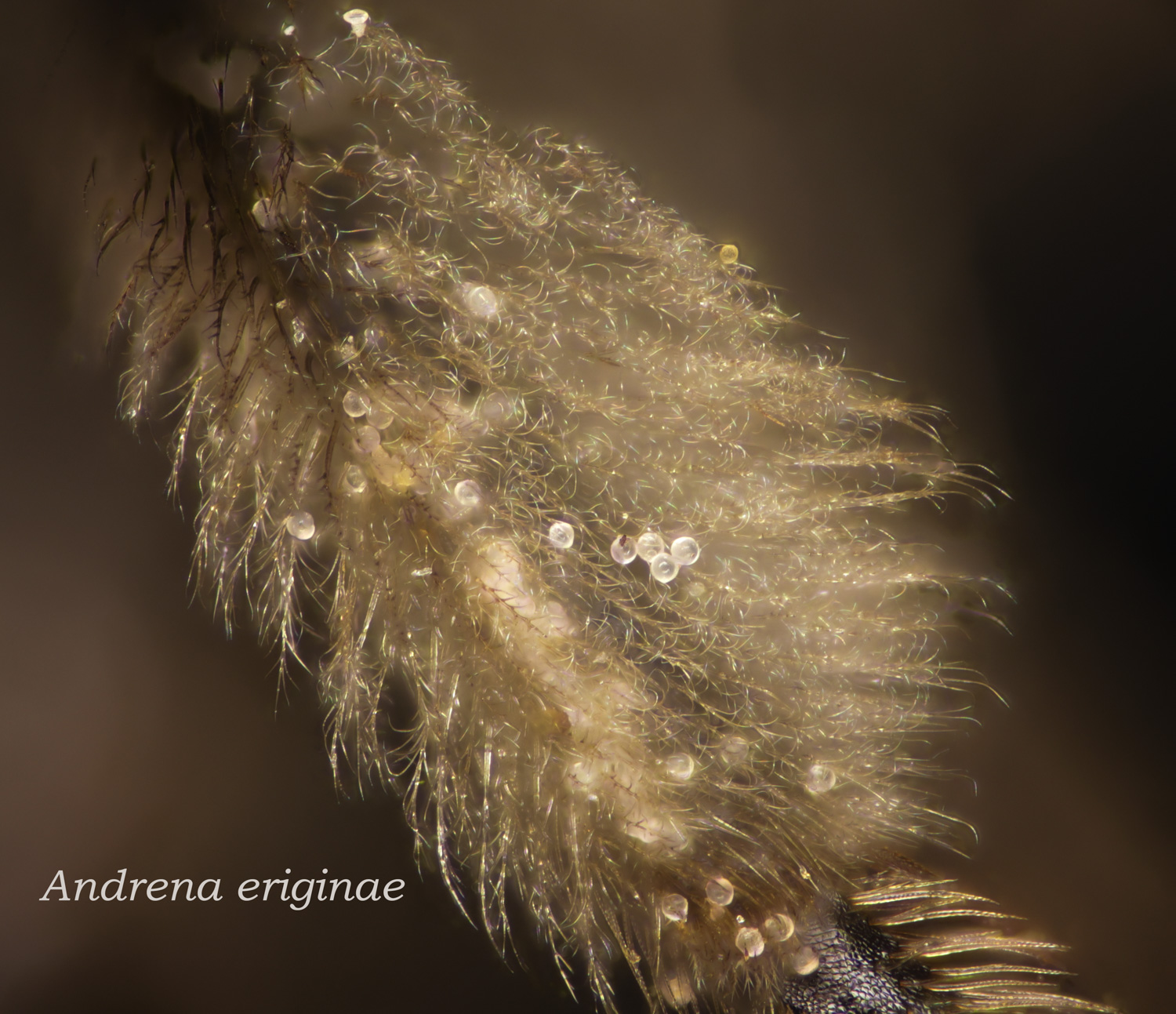
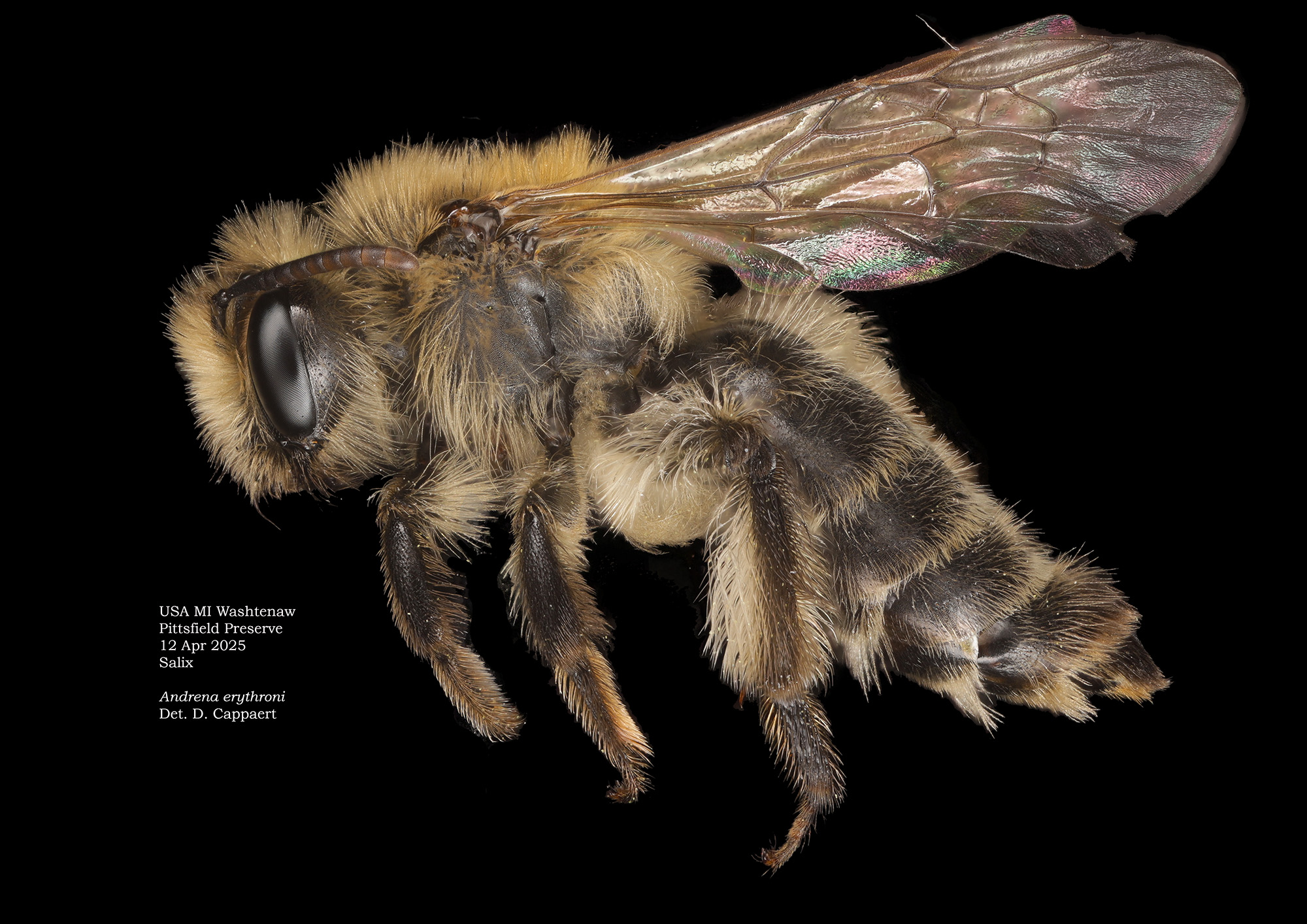
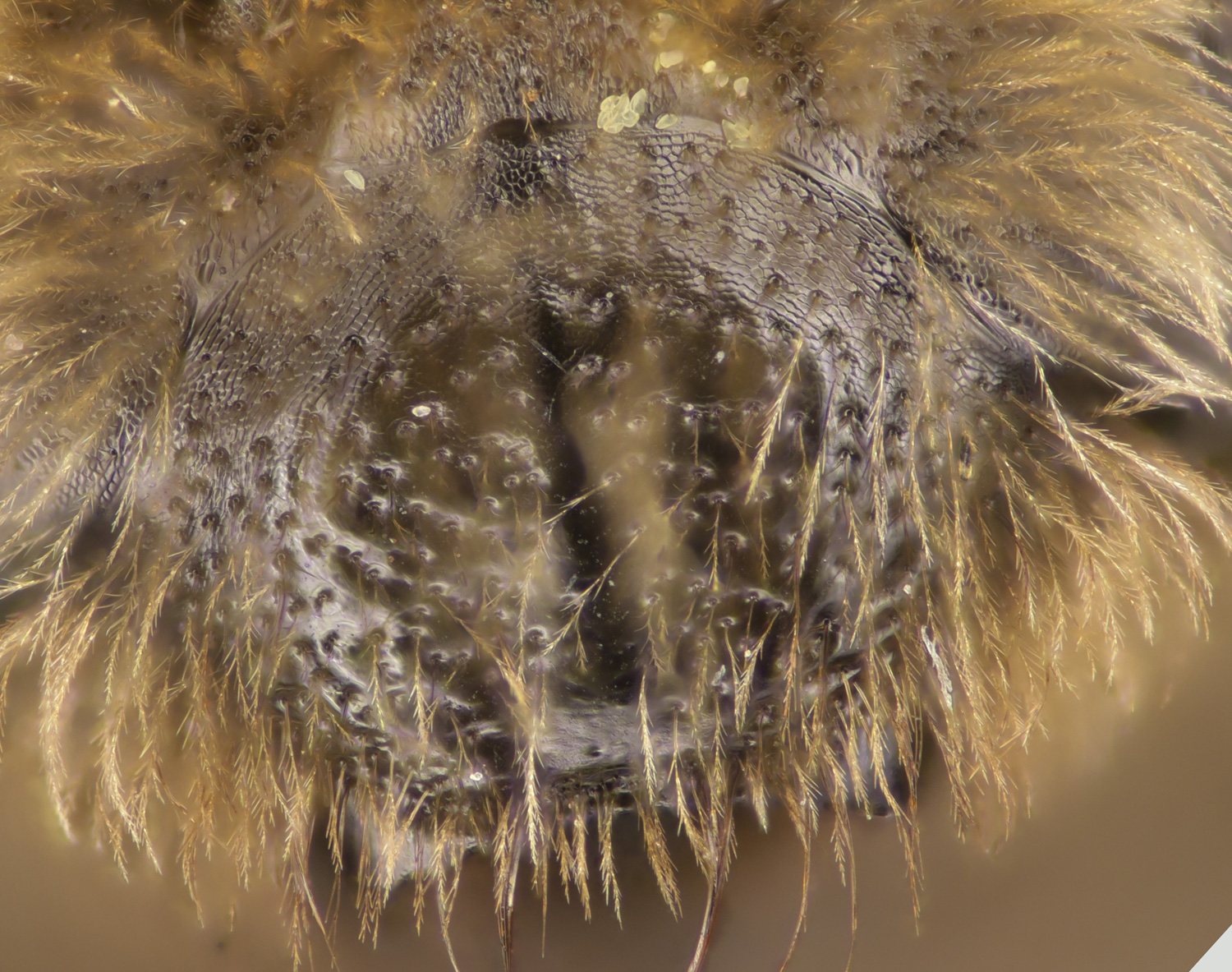
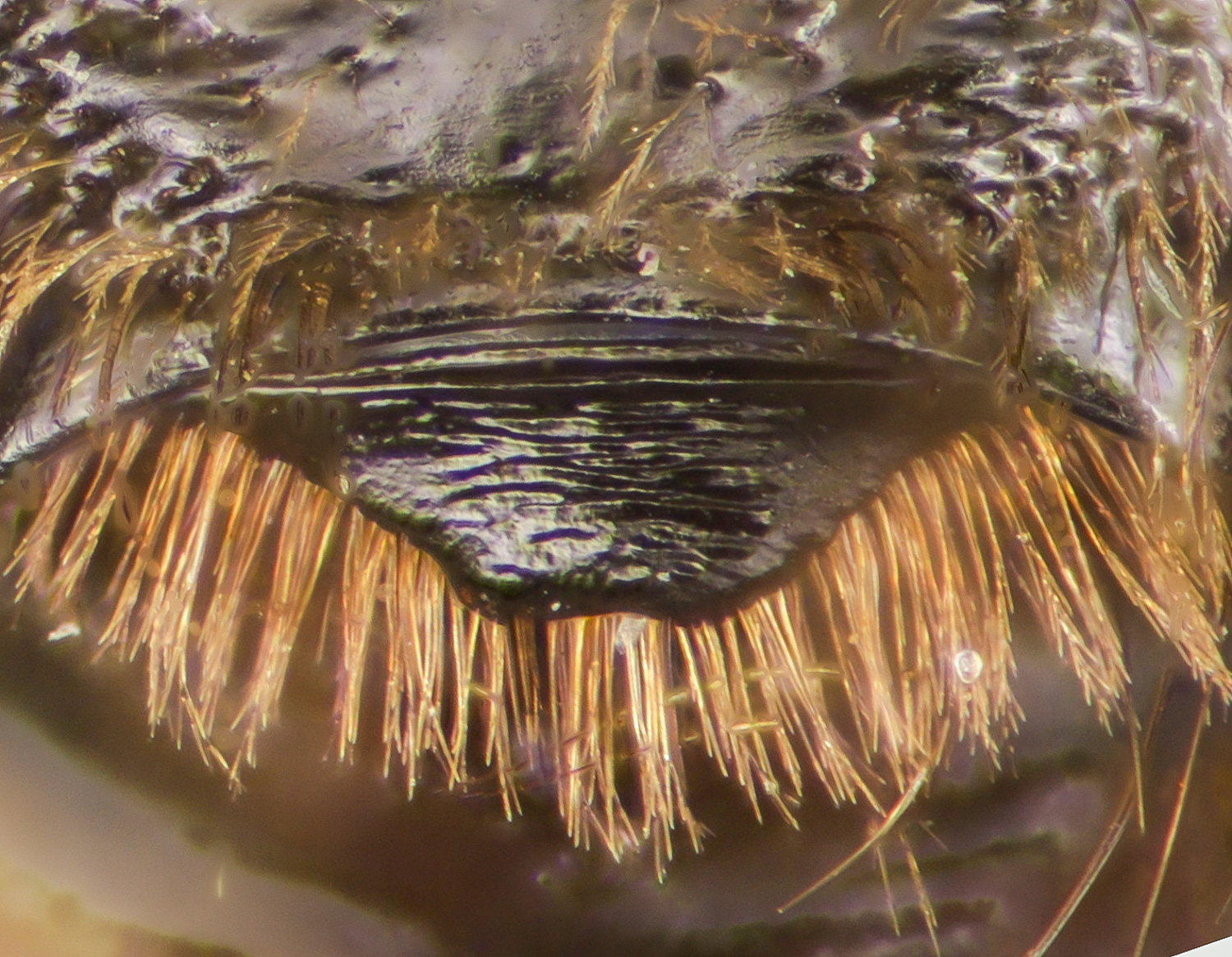
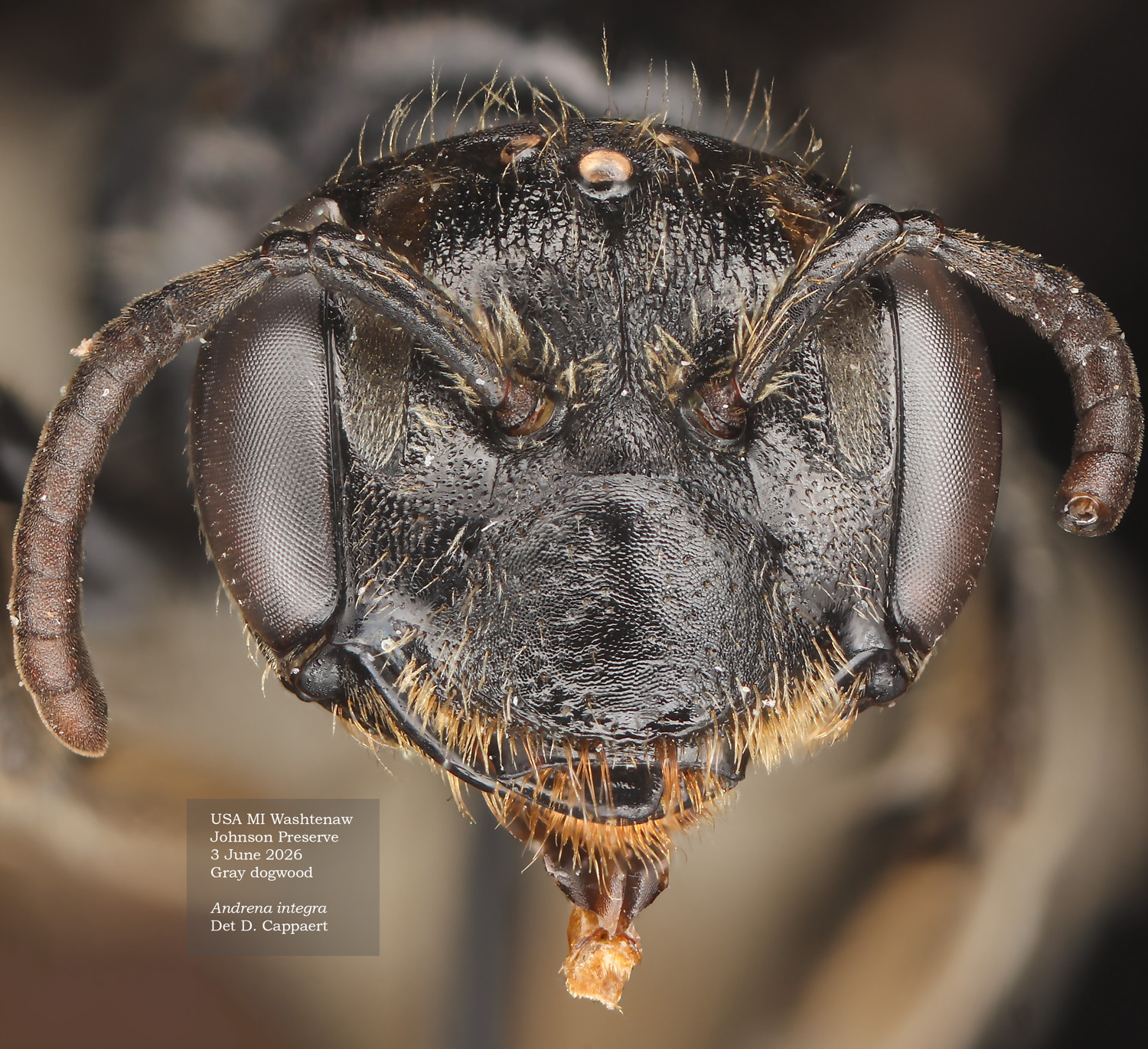
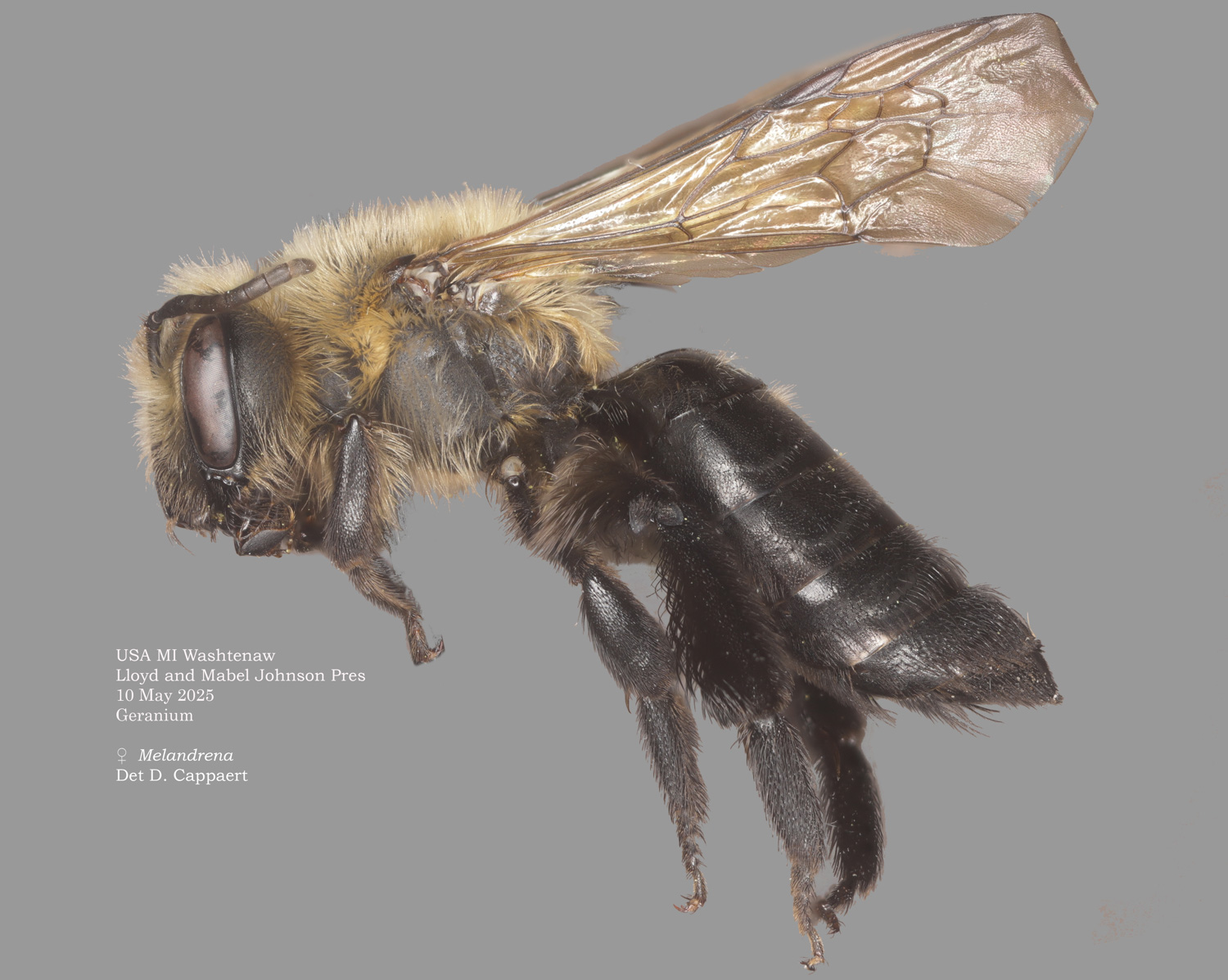
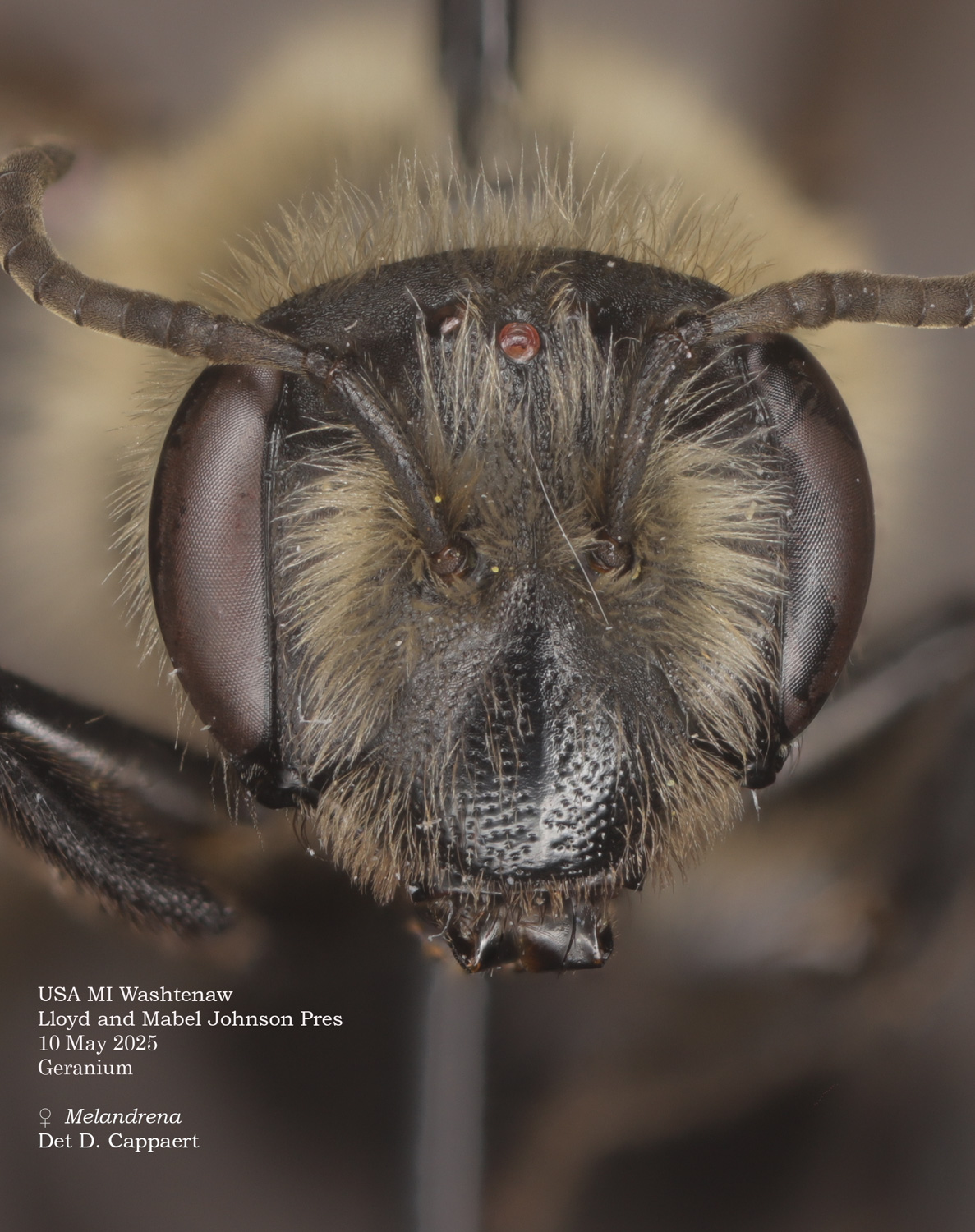
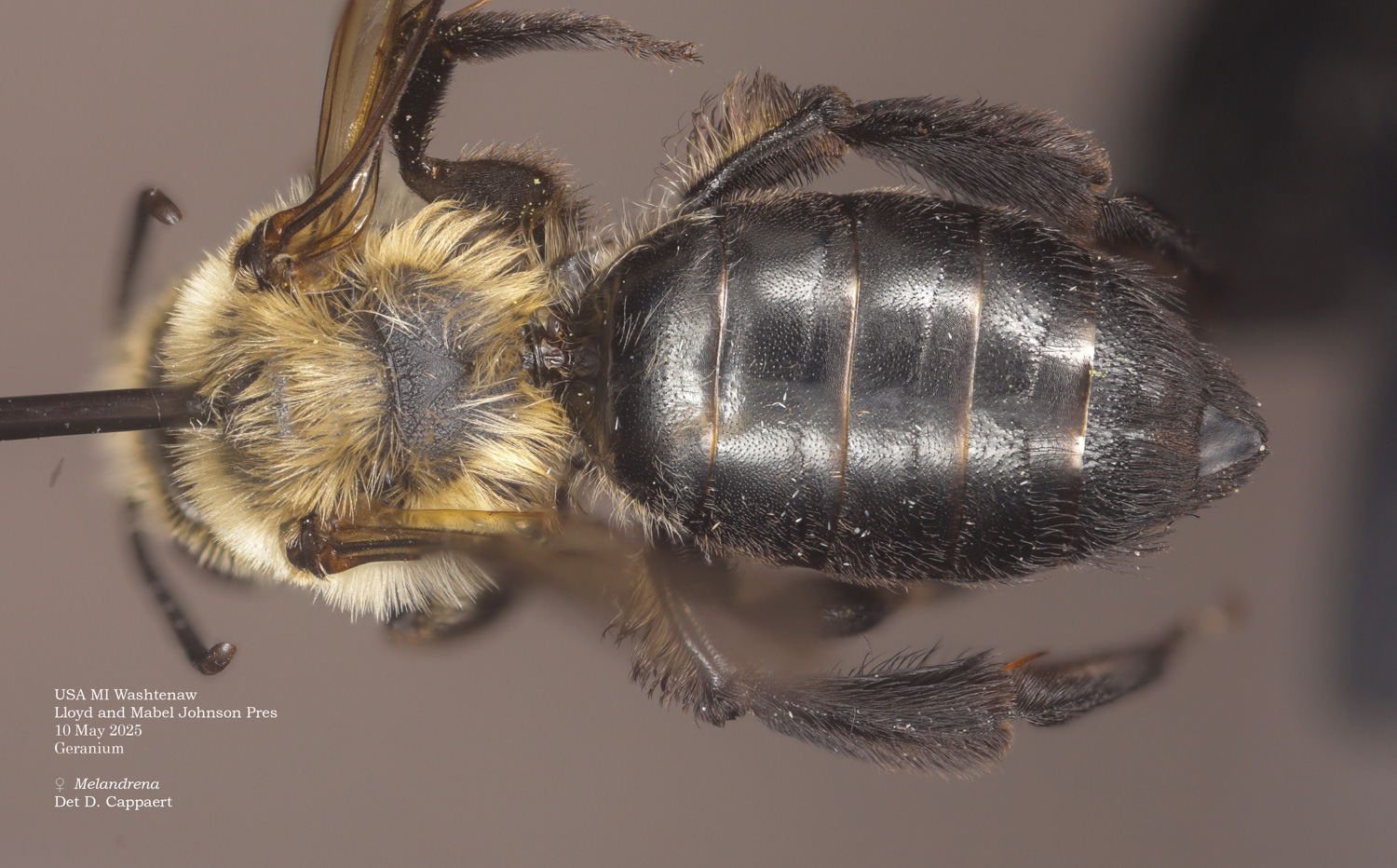
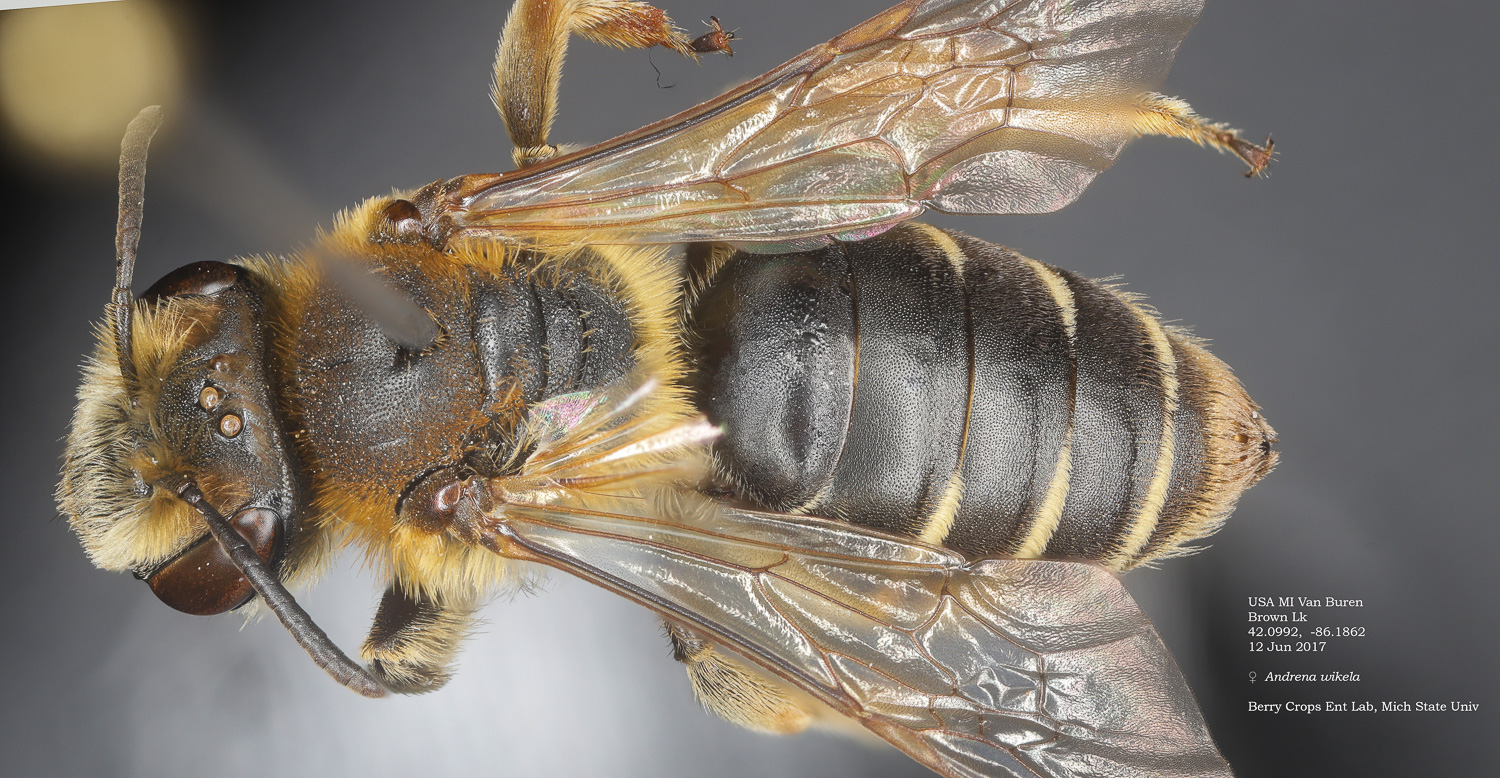
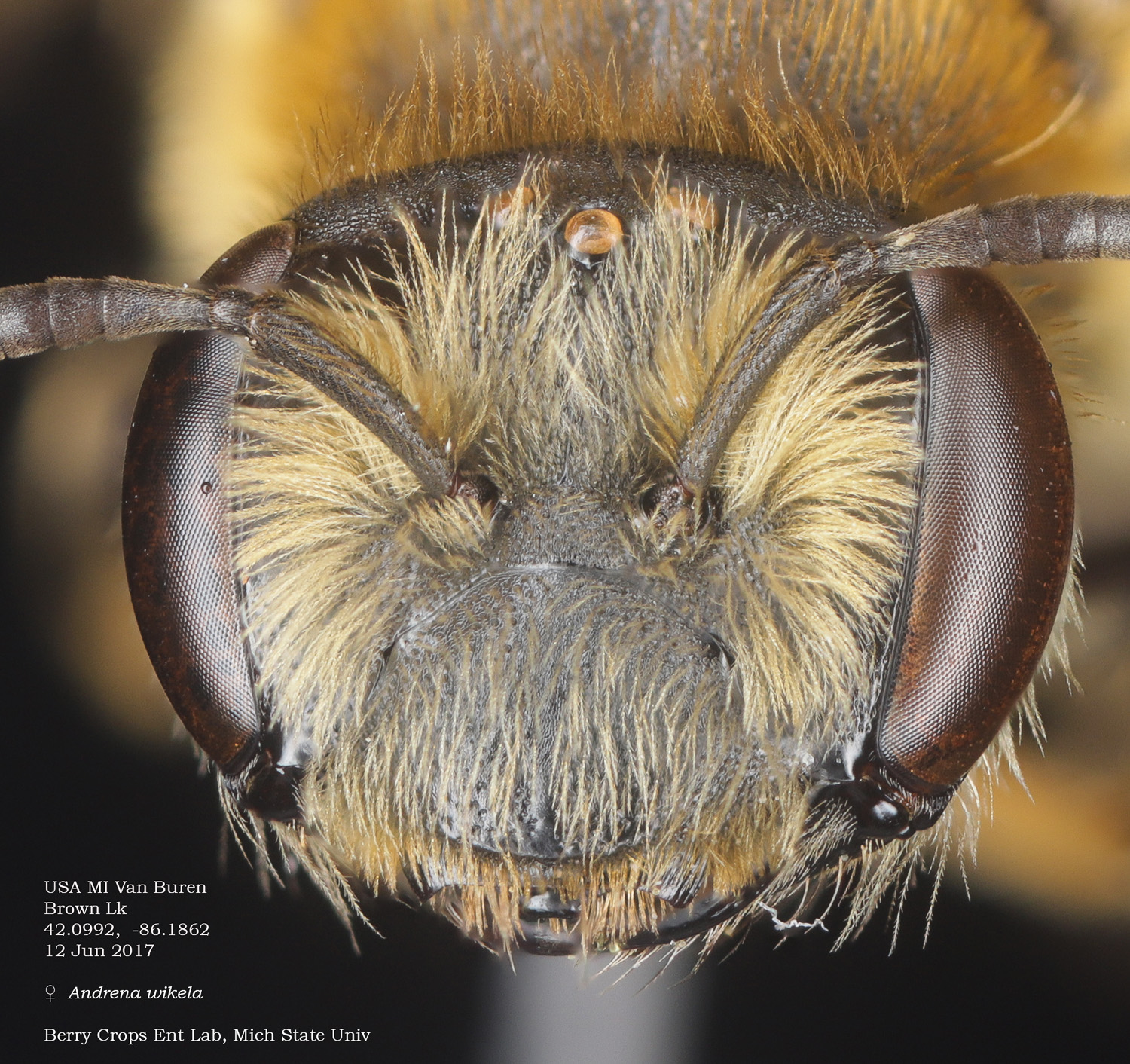
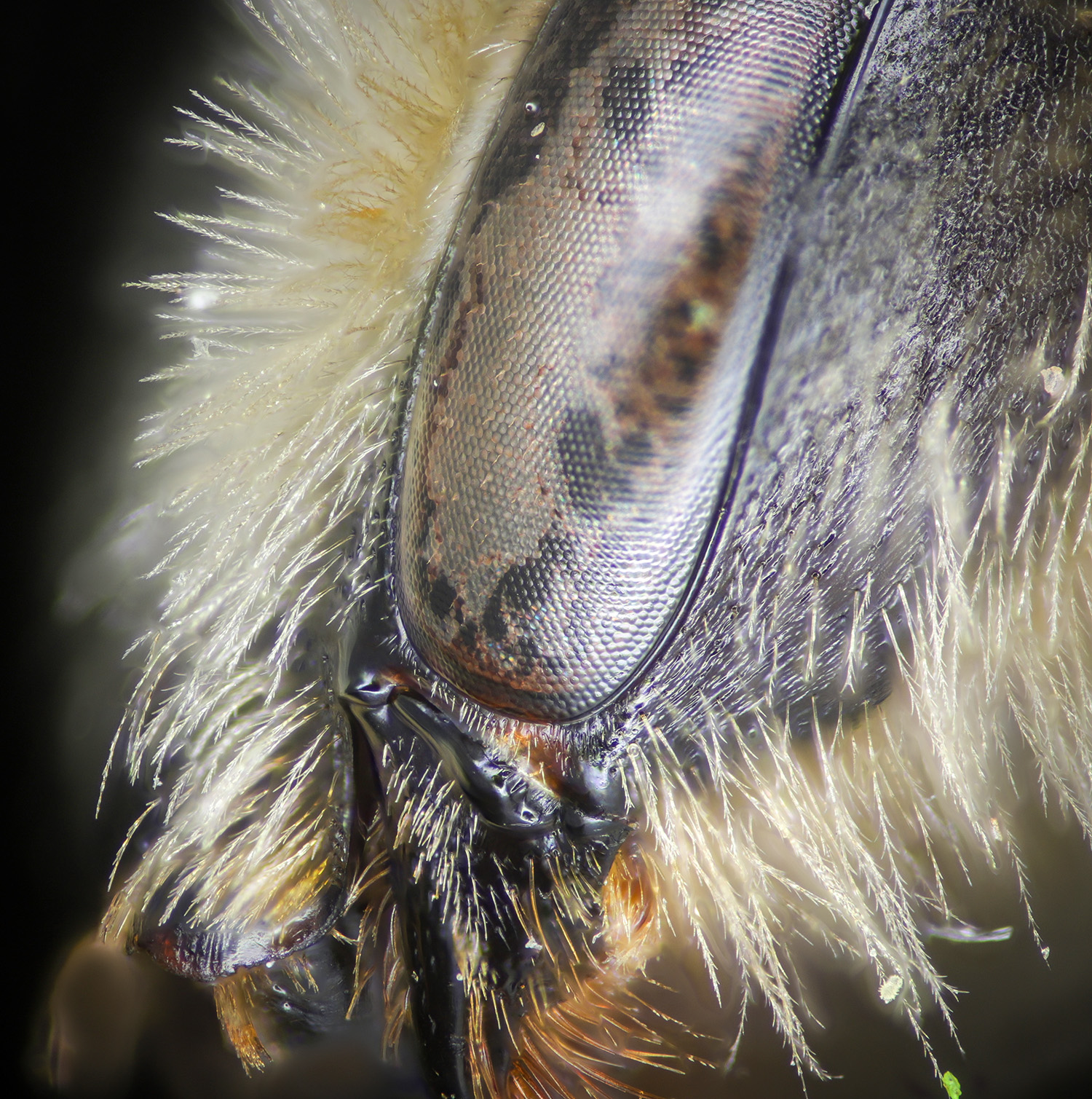
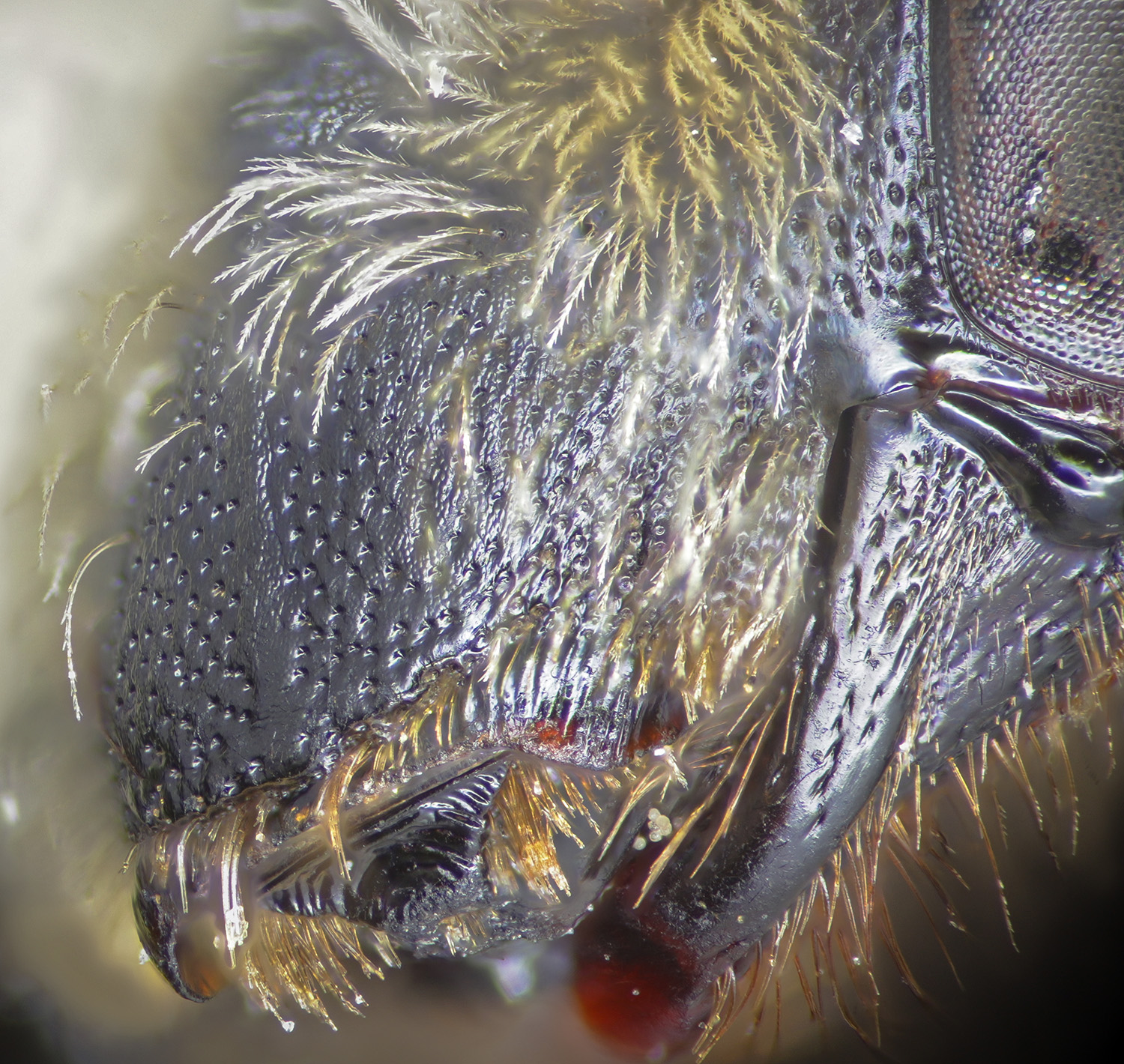
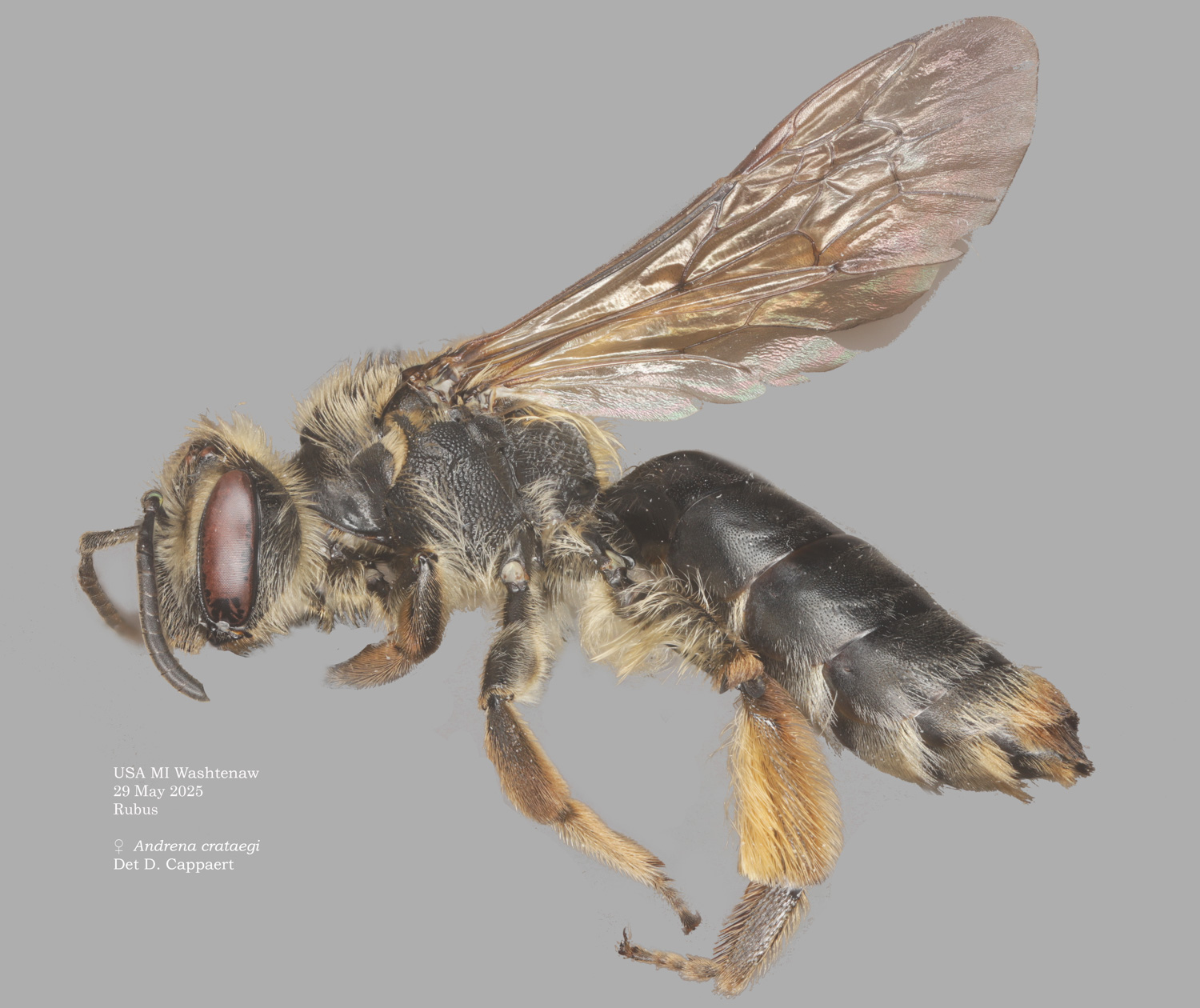
| angustitarsata (WA) astragali (WA) auricoma (OR) caerulea (WA) carlini (MI) carolina male (MI) chlorogaster (OR) crataegi (OR) |
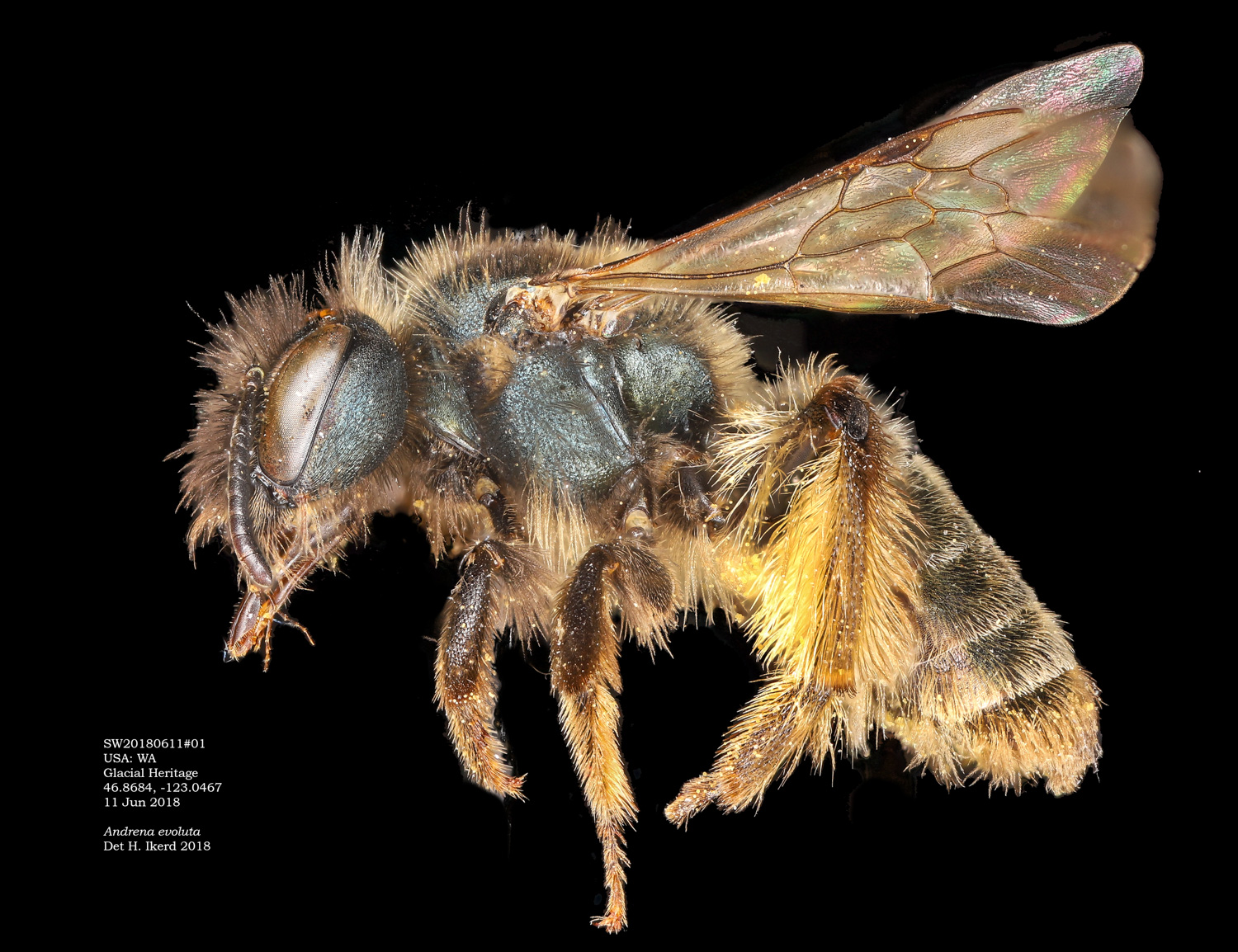
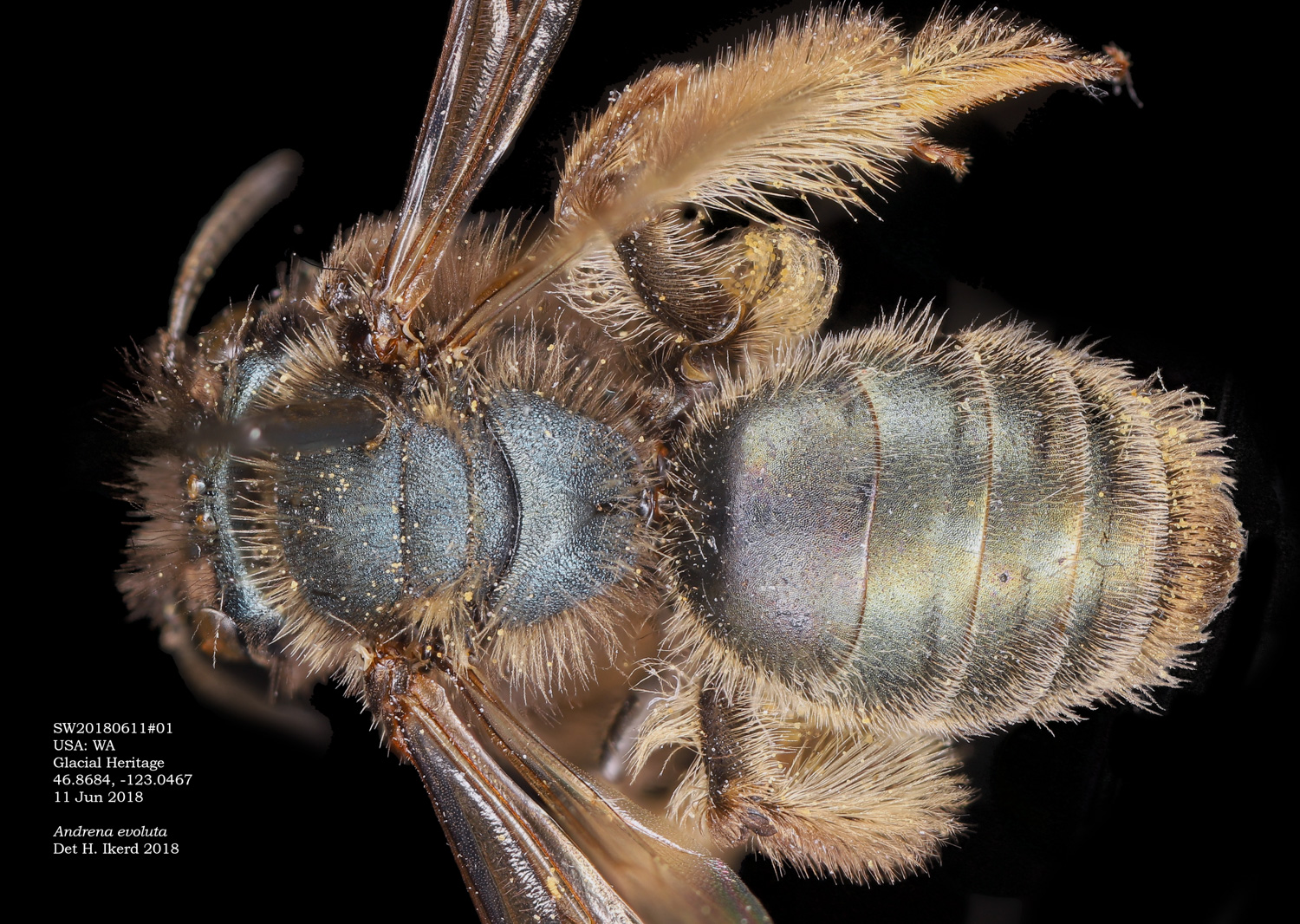
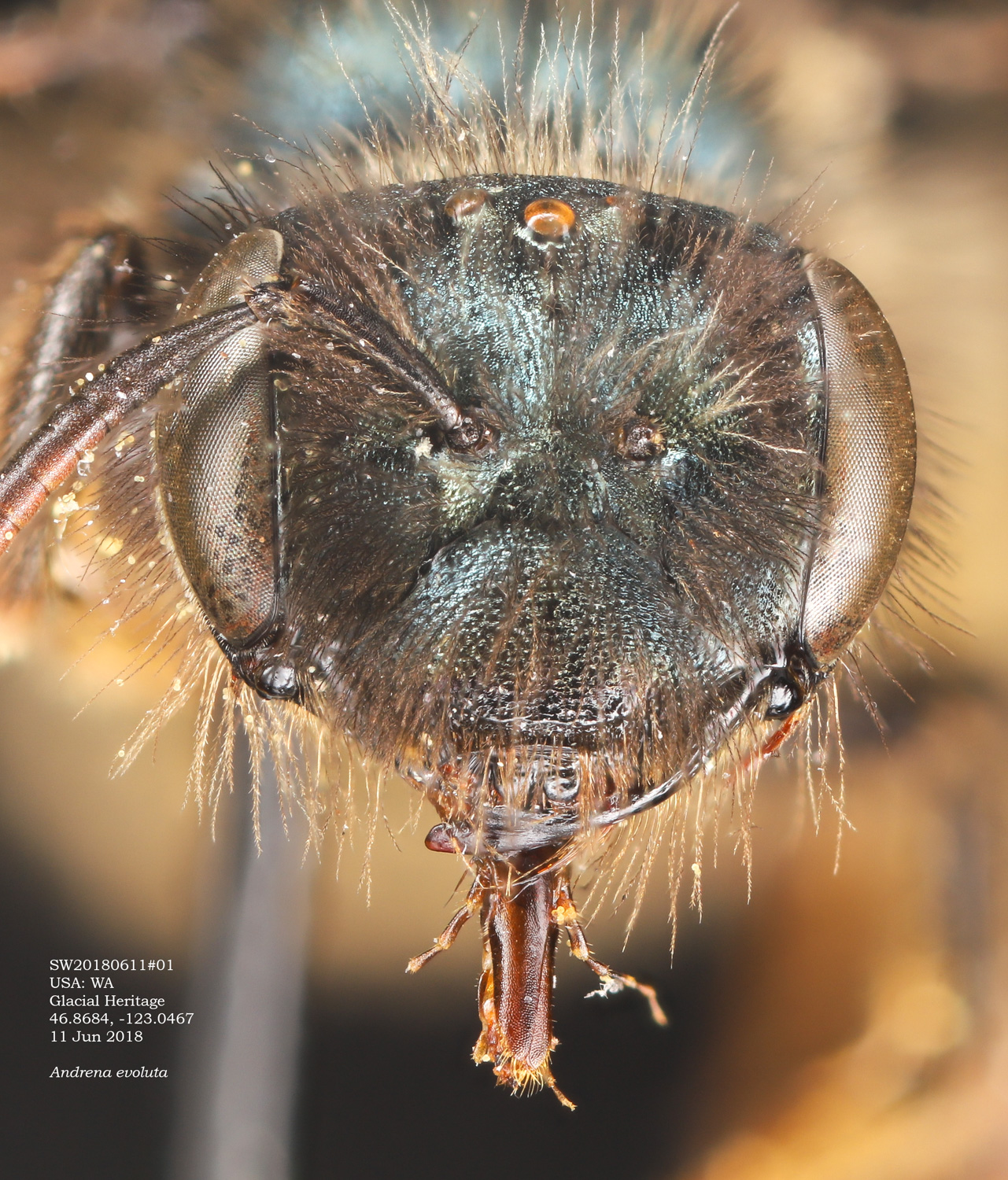
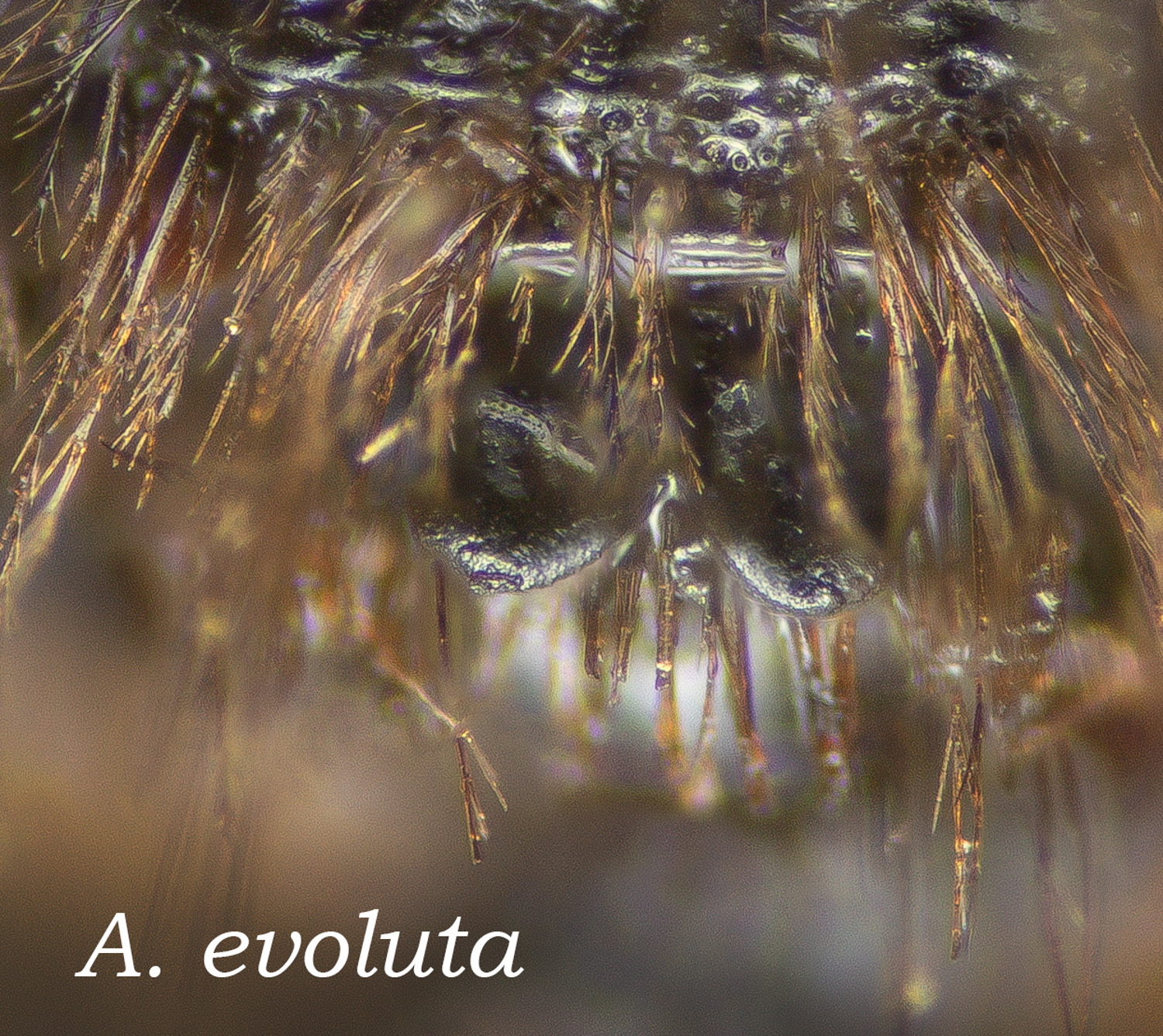
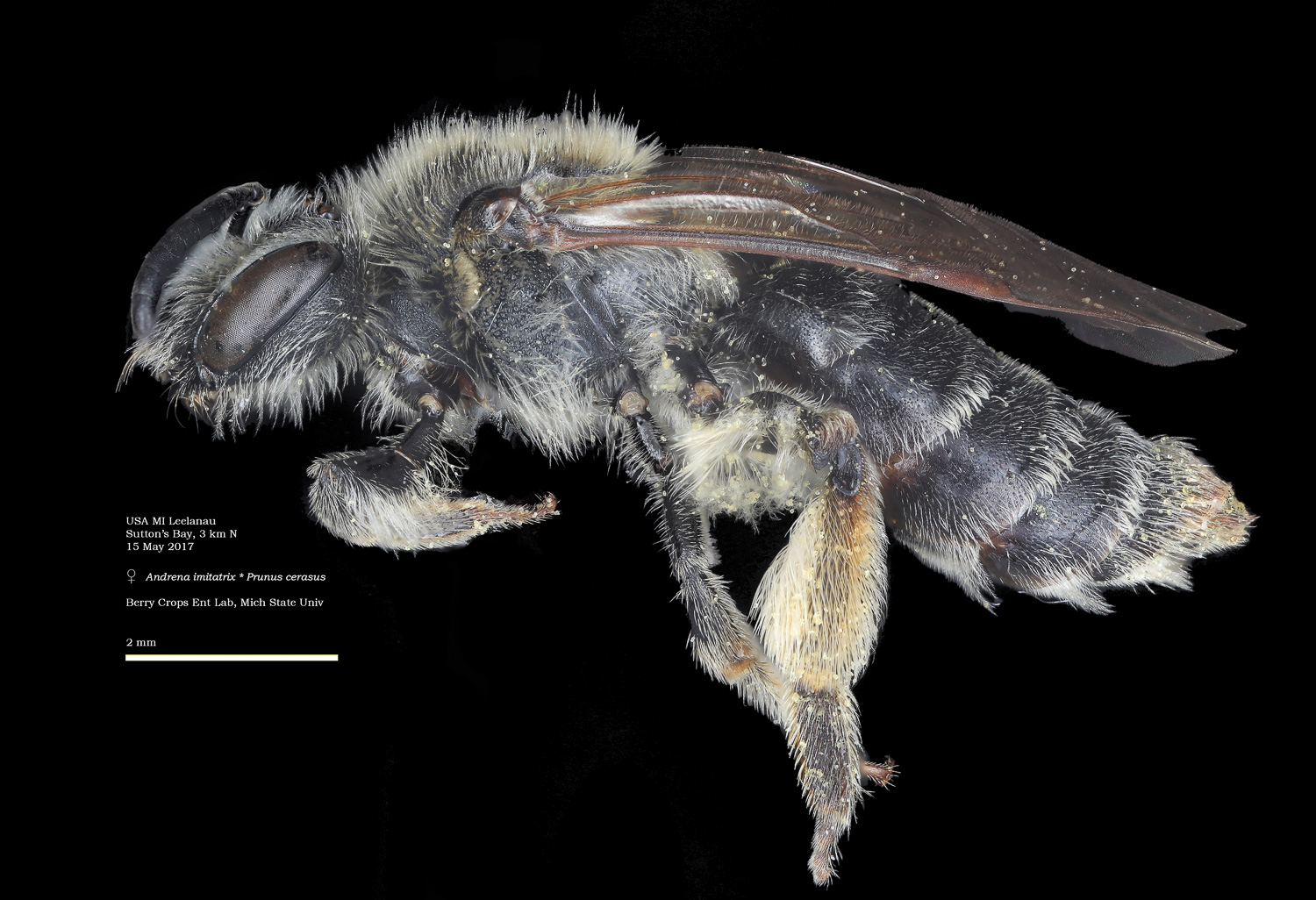
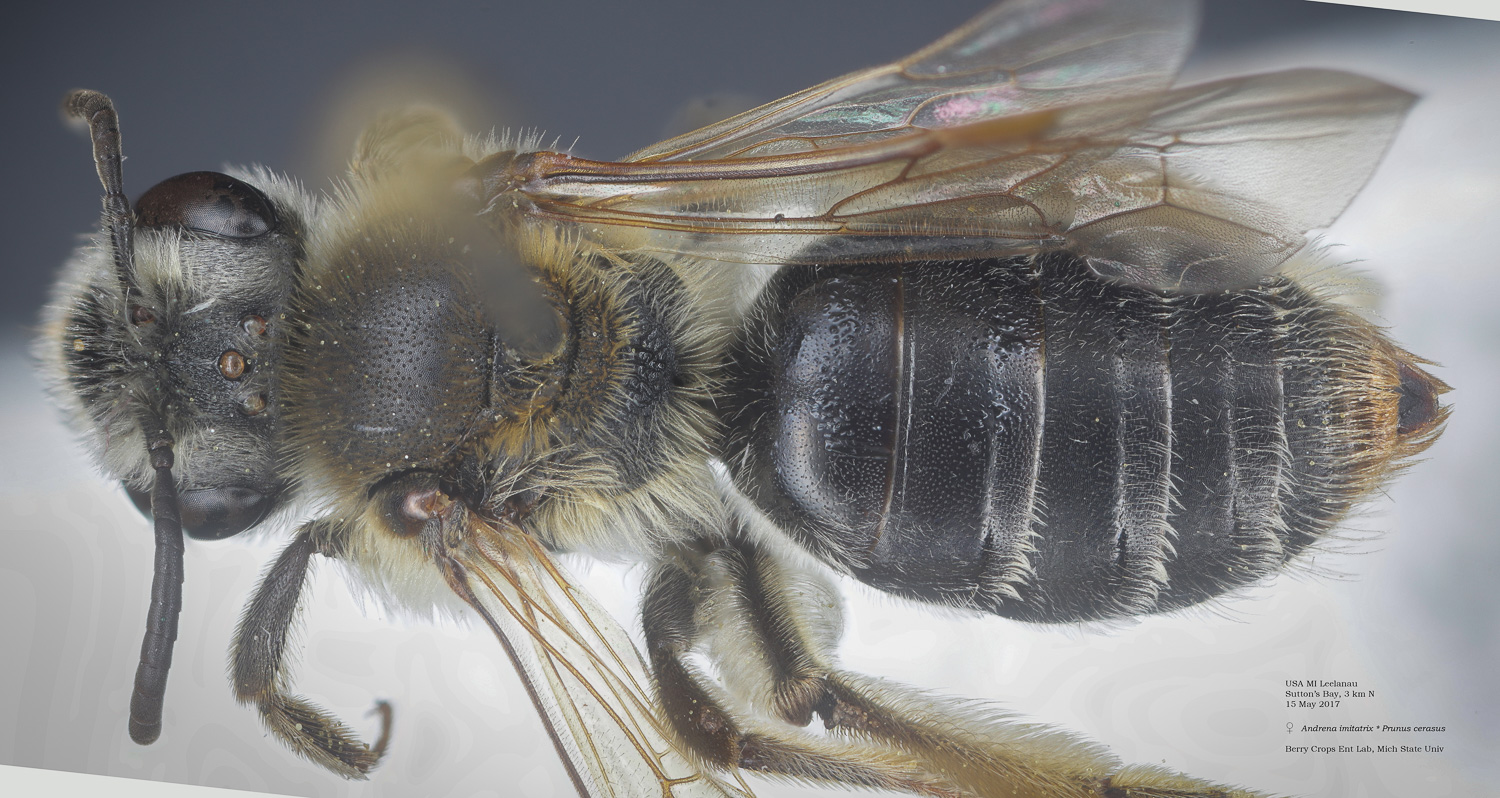
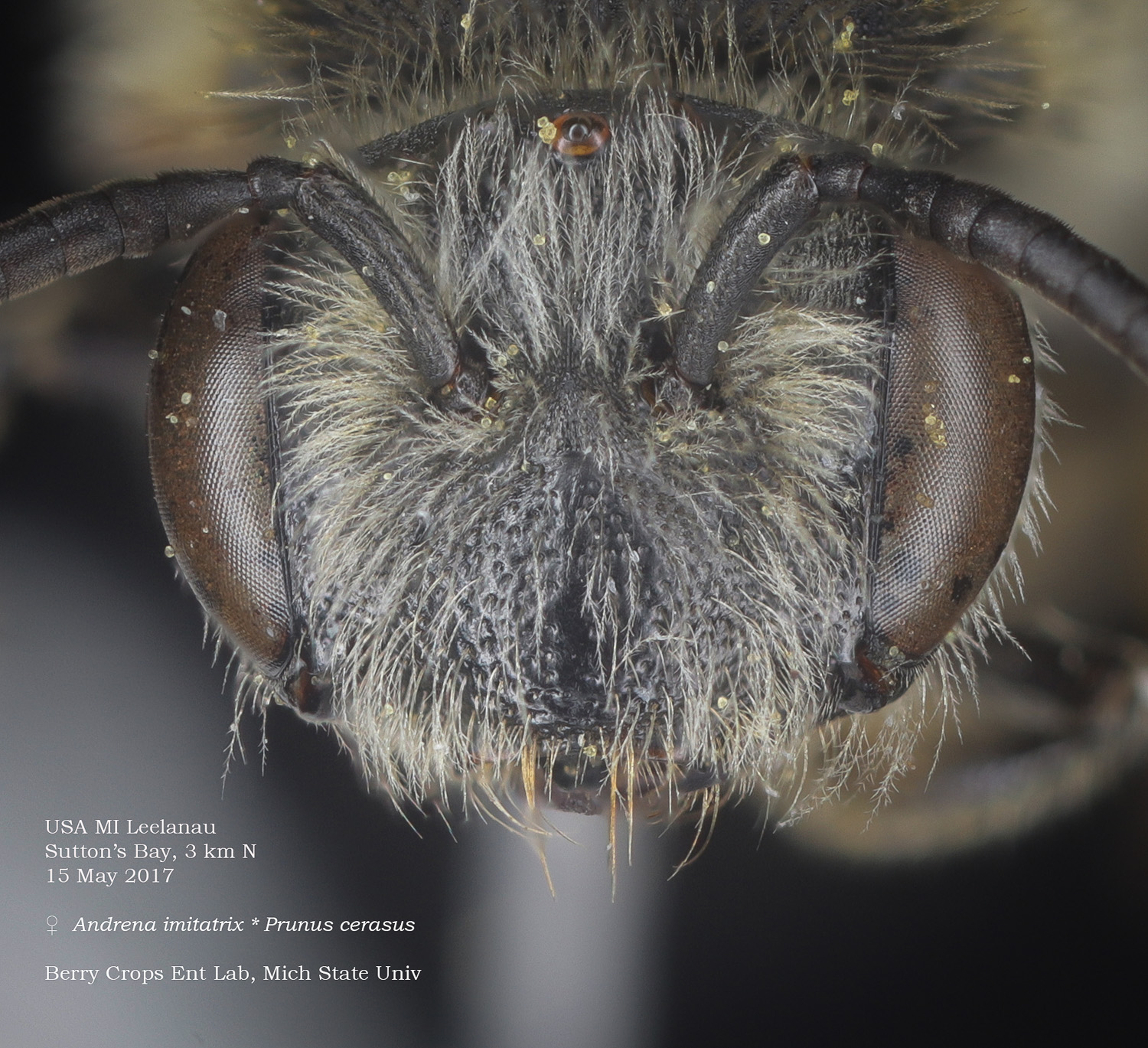
crataegi (MI) cressonii (MI) distans (MI) erigeniae (MI) erythronii (MI) evoluta (WA) forbesii (MI) trachandrena cf. heraclei (MI) imitatrix (MI) |
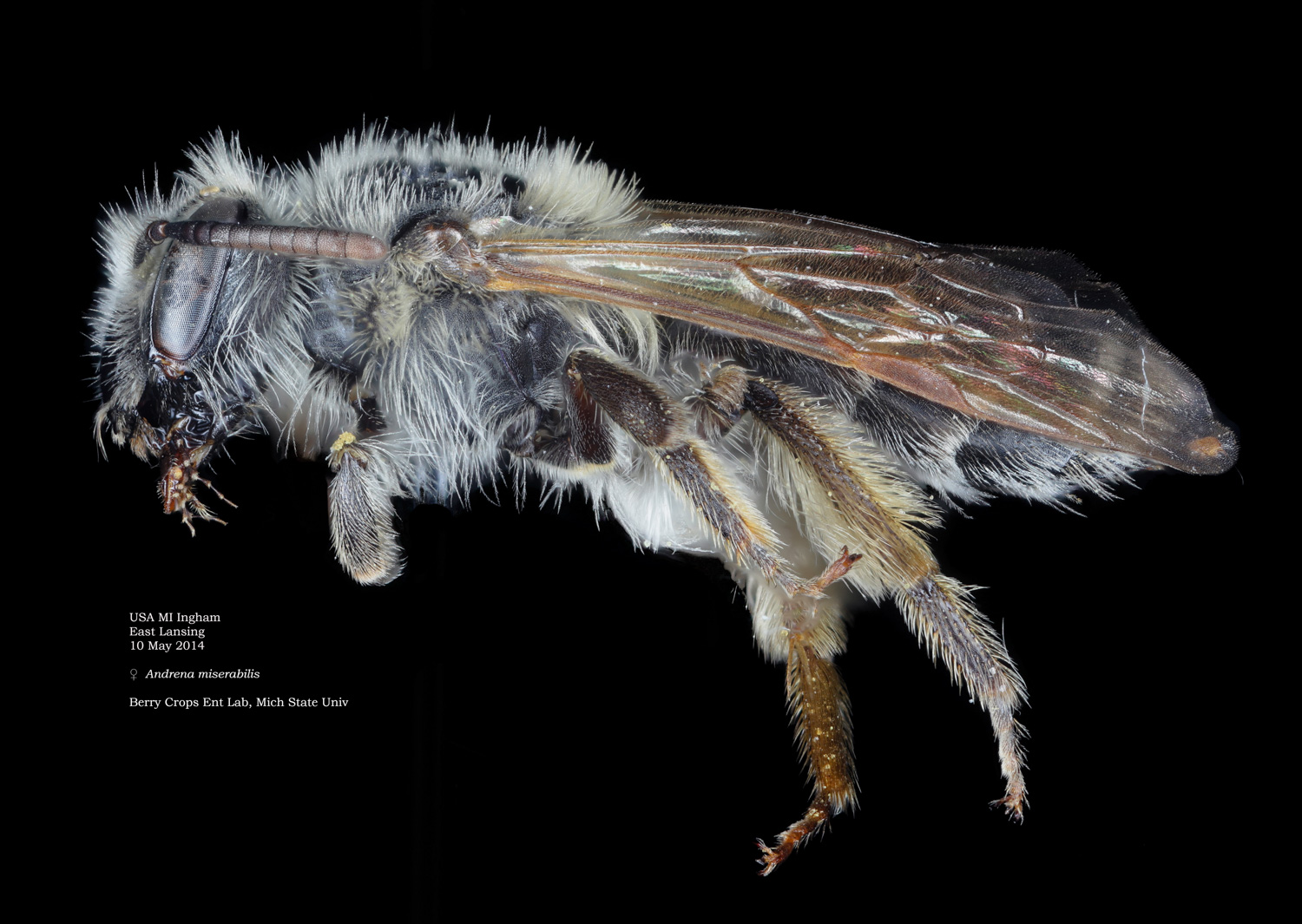
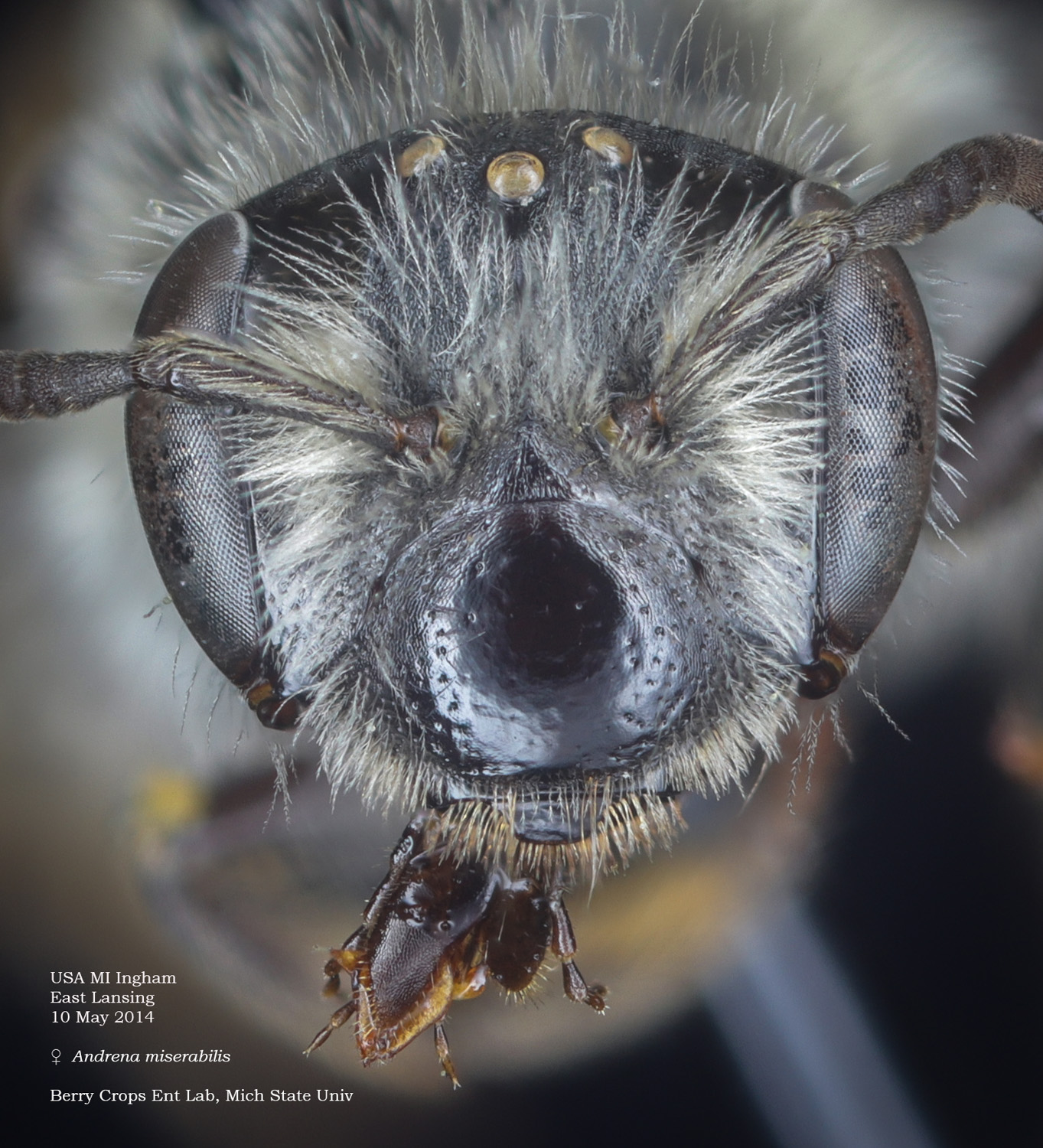
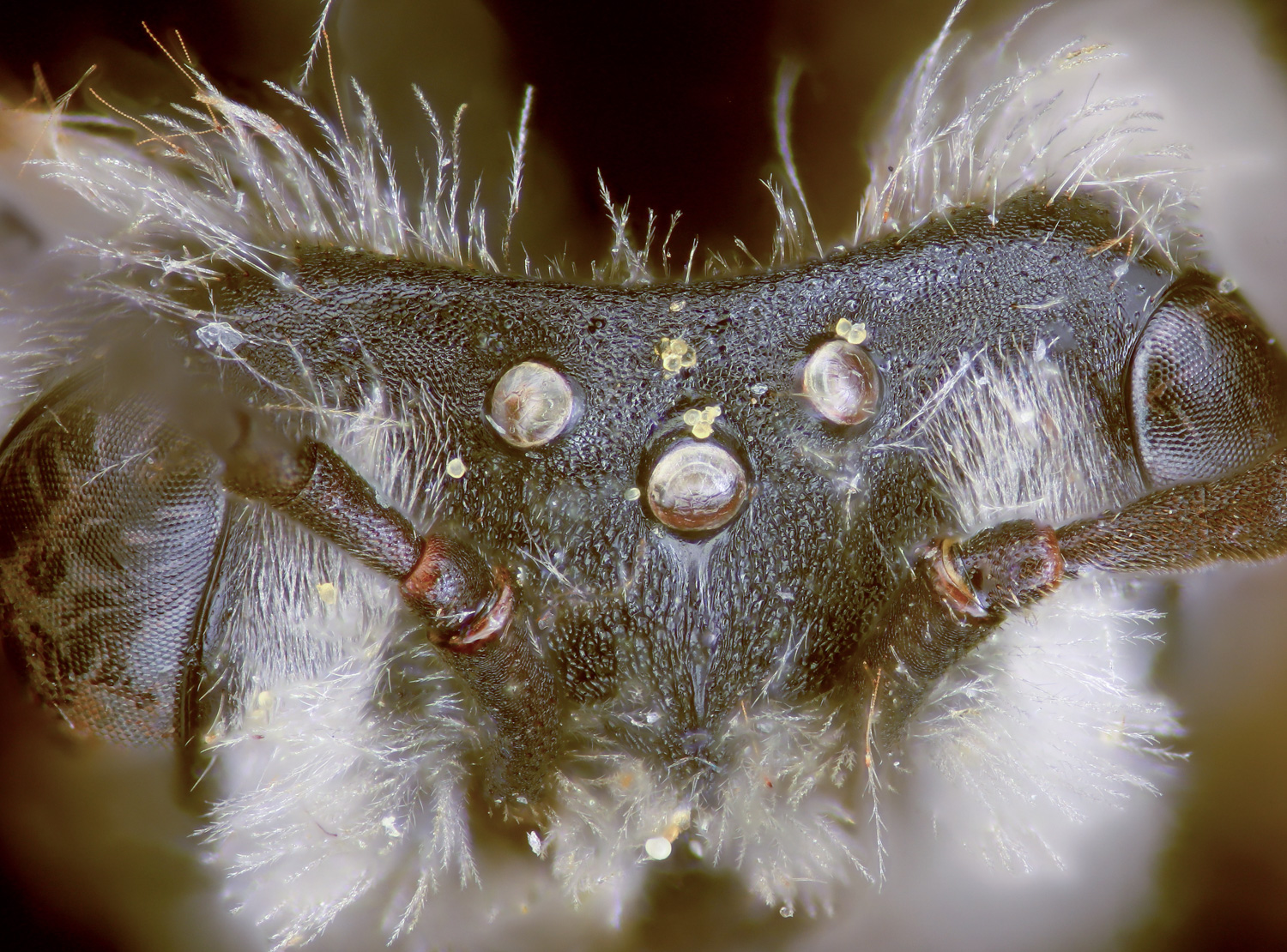
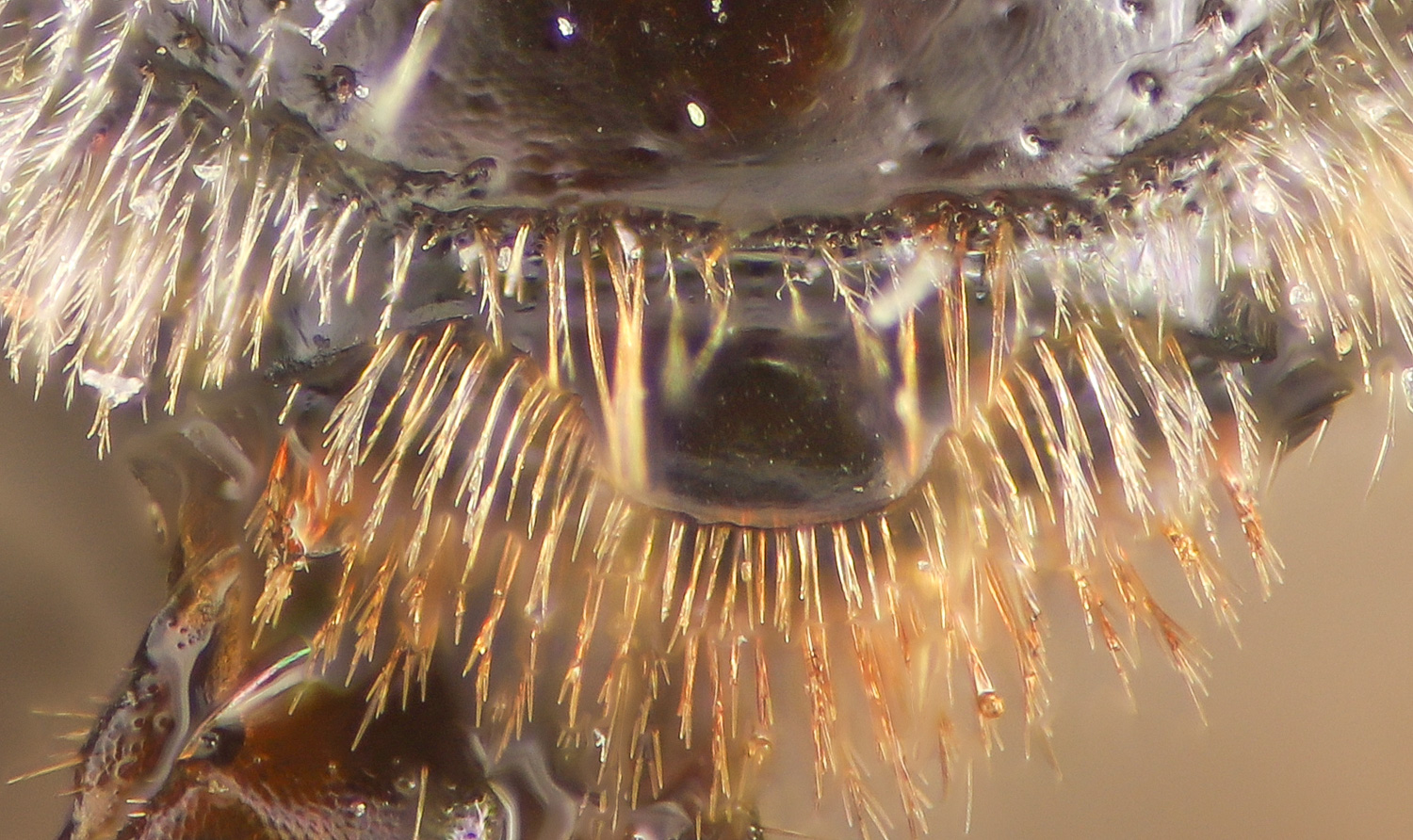
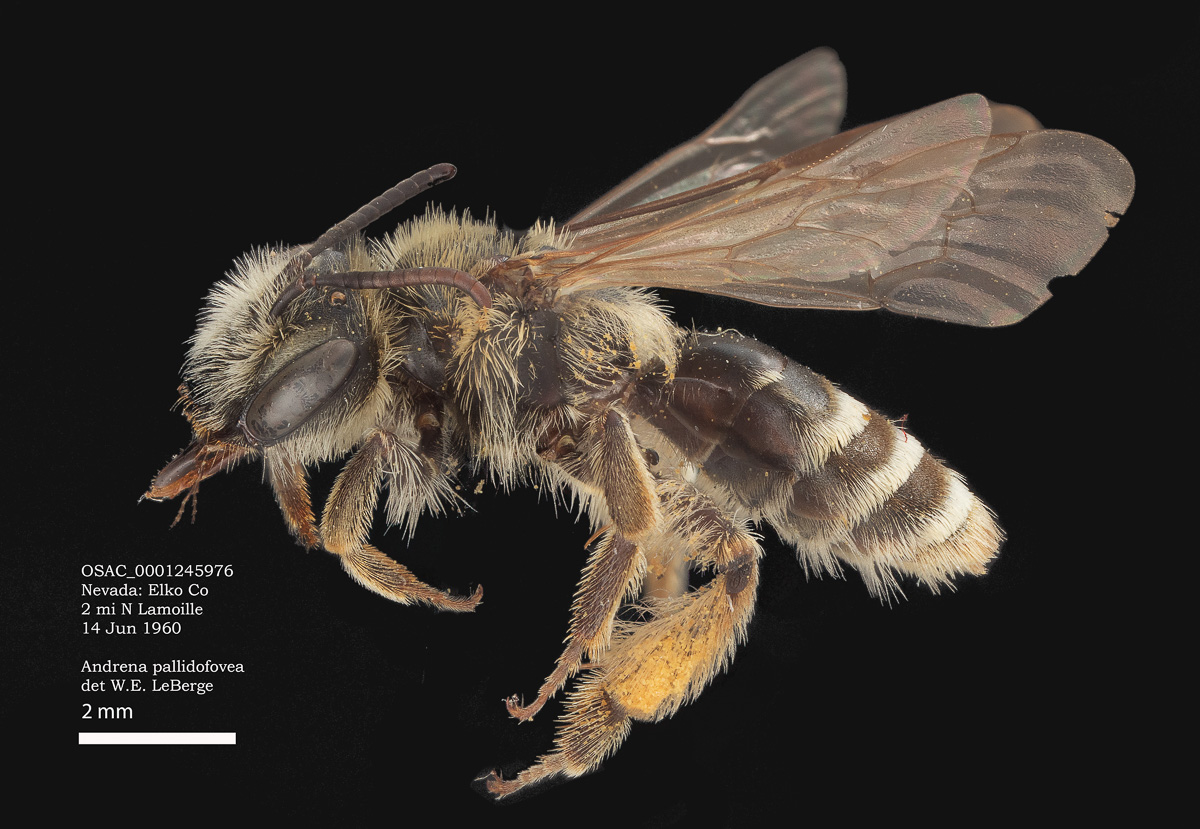
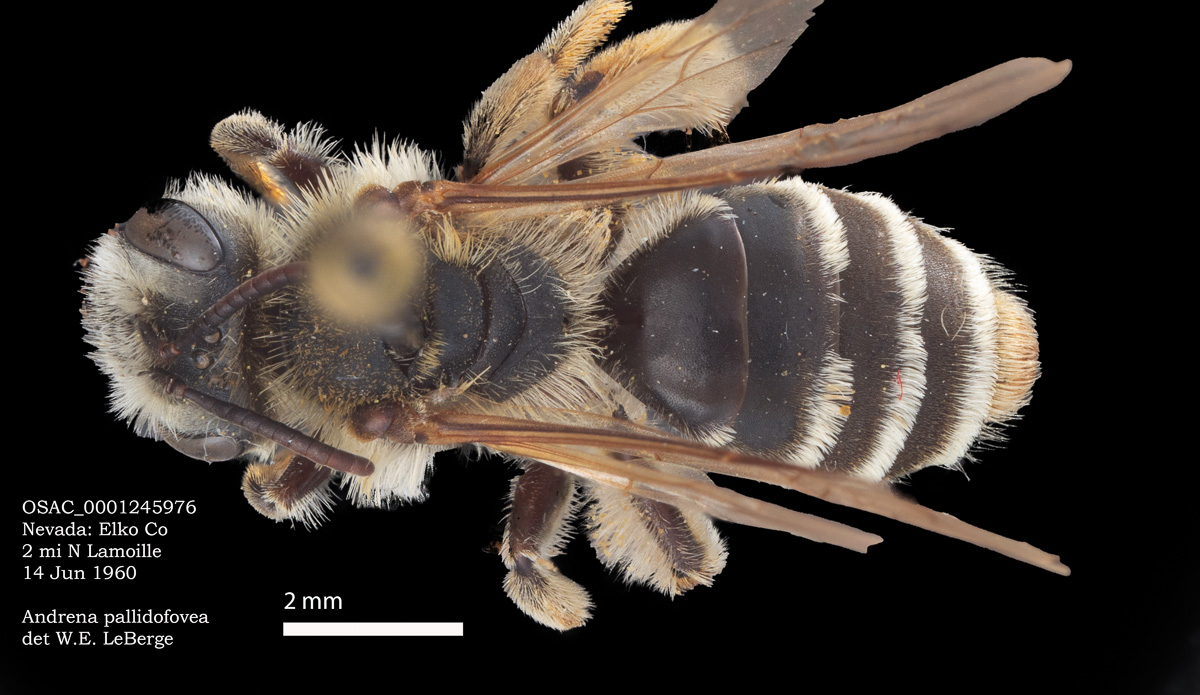
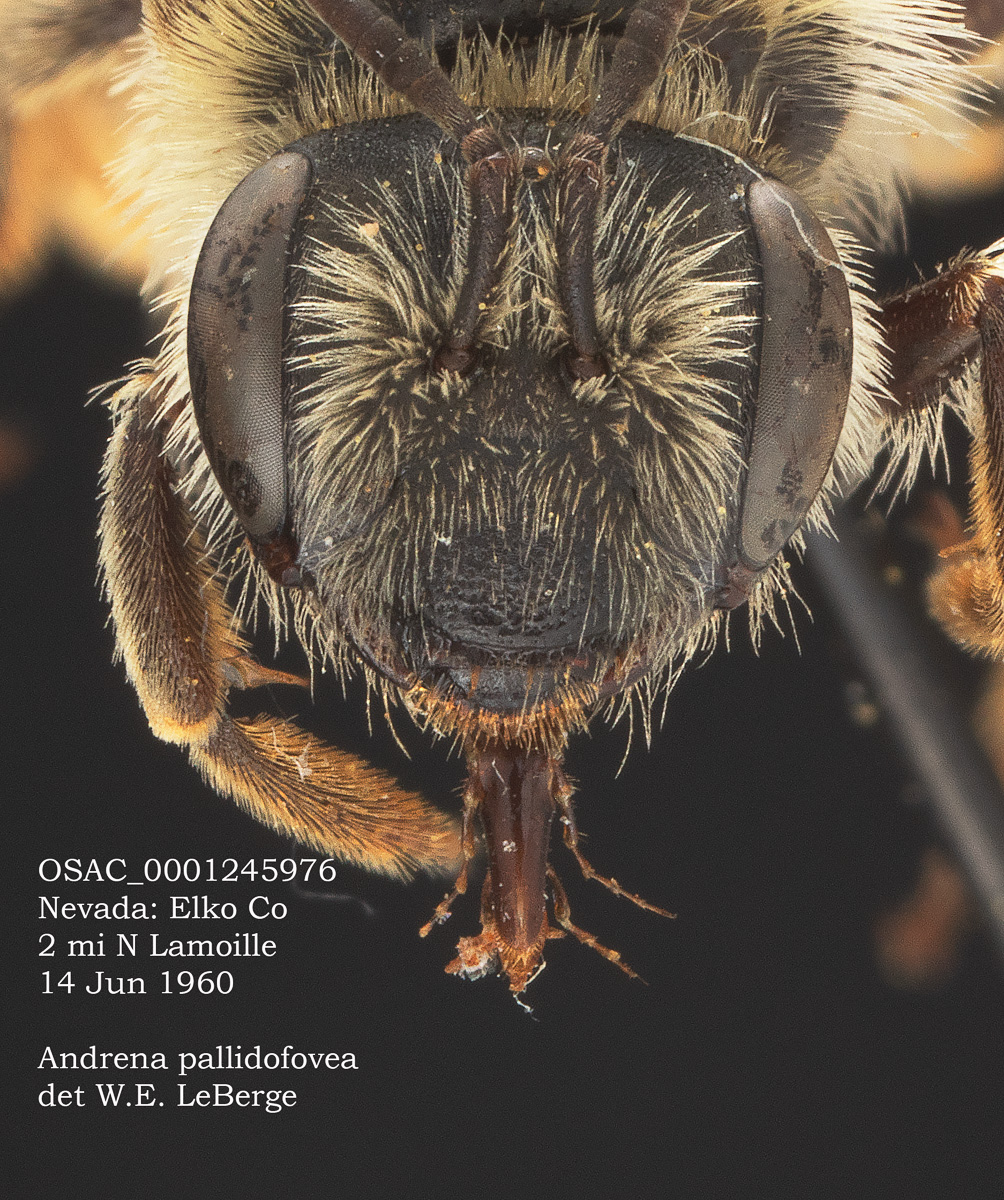
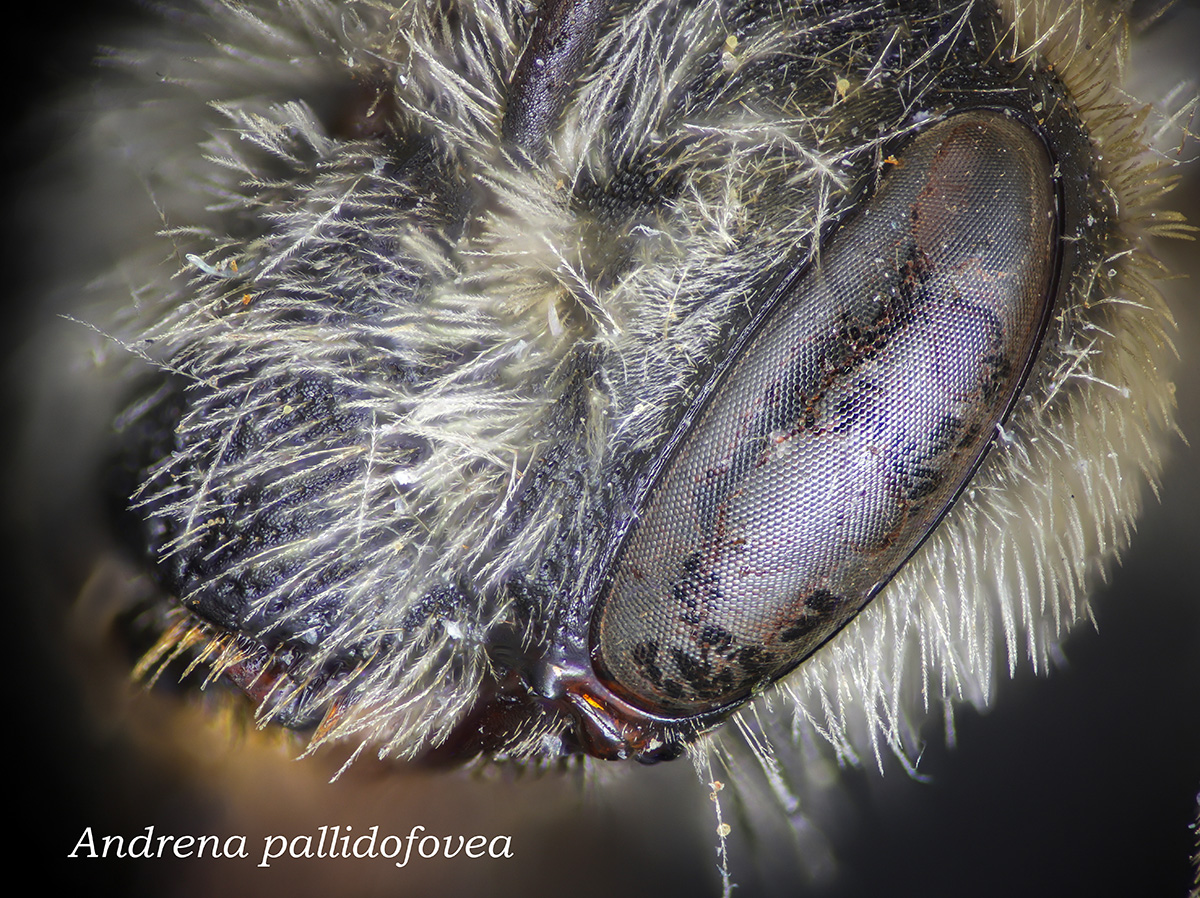
melandrena cf. vicina (MI) miserabilis (MI) nasonii (MI) nigrihirta (WA) nigrocaerulea (OR) orthocarpi (OR) pallidofovea (NV) pensilis (OR) |
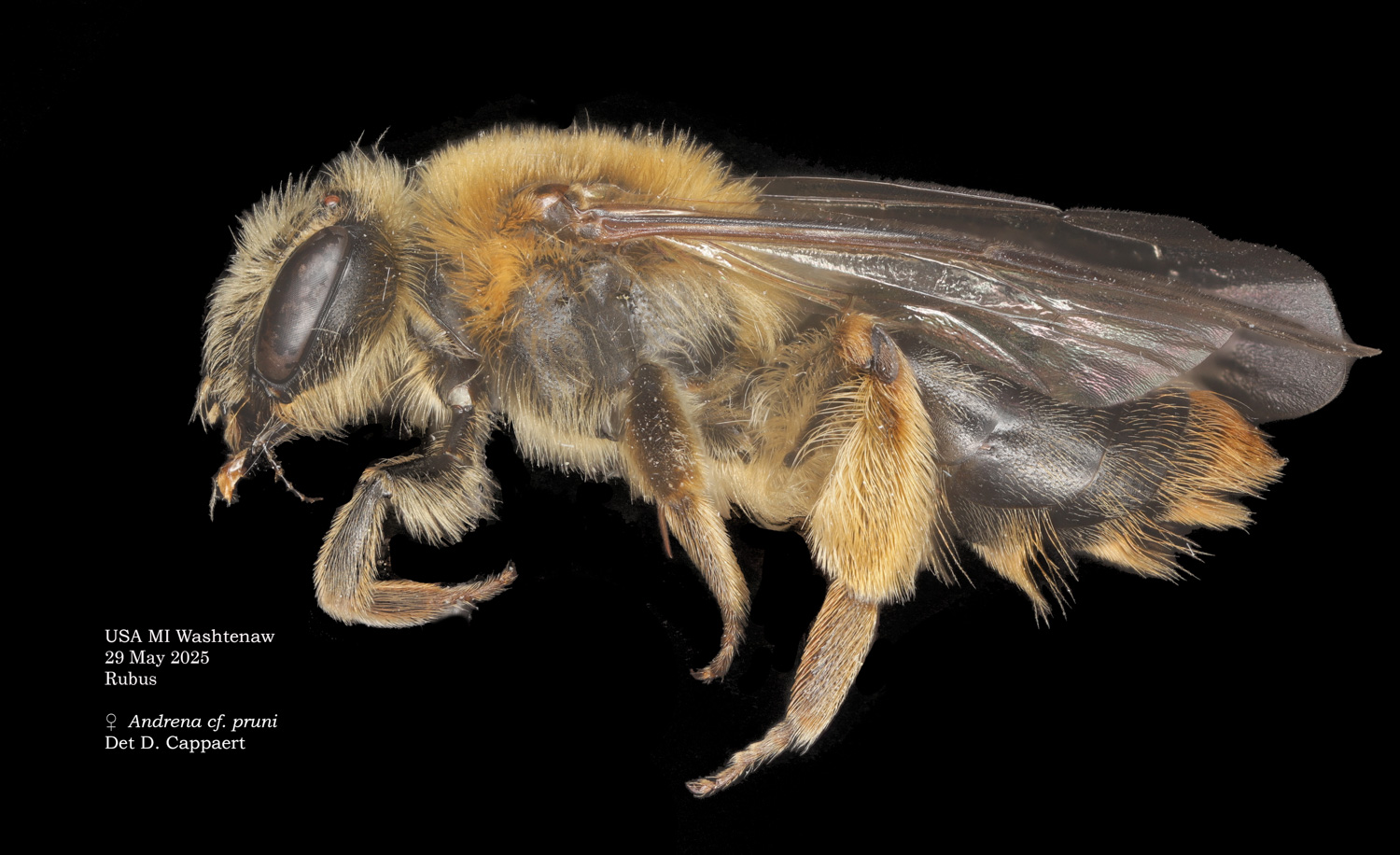
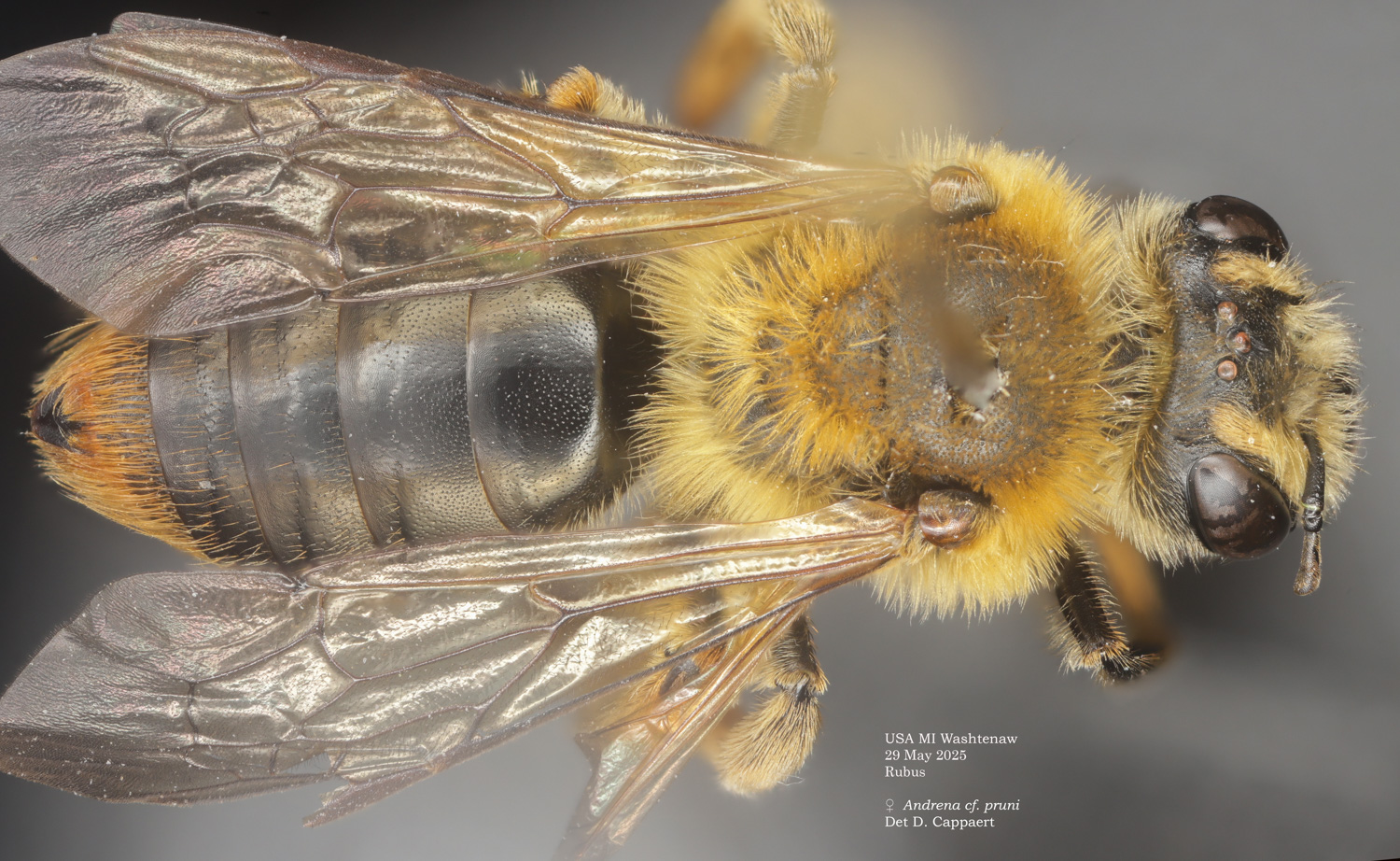
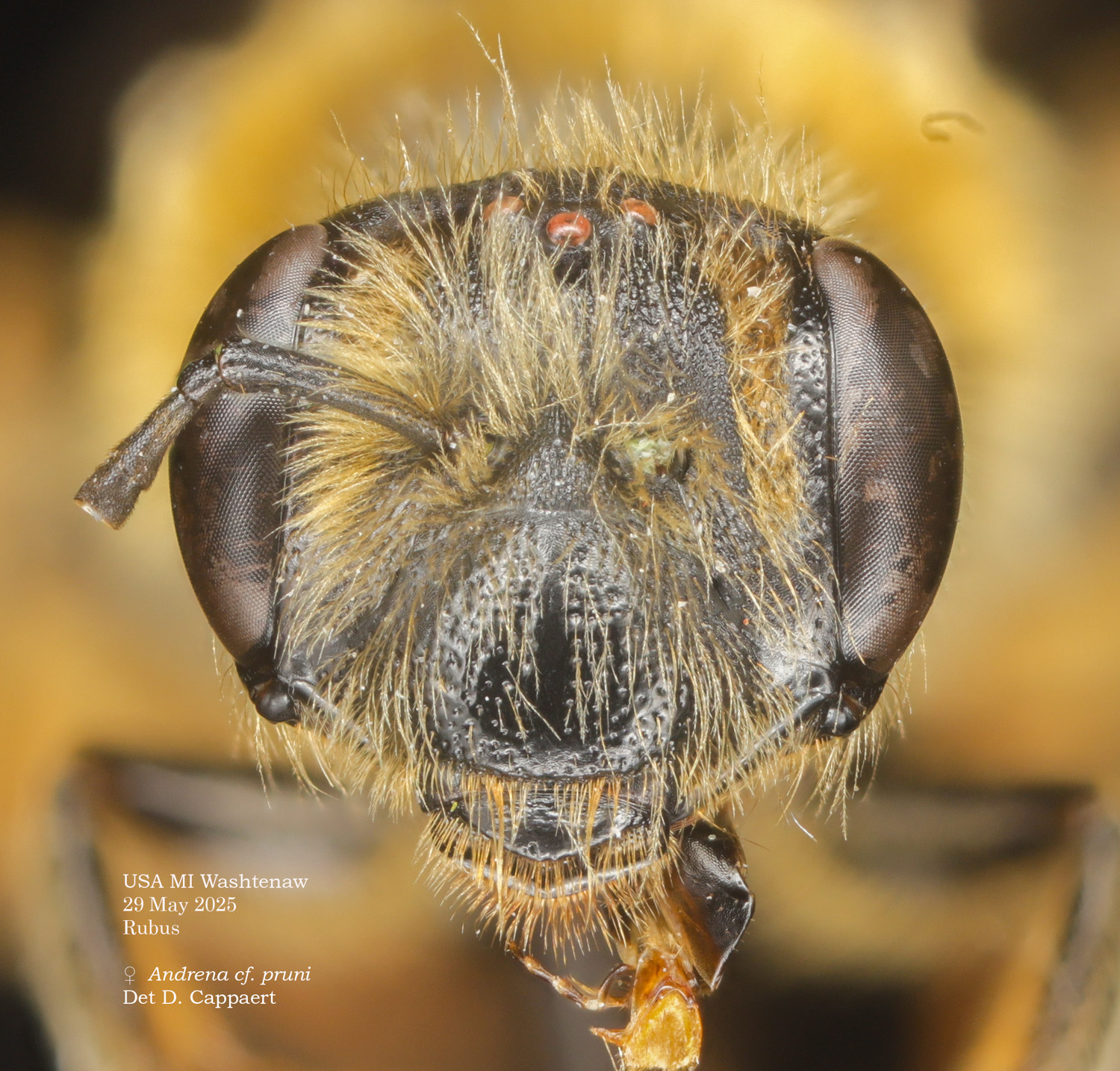
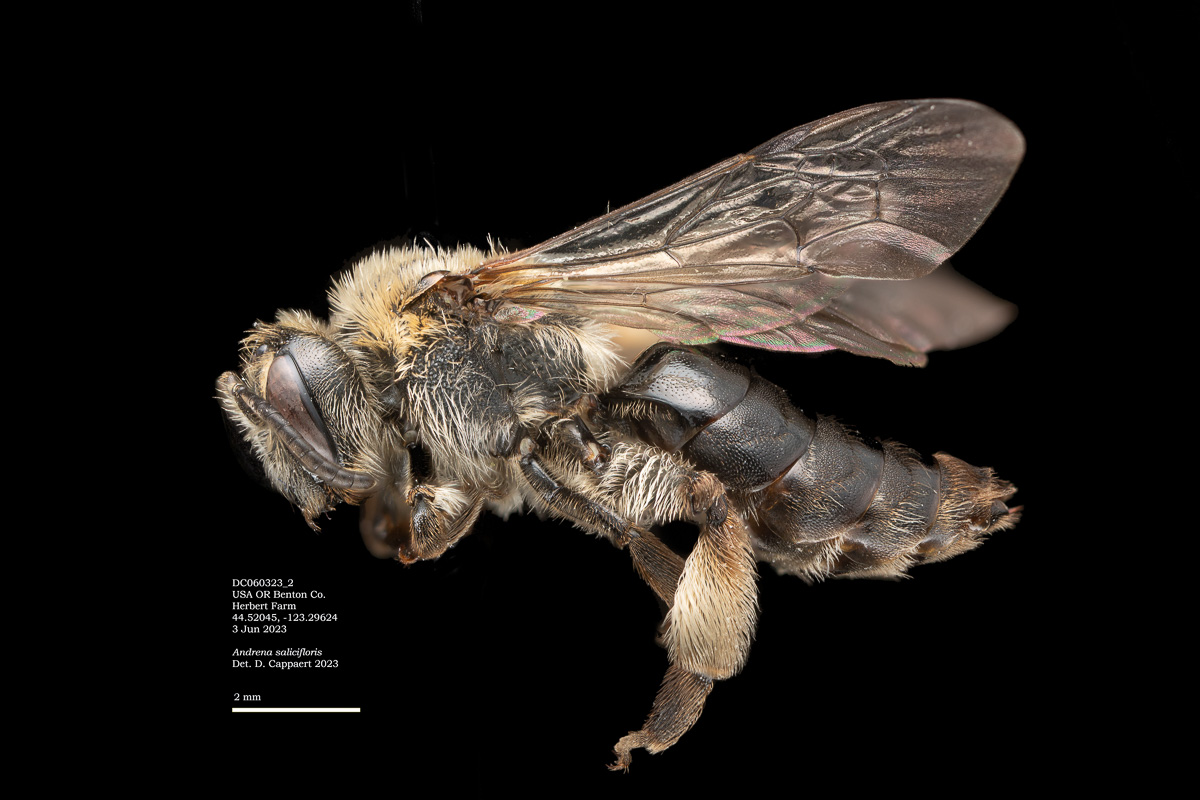
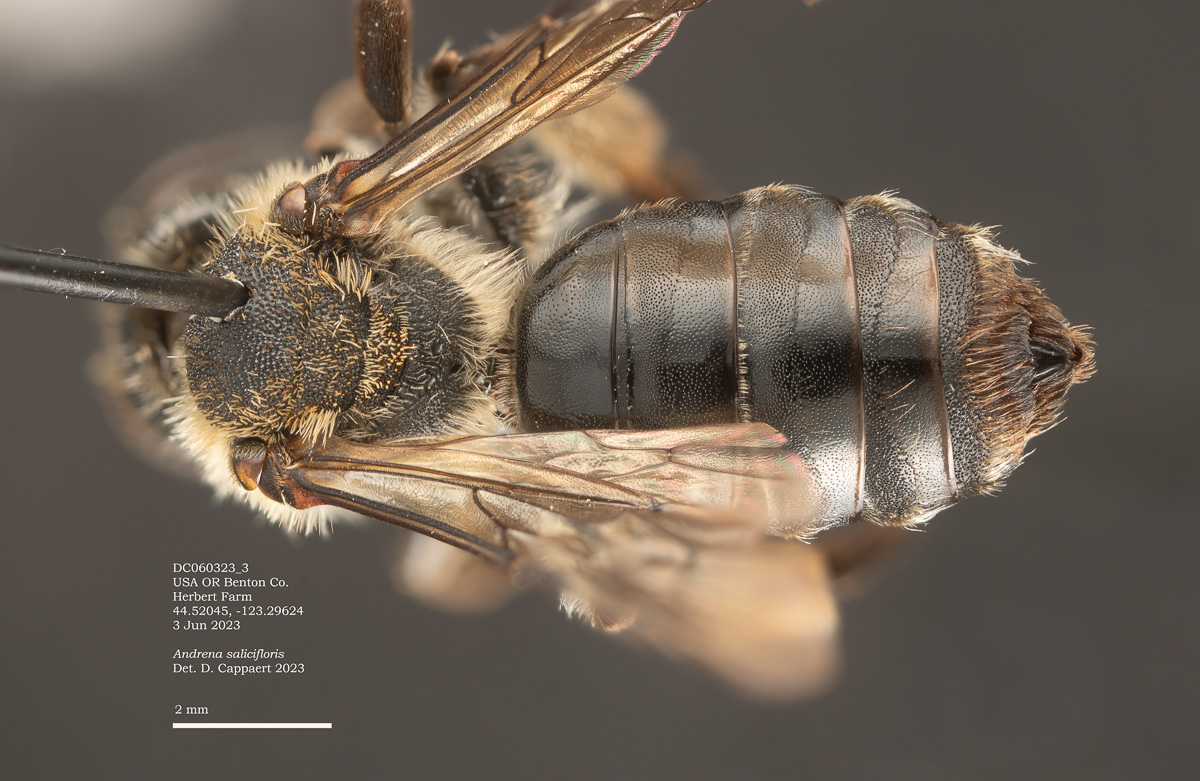
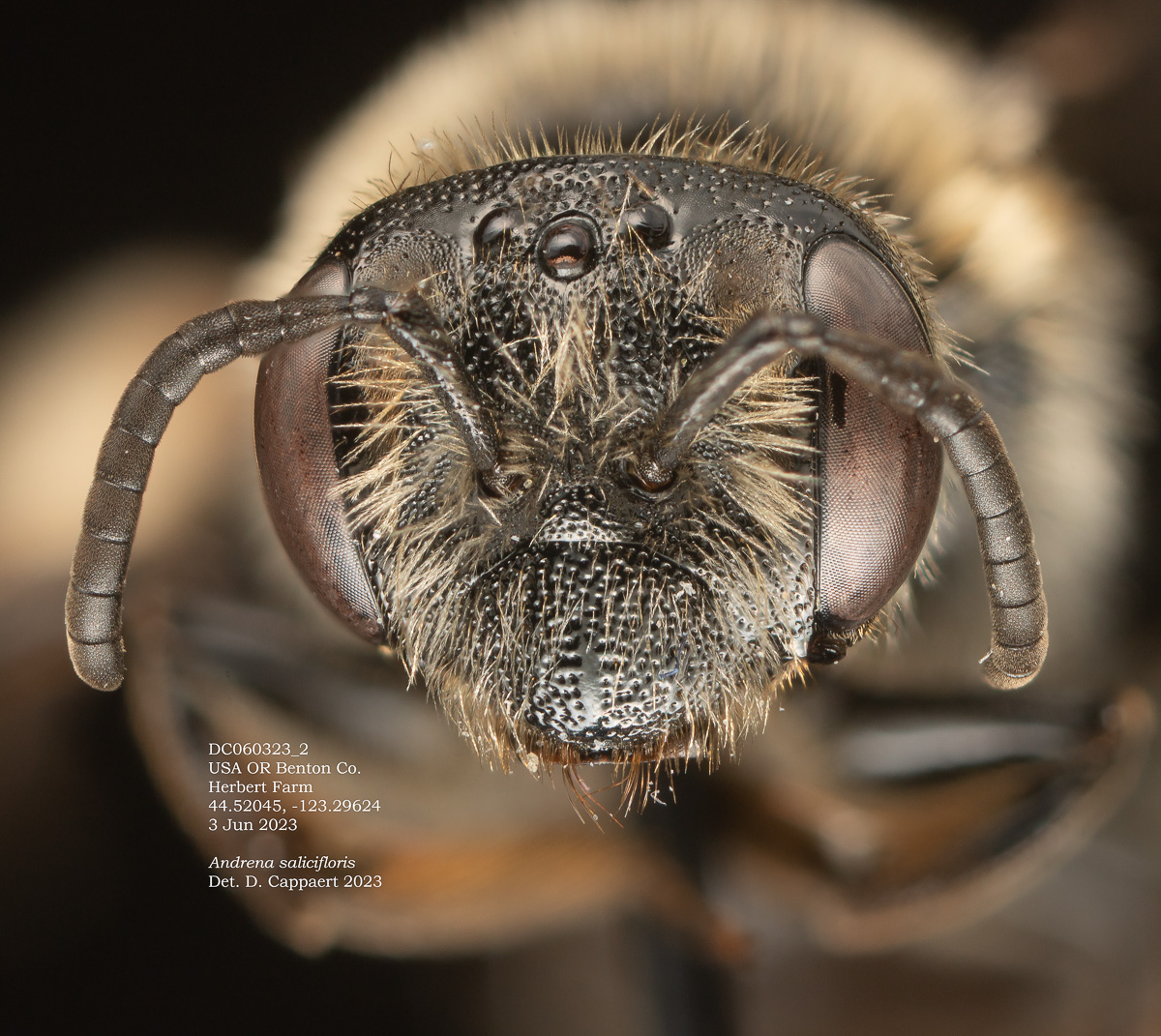
NOT pensilis (OR) placata (MI) pruni (MI) prunorum (WA) salicifloris (OR) vicina (MI) cf. vicina (WA) wilkella (MI) |
Easy calls:
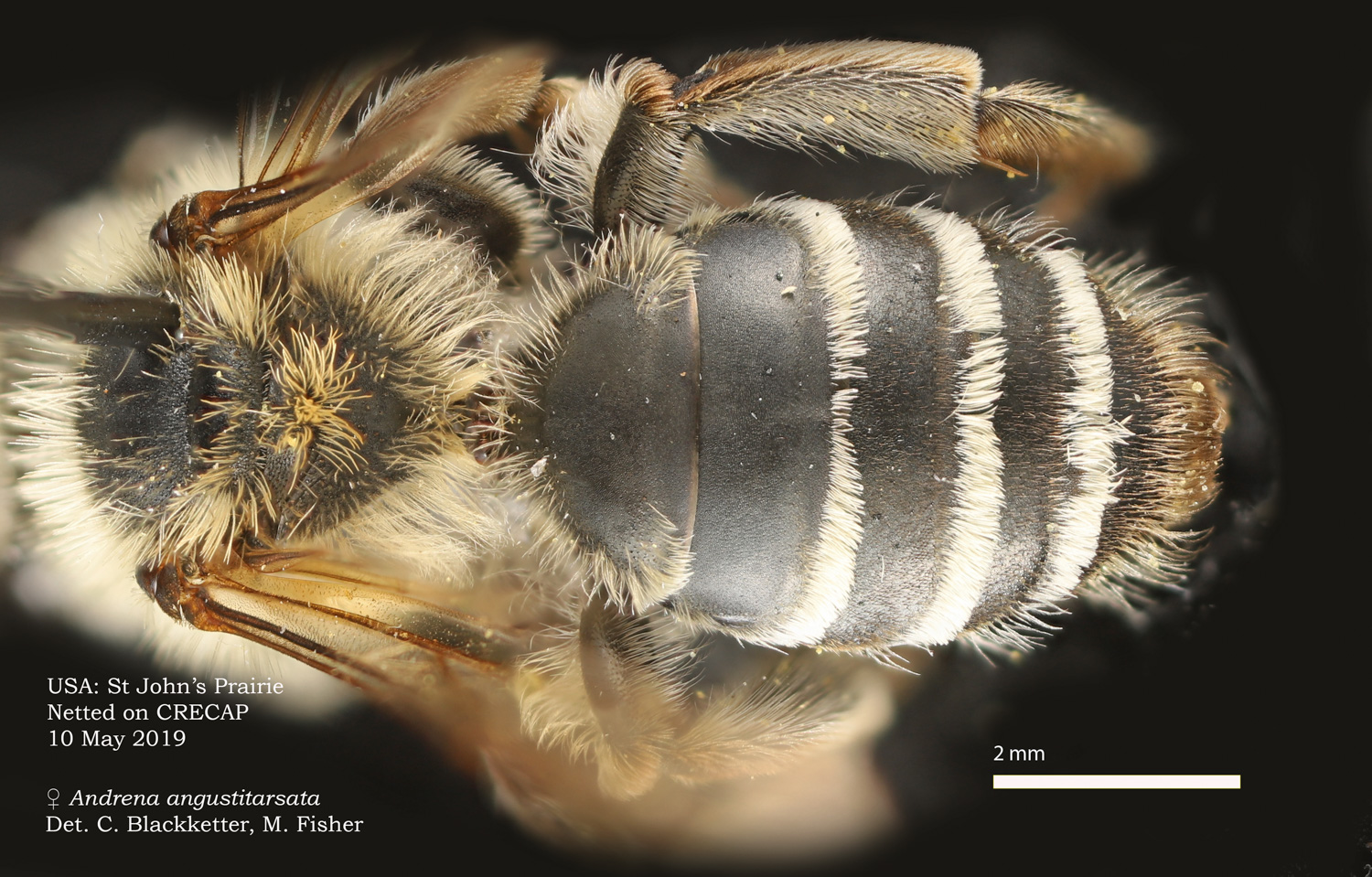
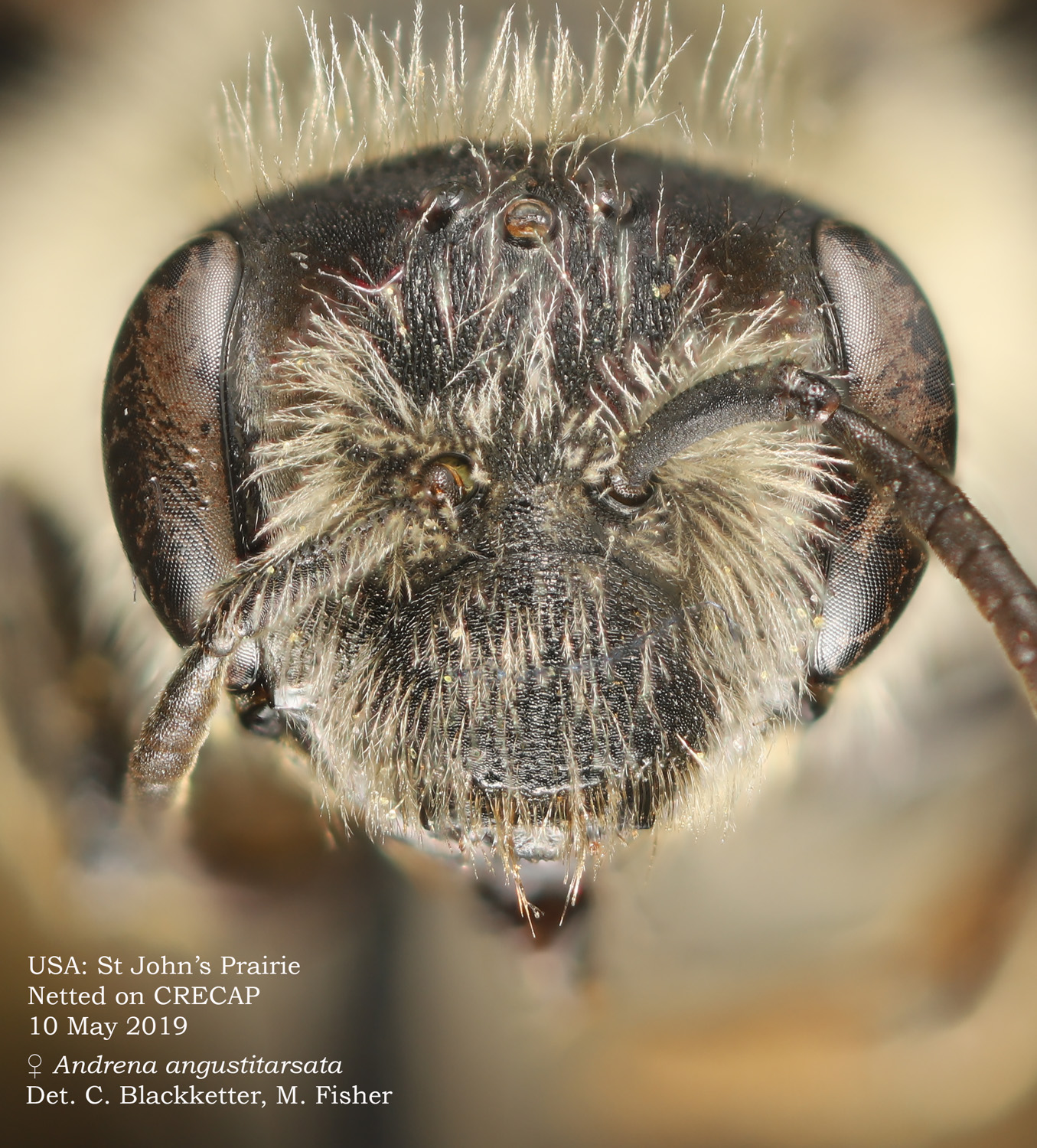
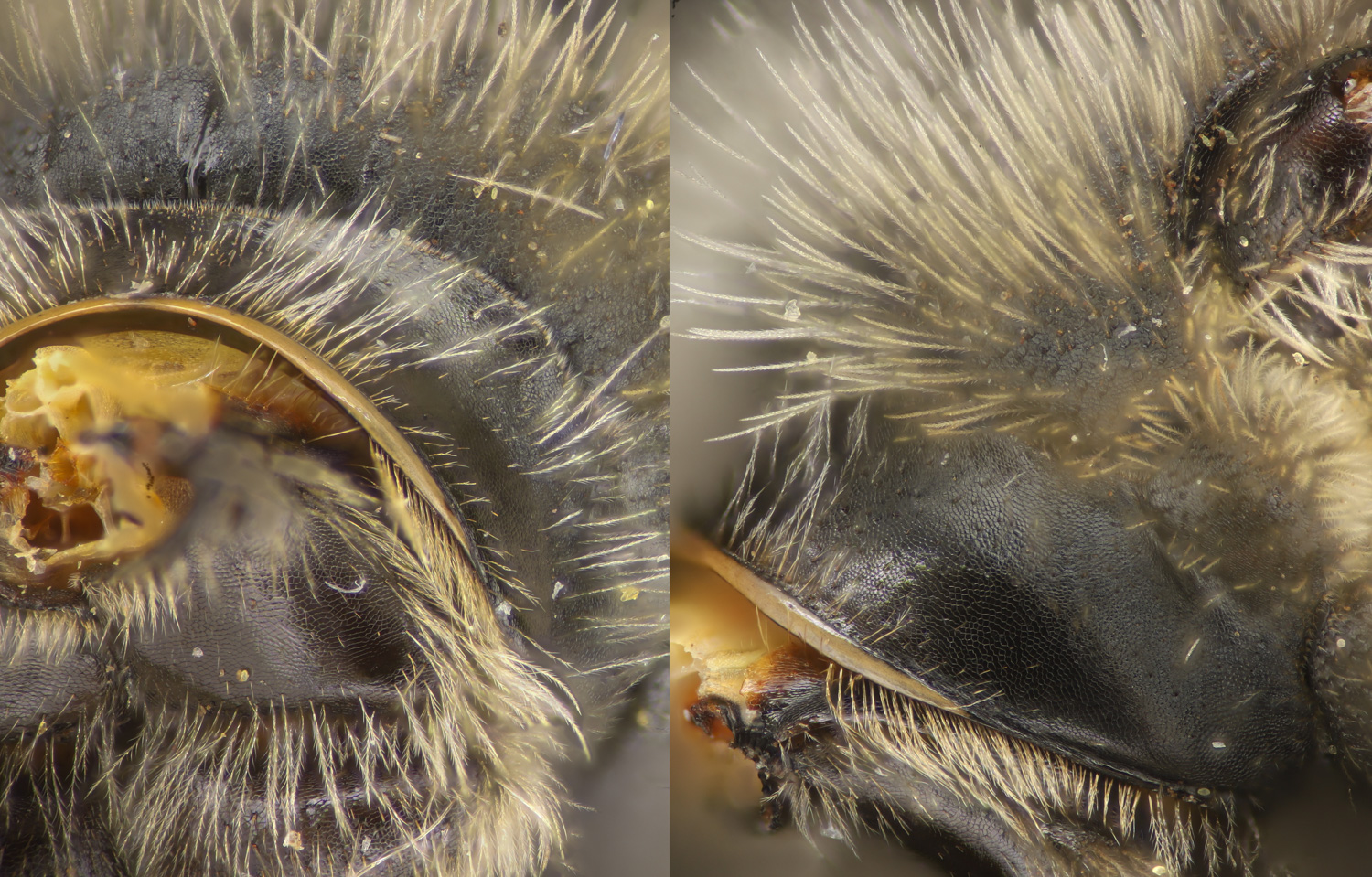
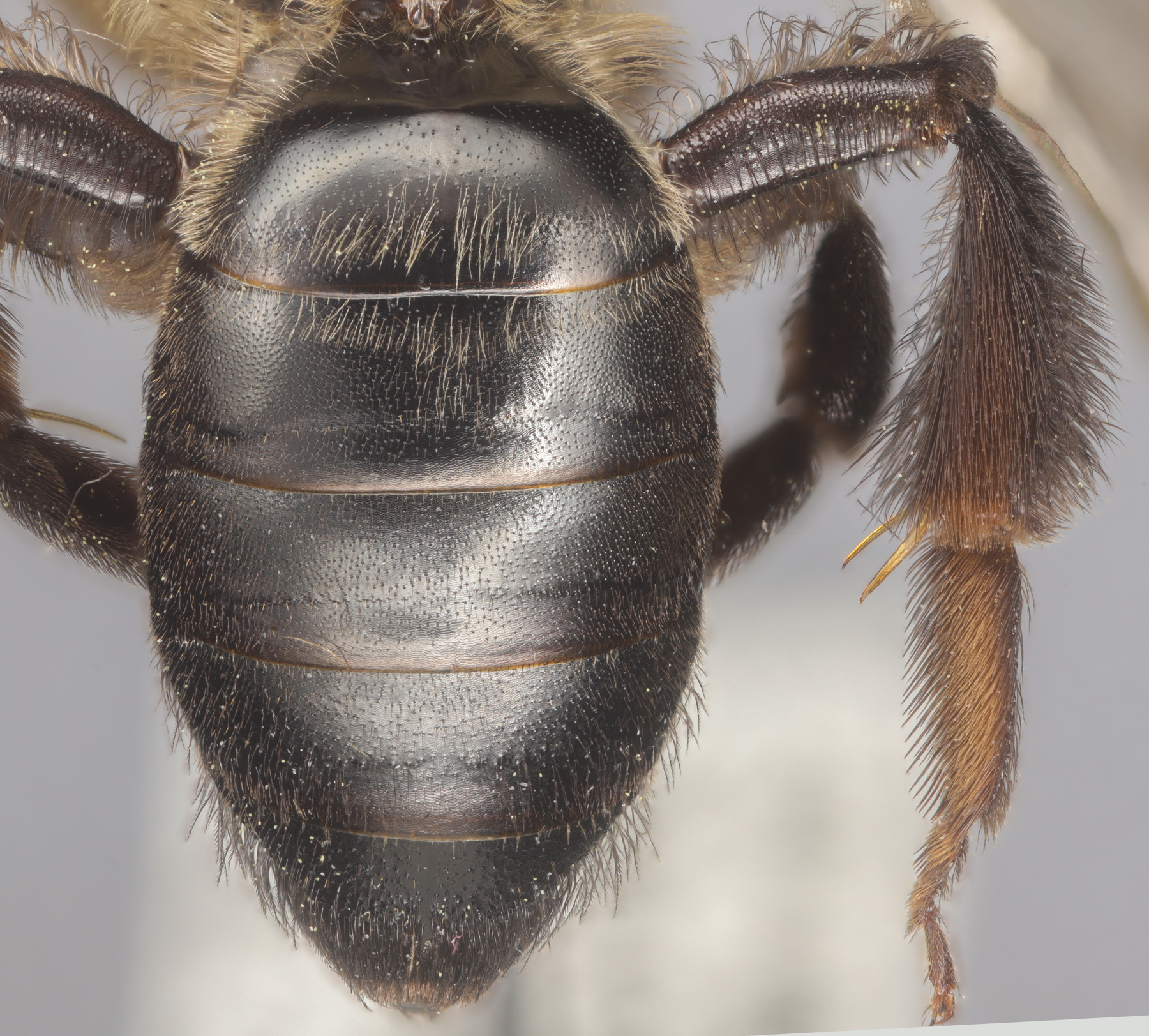
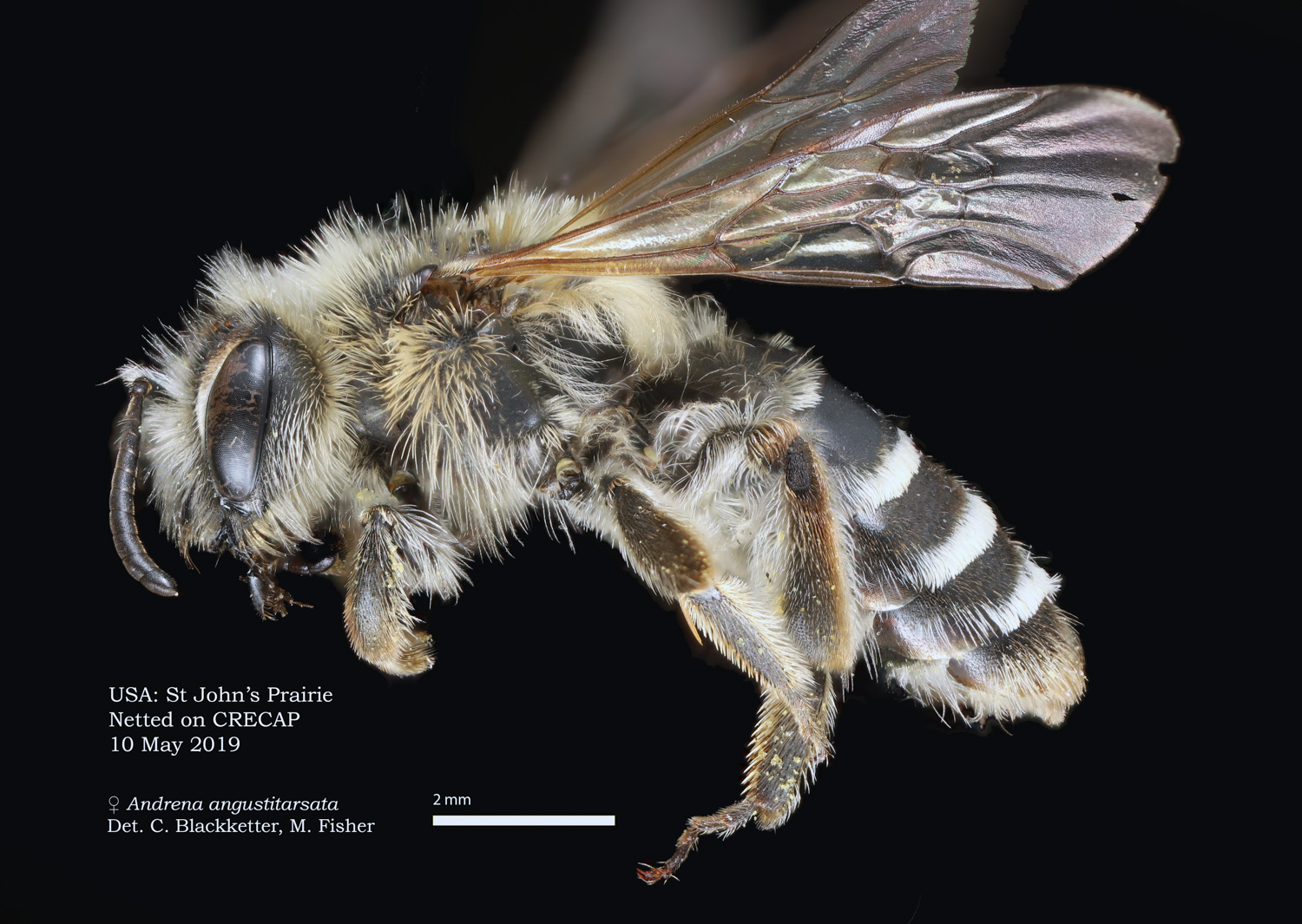
LaBerge: "Andrena angustitarsata Viereck is an extremely common western Andrena, distinguishable in either sex by the terga being punctureless and opaque due to the dense regular tessellation." |
|
Above: Clypeus sculpturing uniformly dull, impunctate.
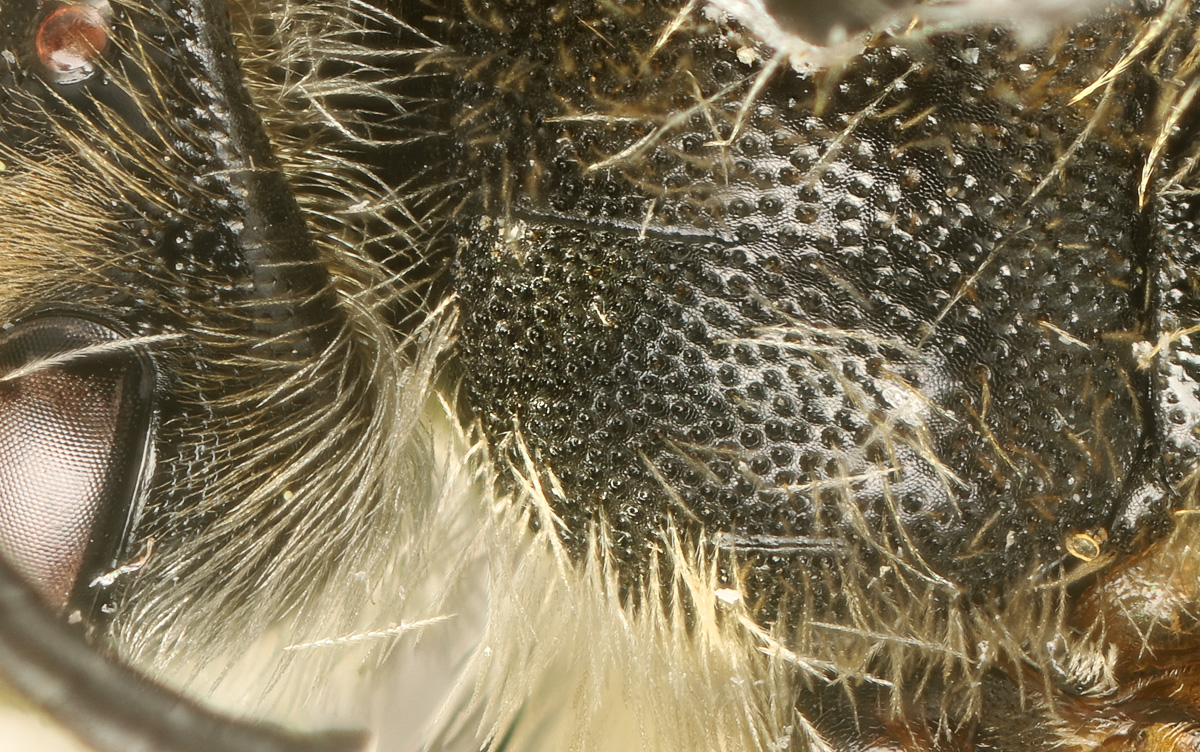
Below: Humeral angle weak, pronotal ridge absent. |
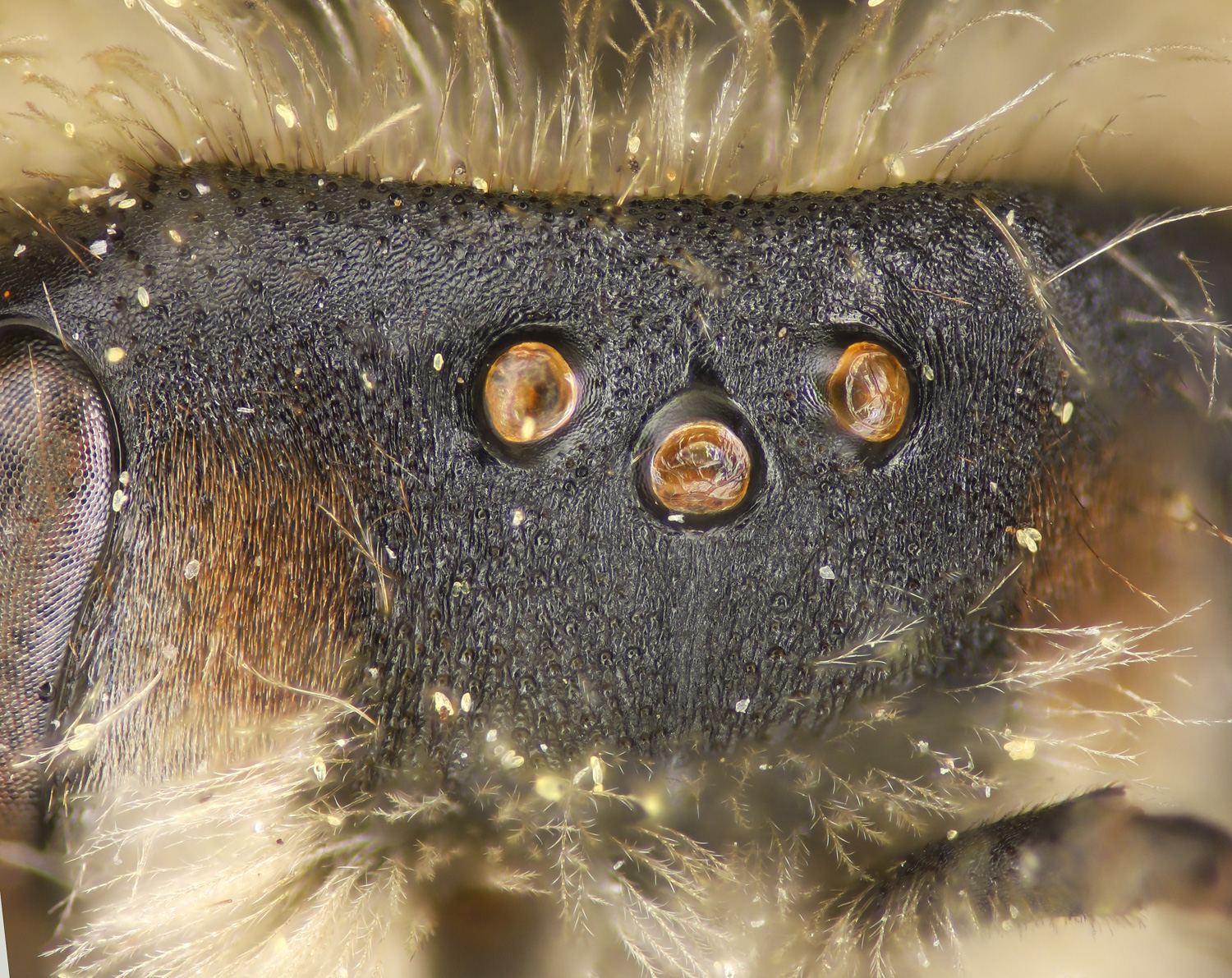
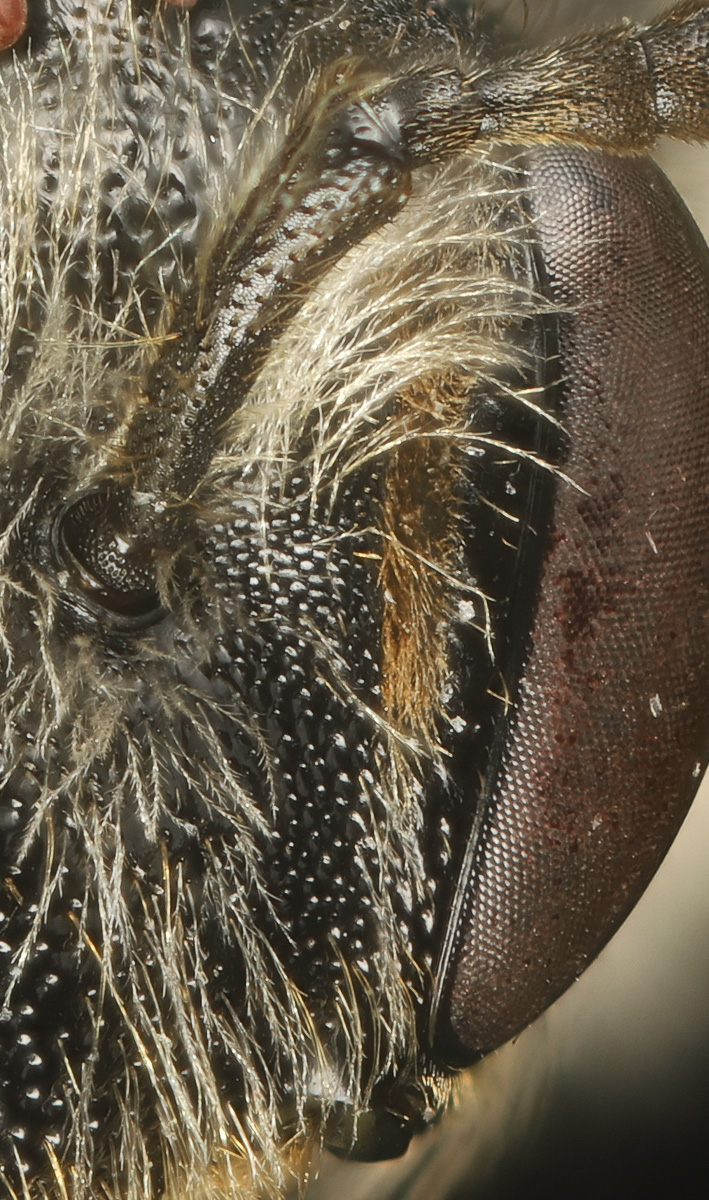
Above: Vertex ~1.4 ocd; fovea dark above.
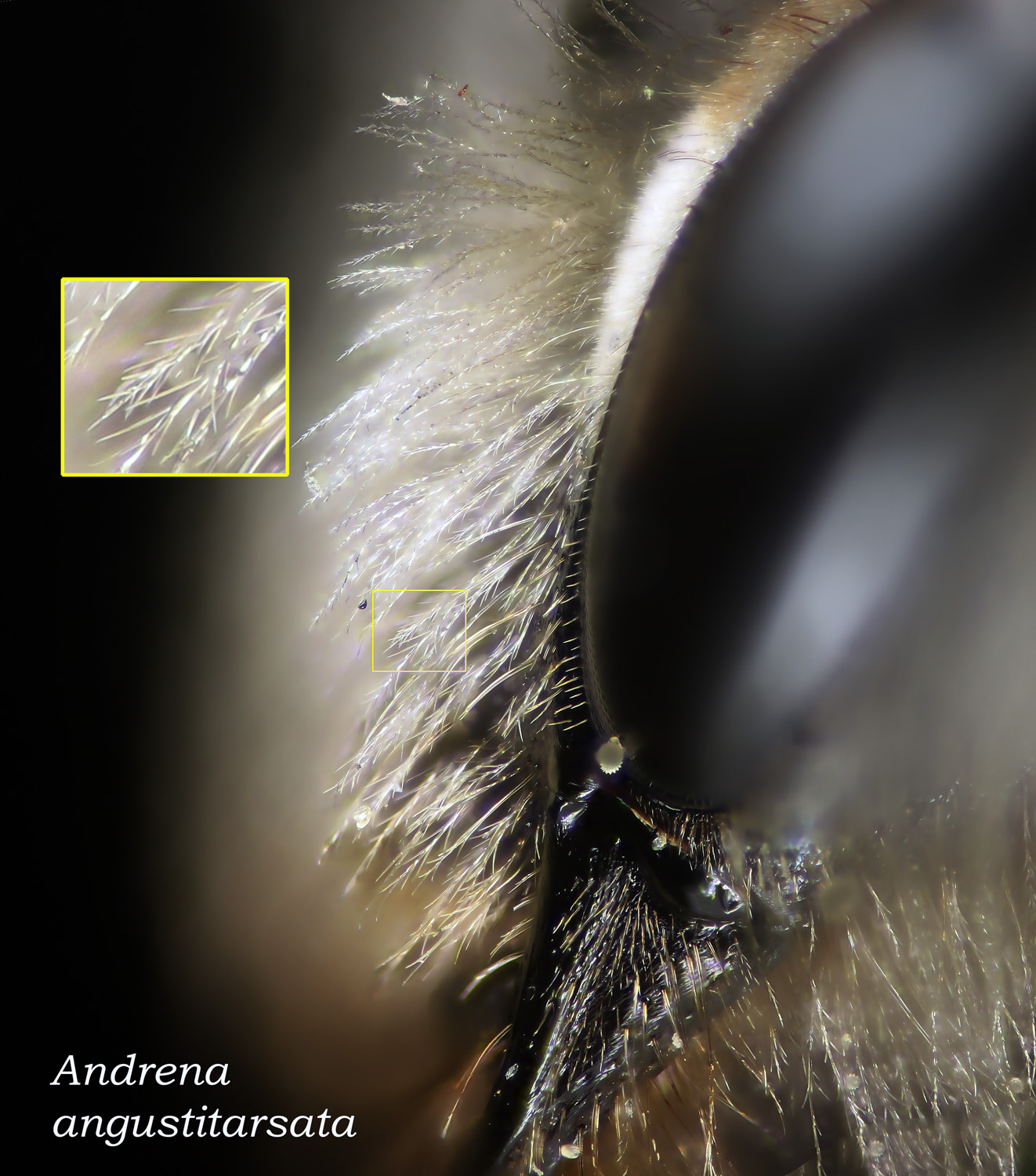
Below: Clypeal hairs plumose. |
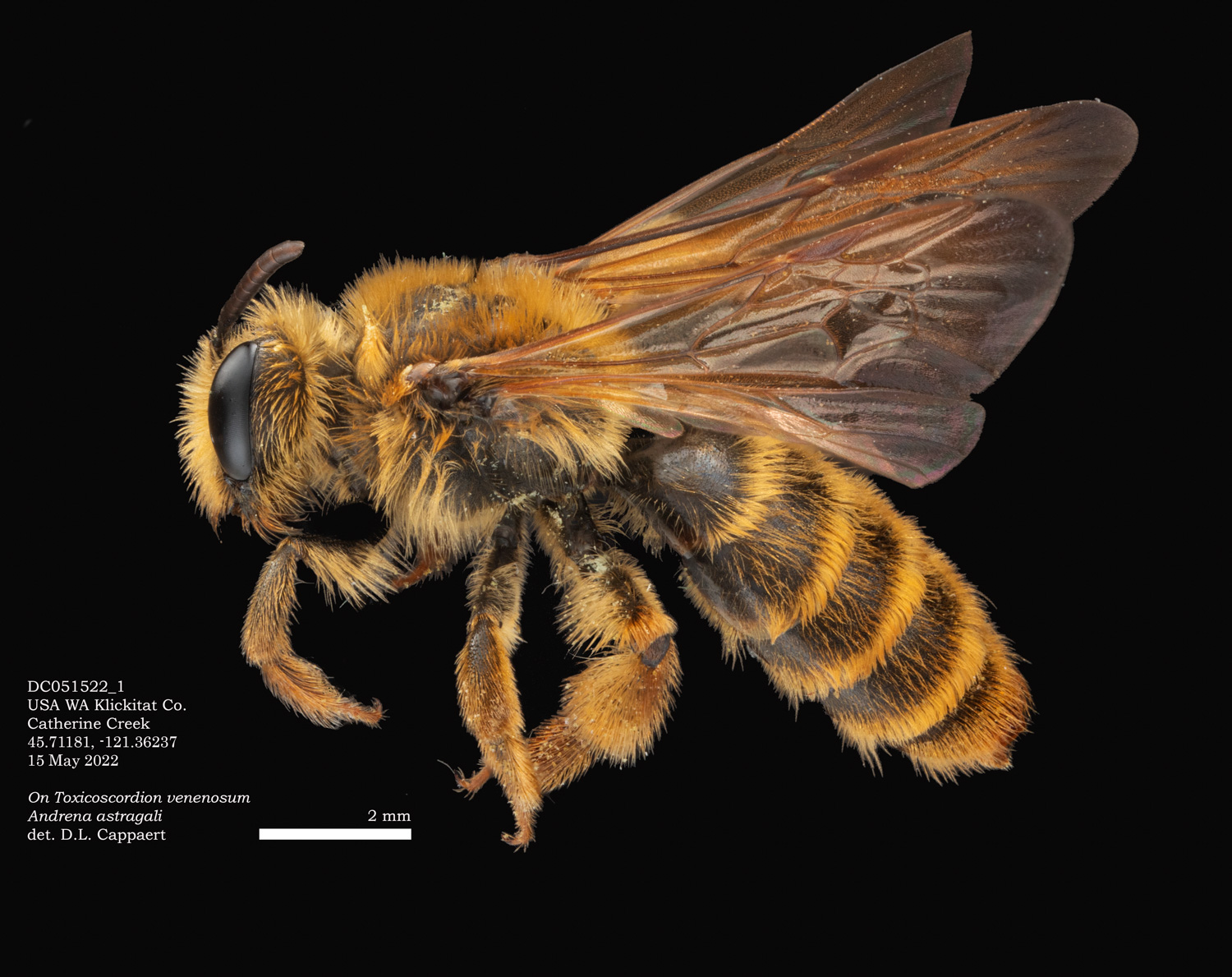
Shortcut: Andrena astragali forages exclusively on death camas, which is visited by no other bee. Discoverlife species page and range map ![]() |
|
Easy calls:
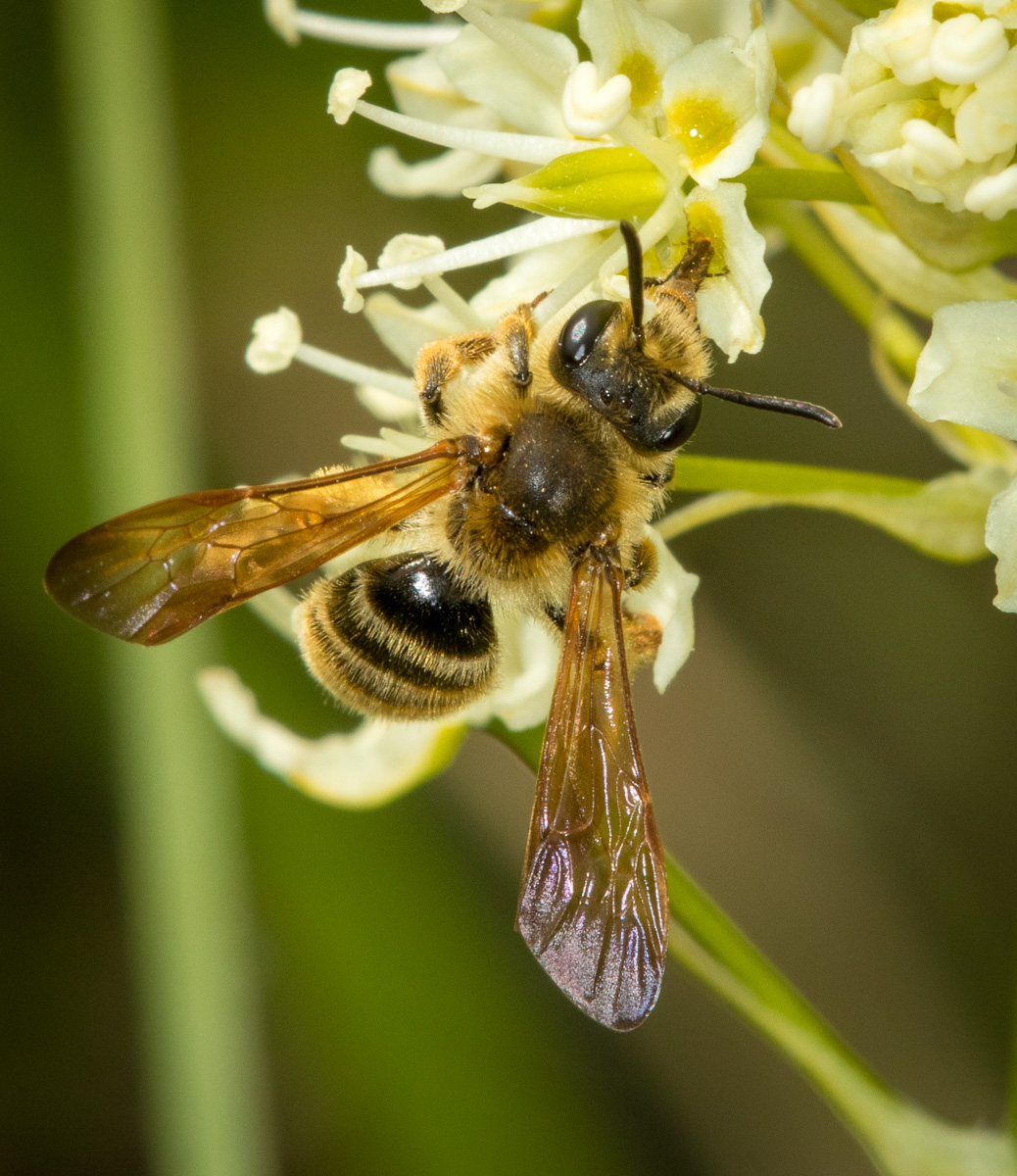
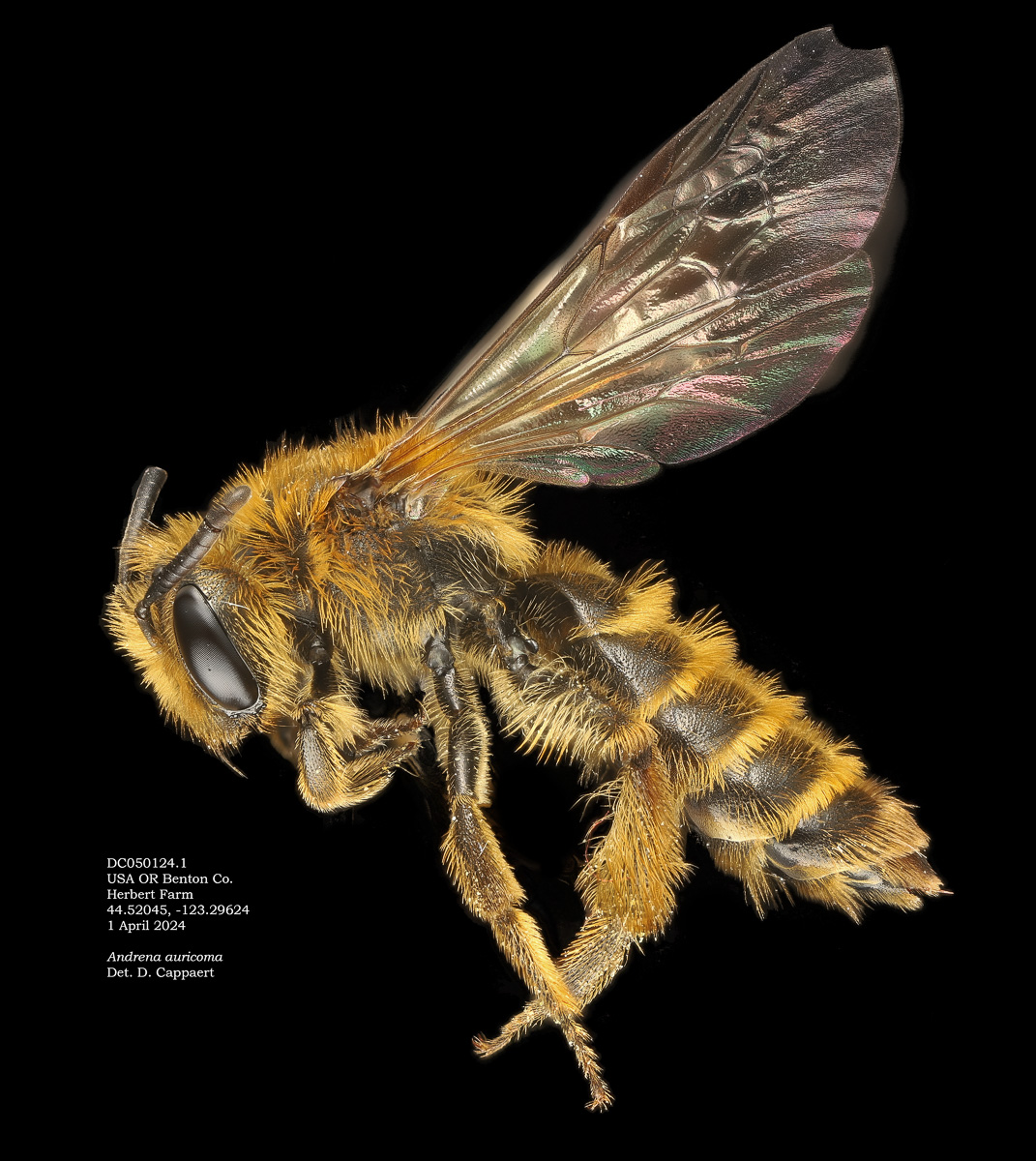
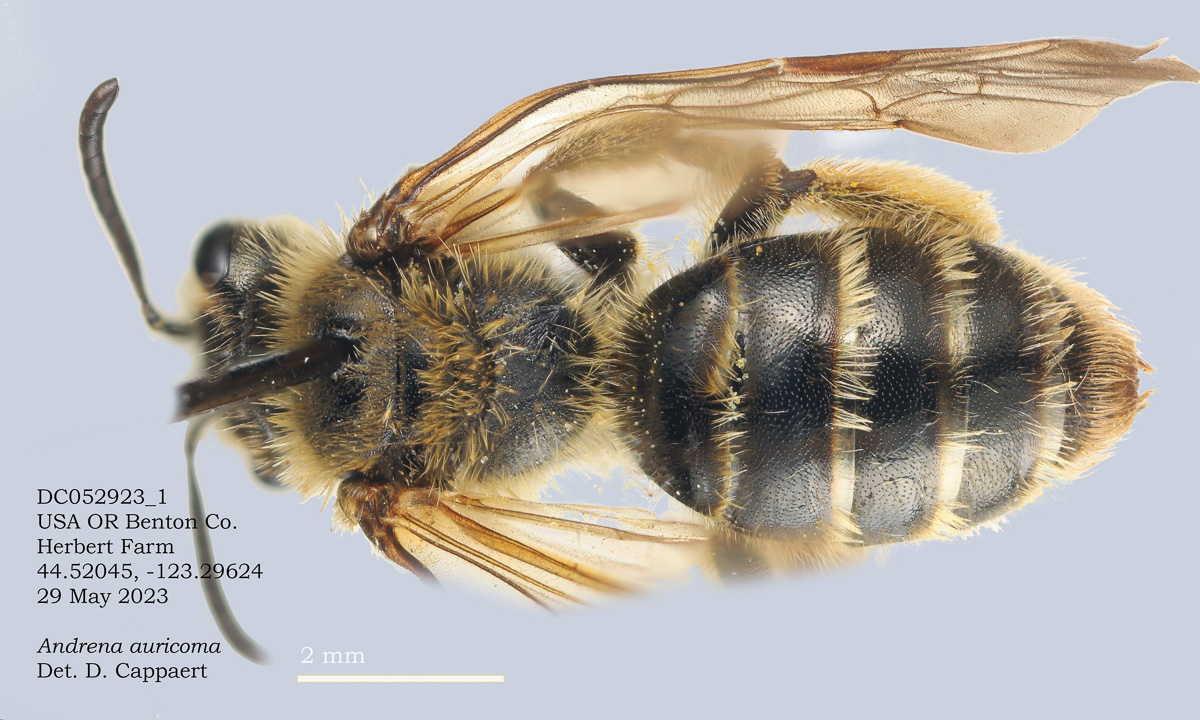
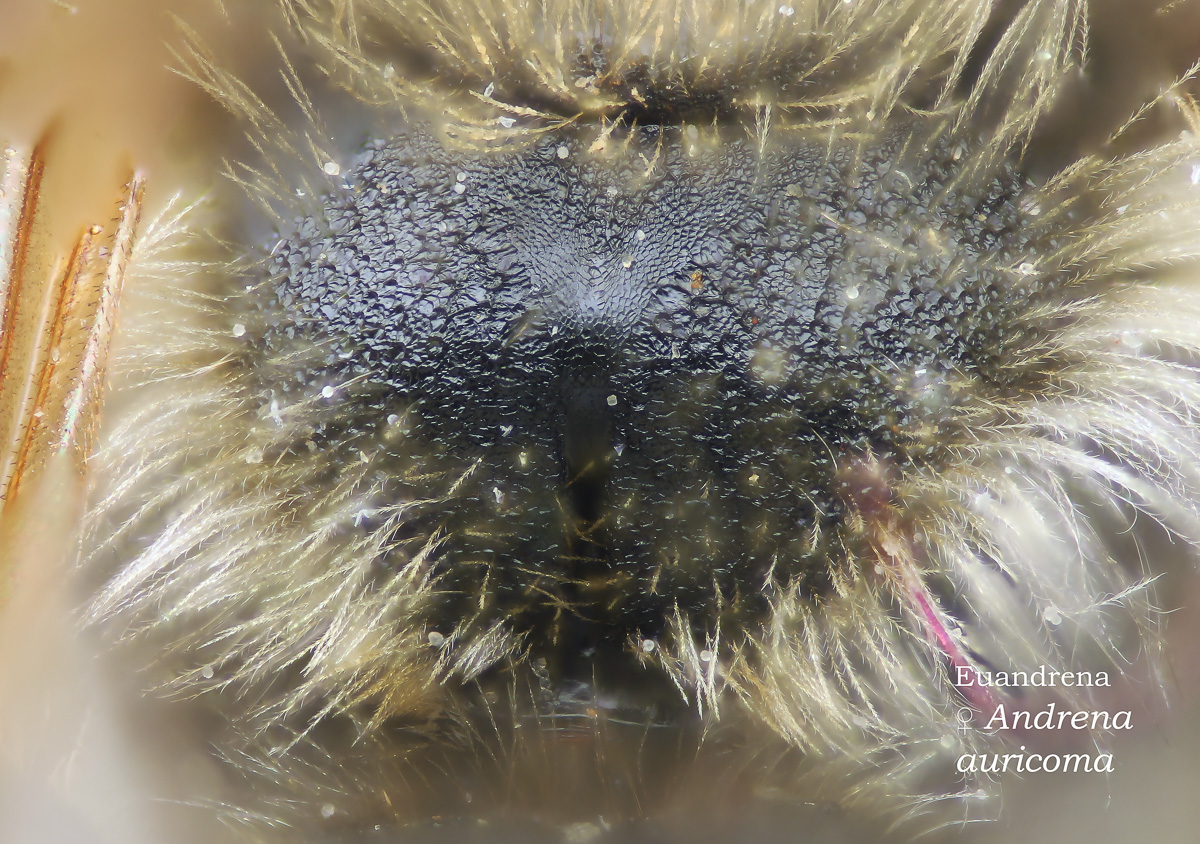
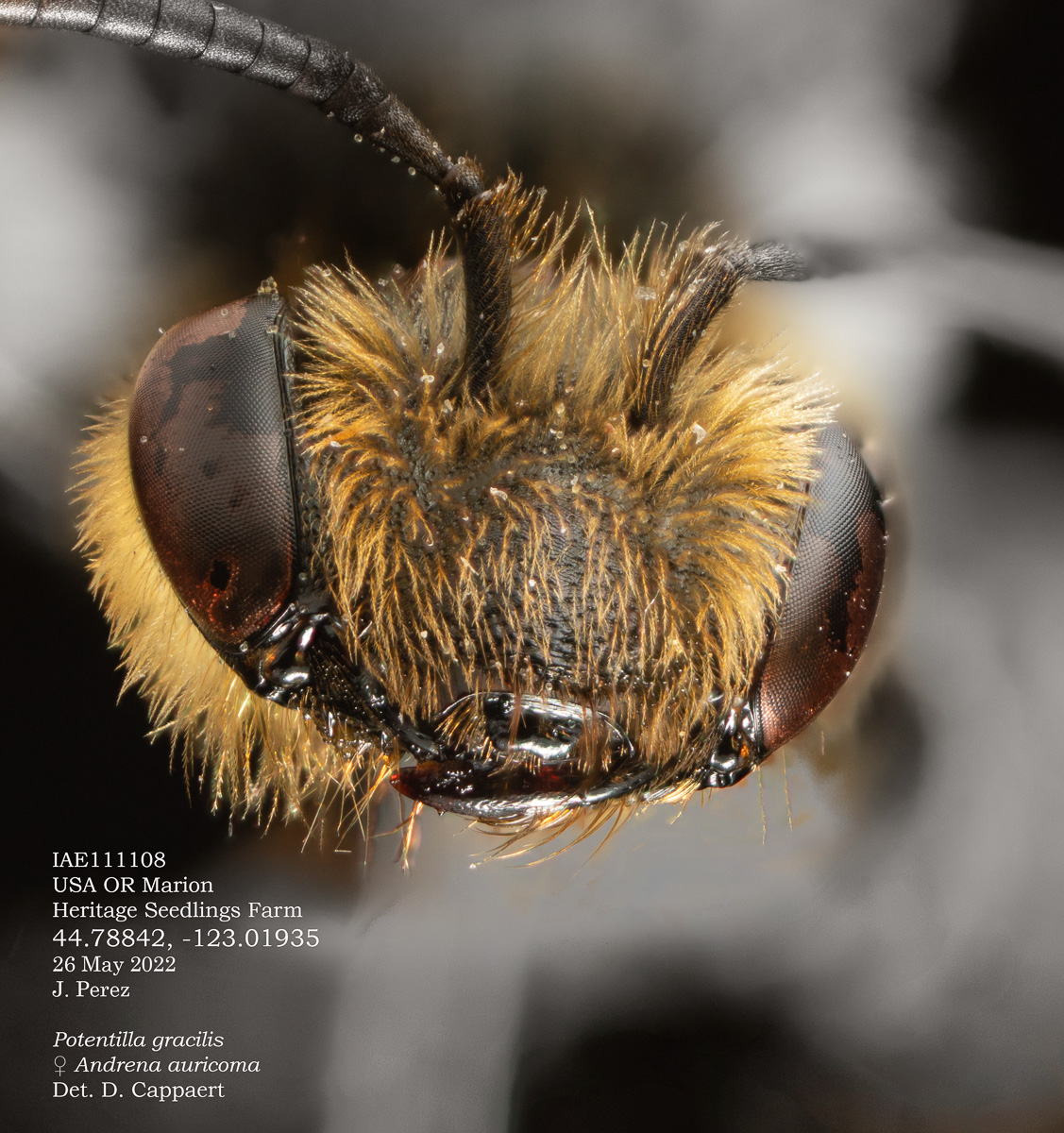
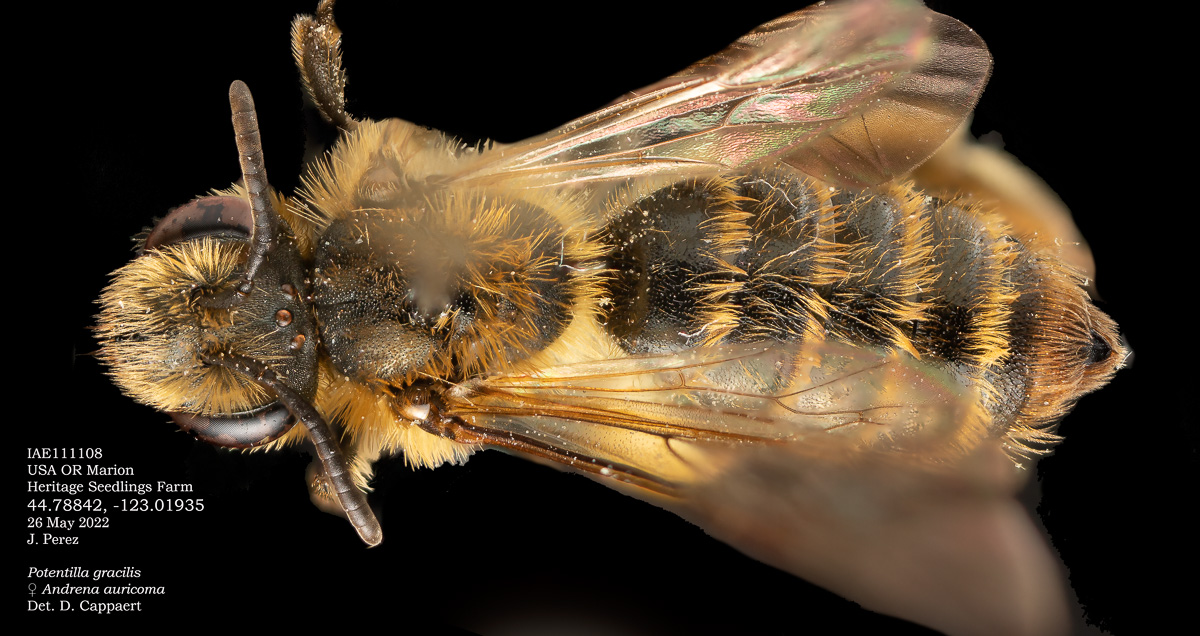
DL has no images of bucculenta or lutehirta, so overall appearance is unhelpful. A. lutehirta is scored as having a long vertex (1.5-2od), whereas this specimen has vertex less than one ocellar diameter. This specimen has 3 SMC, whereas A. bucculenta is scored as having 2SMC, a condition that excludes the subgenus of the other two options. This leaves a diagnosis of A. auricoma. |
|
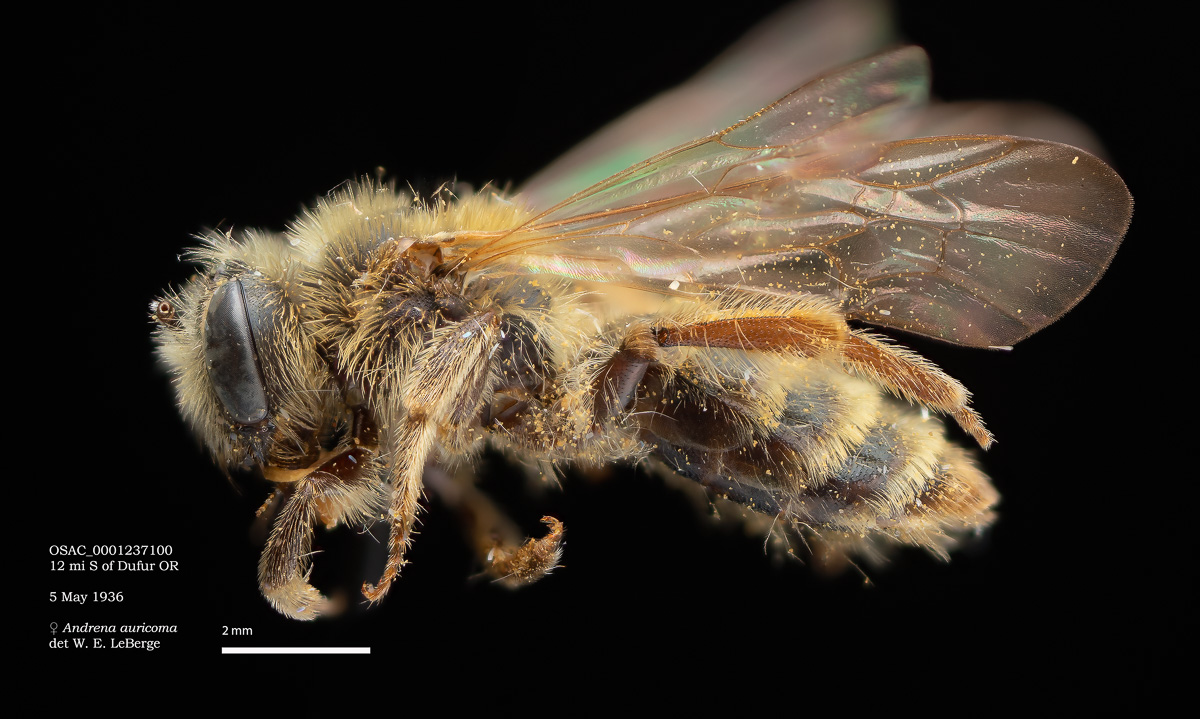
Above: An 88 year old specimen from OSU. Note cuneate tibia.
Below: The sculpturing here is 0% sculptured, although the surface texture is borderline. The label here indicates Euandrena. But Ptilandrena is the updated classification. Cautionary notes: Scoring for western Andrena species is often incomplete. The LaBerge subgenus key would seem to indicate Ptilandrena as having highly plumose tibial scopae, whereas this specimen has simple hairs. However LaBerge himself contradicts this: I have images of a specimen, with det. by LaBerge, of another Ptilandrena (A. nigrihirta) with tibial scopa very similar to this specimen, with simple hairs. |
Above: Slightly emarginate labral process.
Below: Note super-shiny tergae, sculpturing of frons. |
Easy calls:
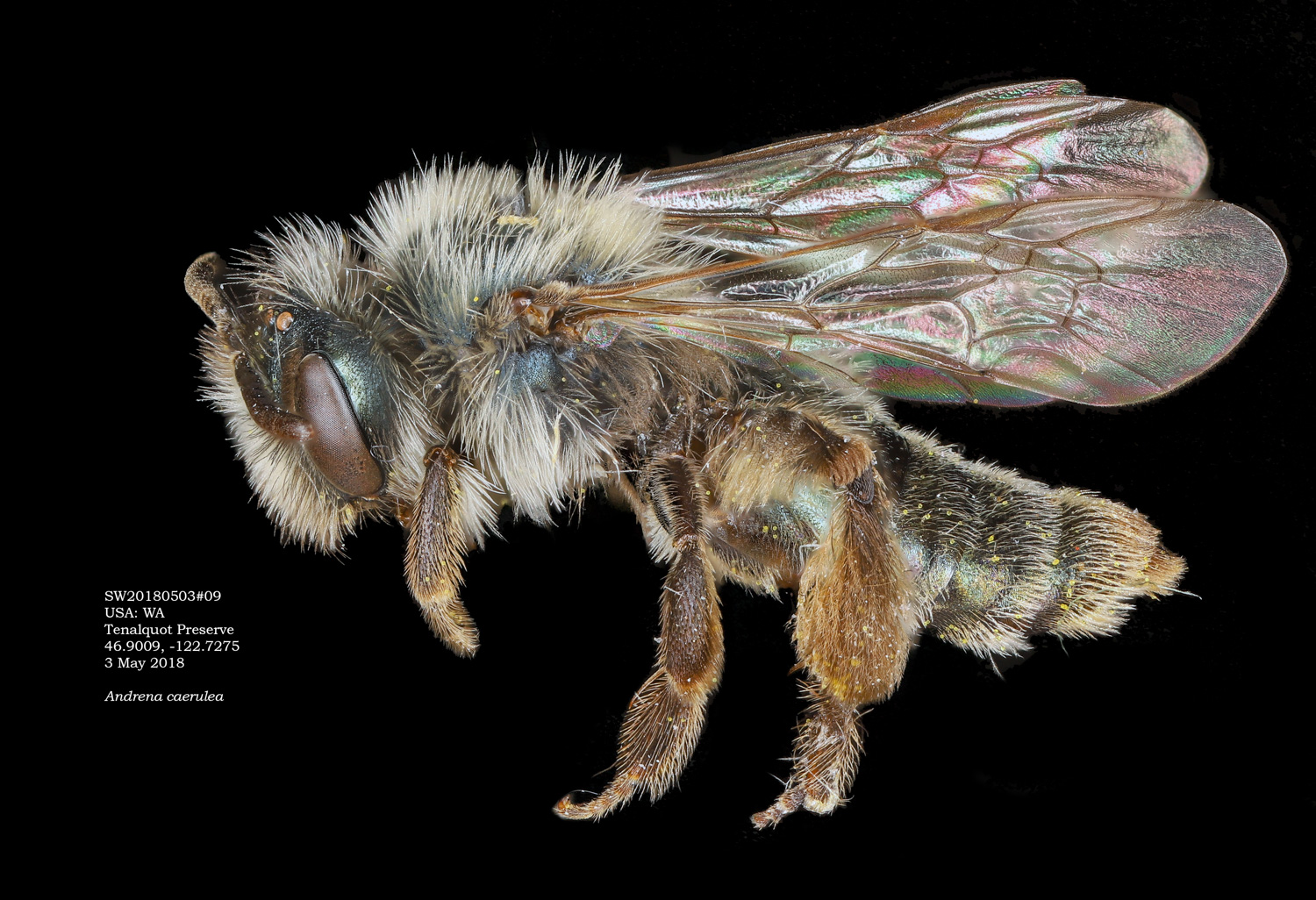
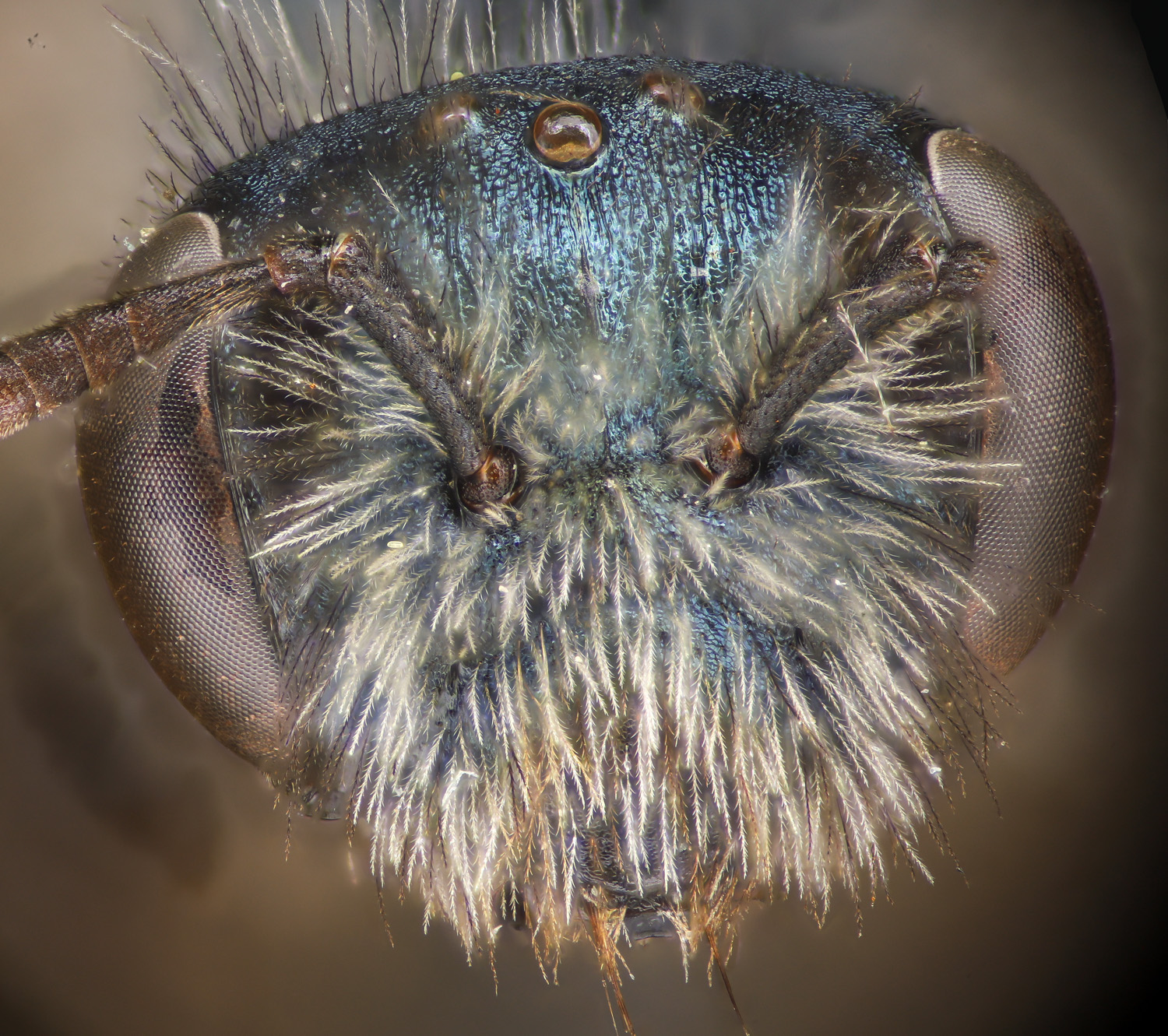
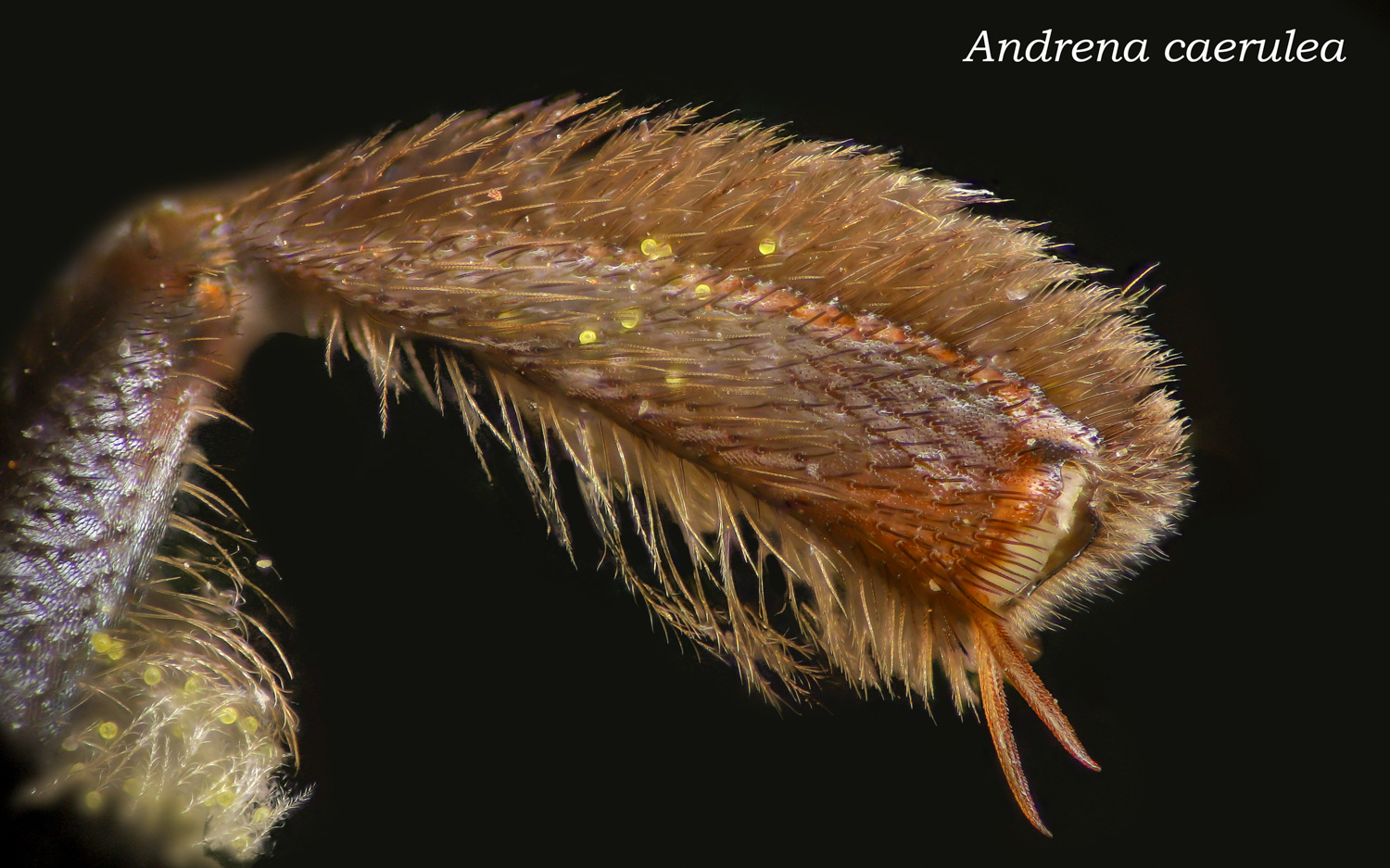
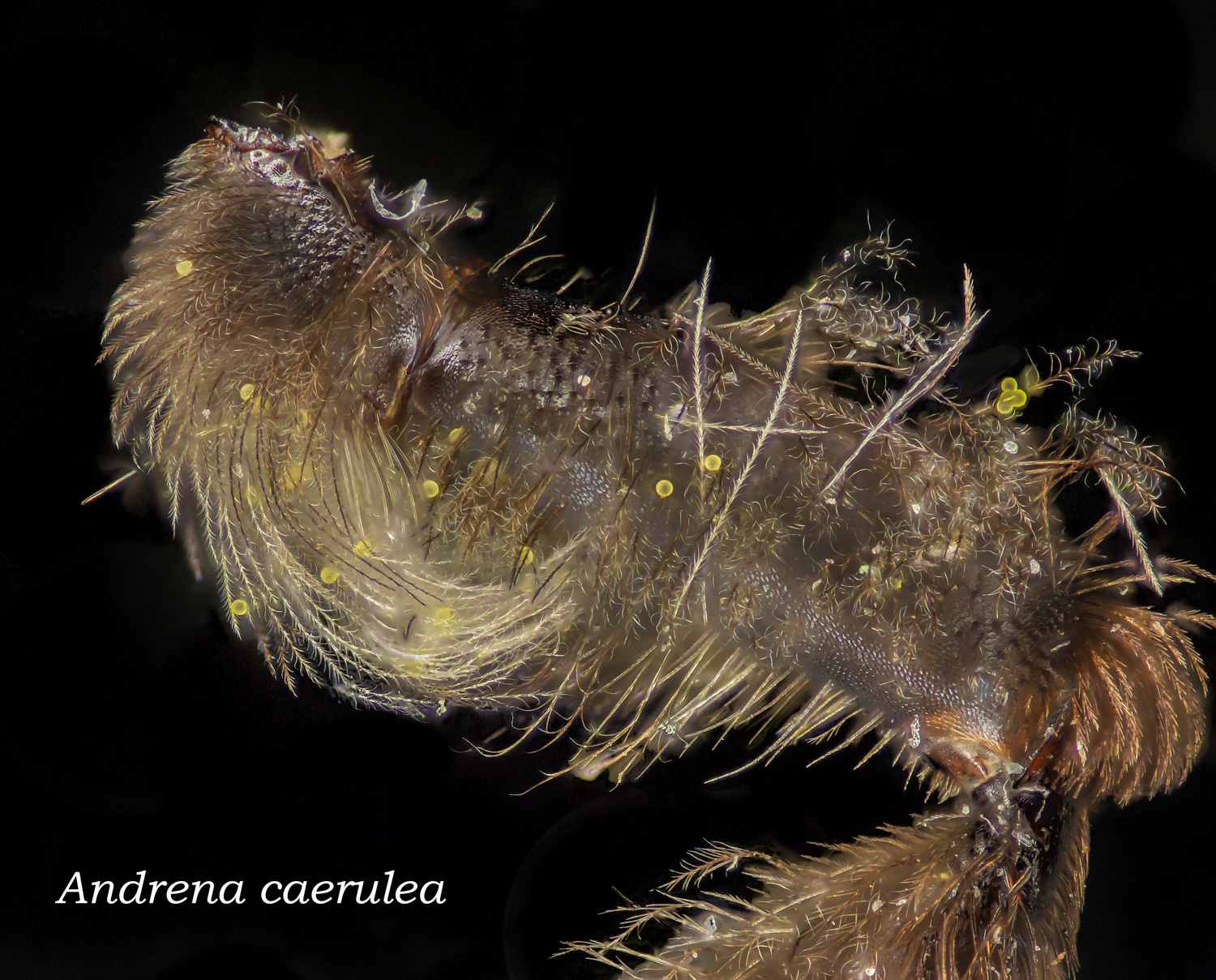
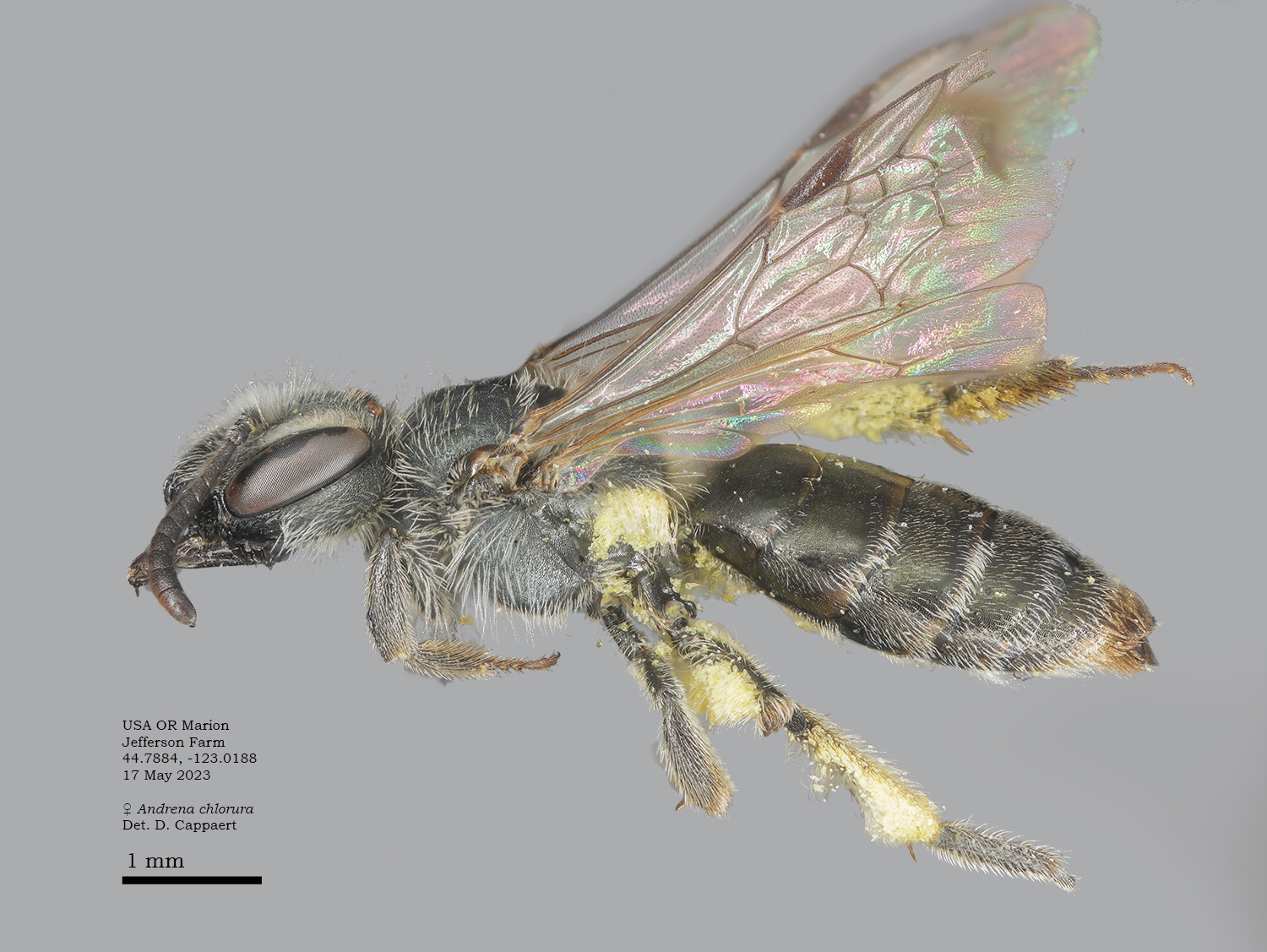
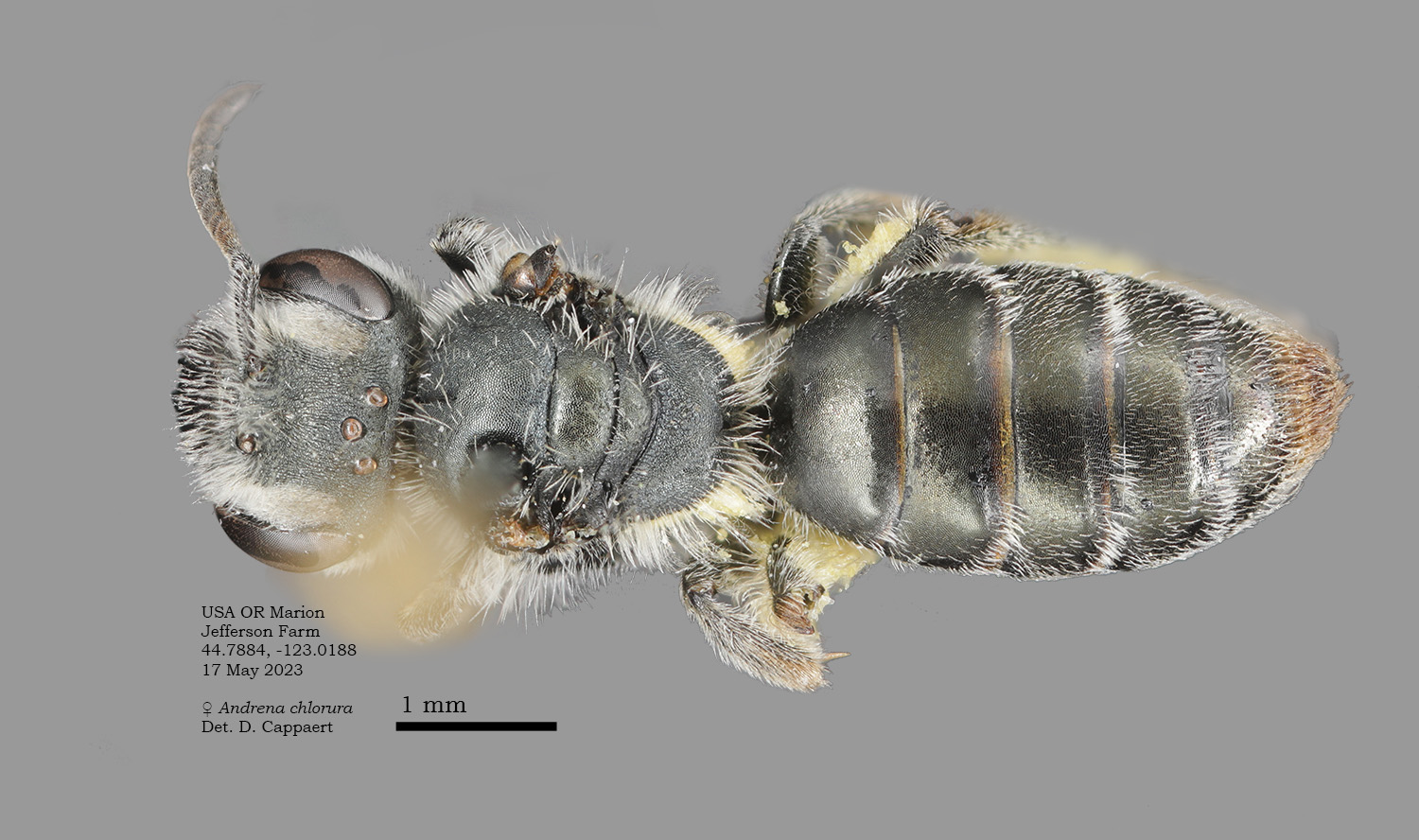
... yields A. caerulea in DiscoverLife. LaBerge: "Both sexes of A. caerulea can be separated from related bees by the metallic coloration, the short clypeus which is only obscurely punctate, and the highly plumose hairs of the tibial scopae, the propodeal corbicula and the dorsal femoral flocculus." The small size, light hairs and plumosity diffentiate this species from A. nigrocaerulea. |
|
![]() |
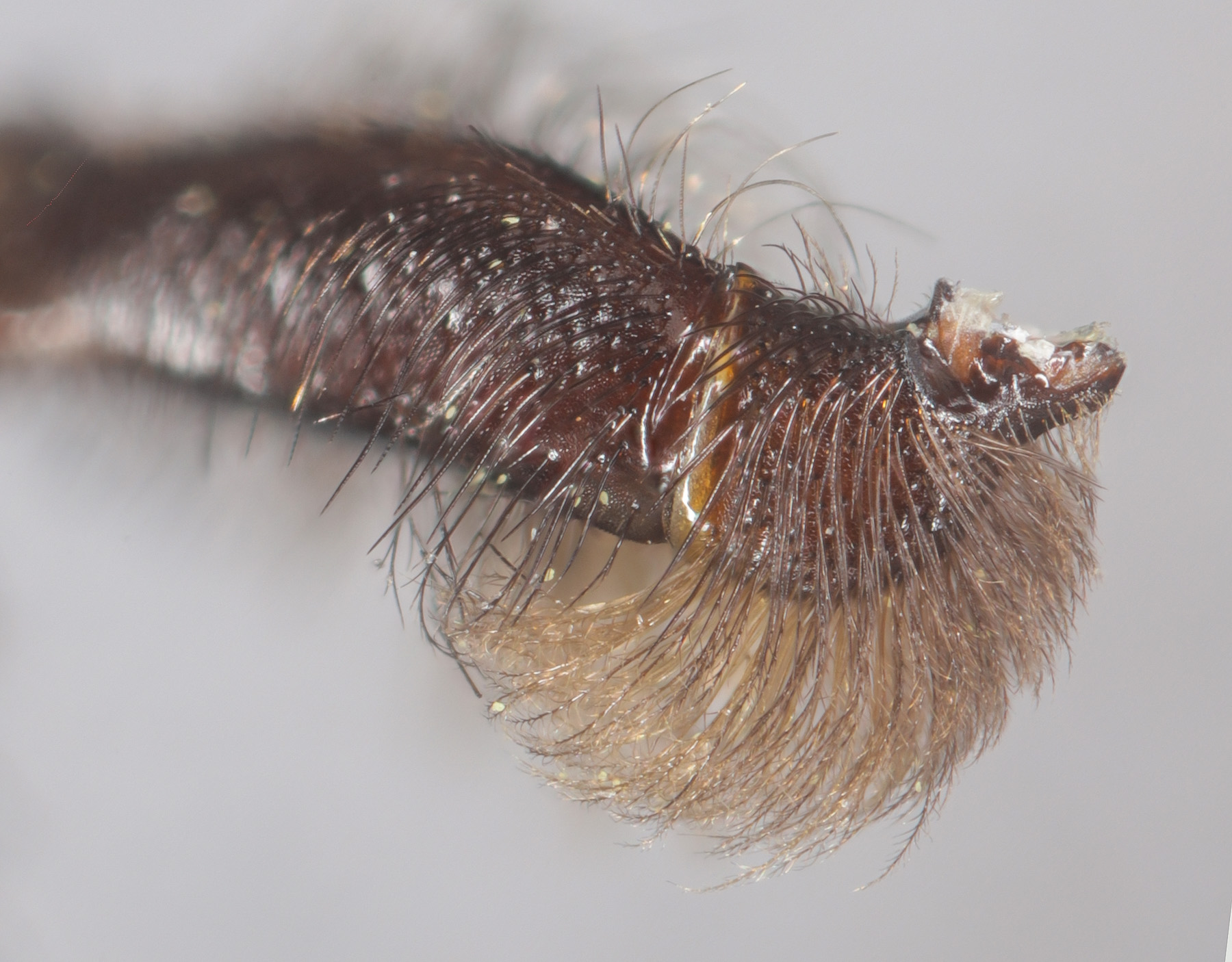
Above: Highly plumose tibial scopa, dark(ish) hairs.
Below: Trochanteral flocculus (and adjacent femur) with plumose hairs. |
Easy calls, based on 2 images at right:
|
|
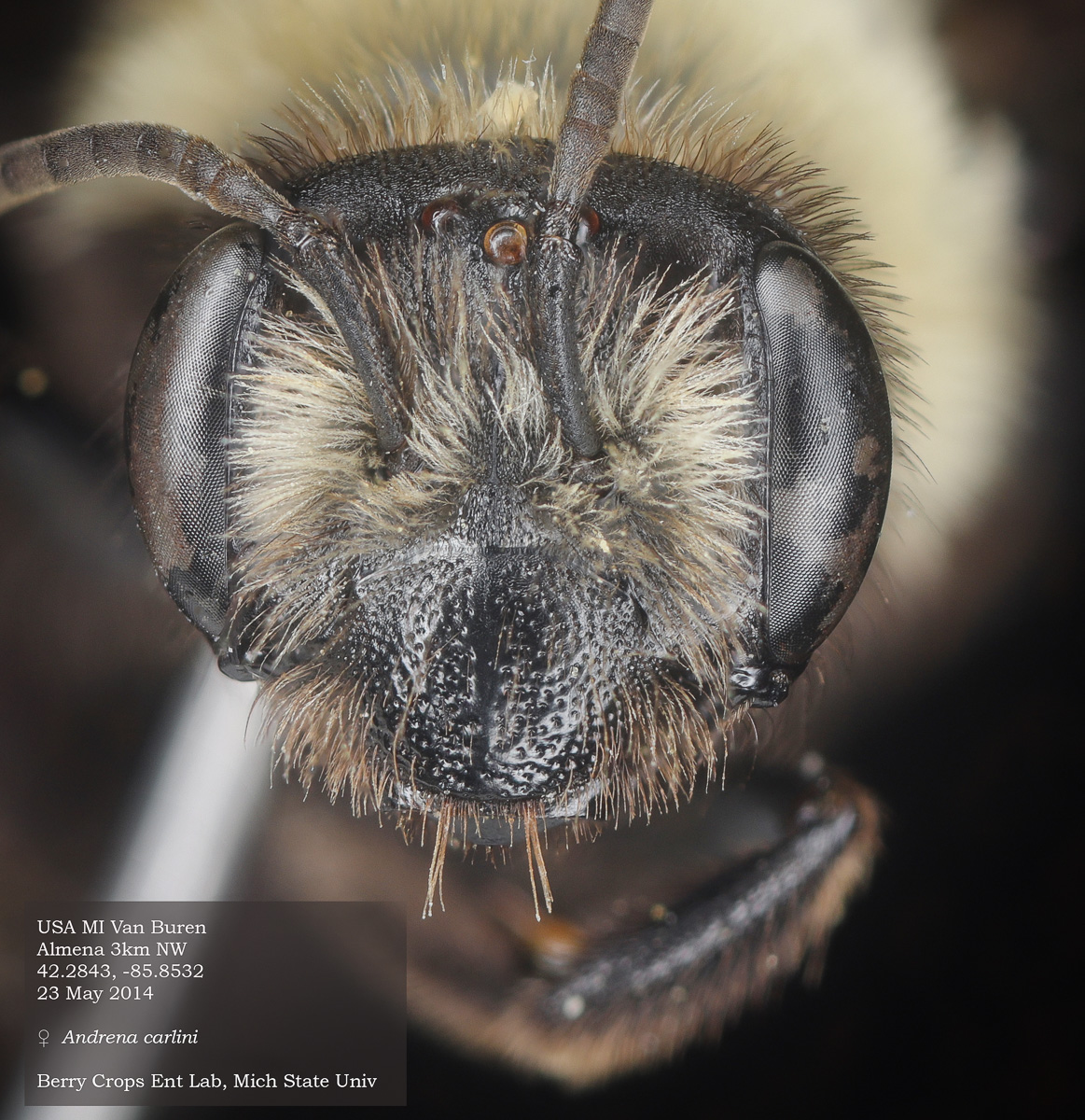
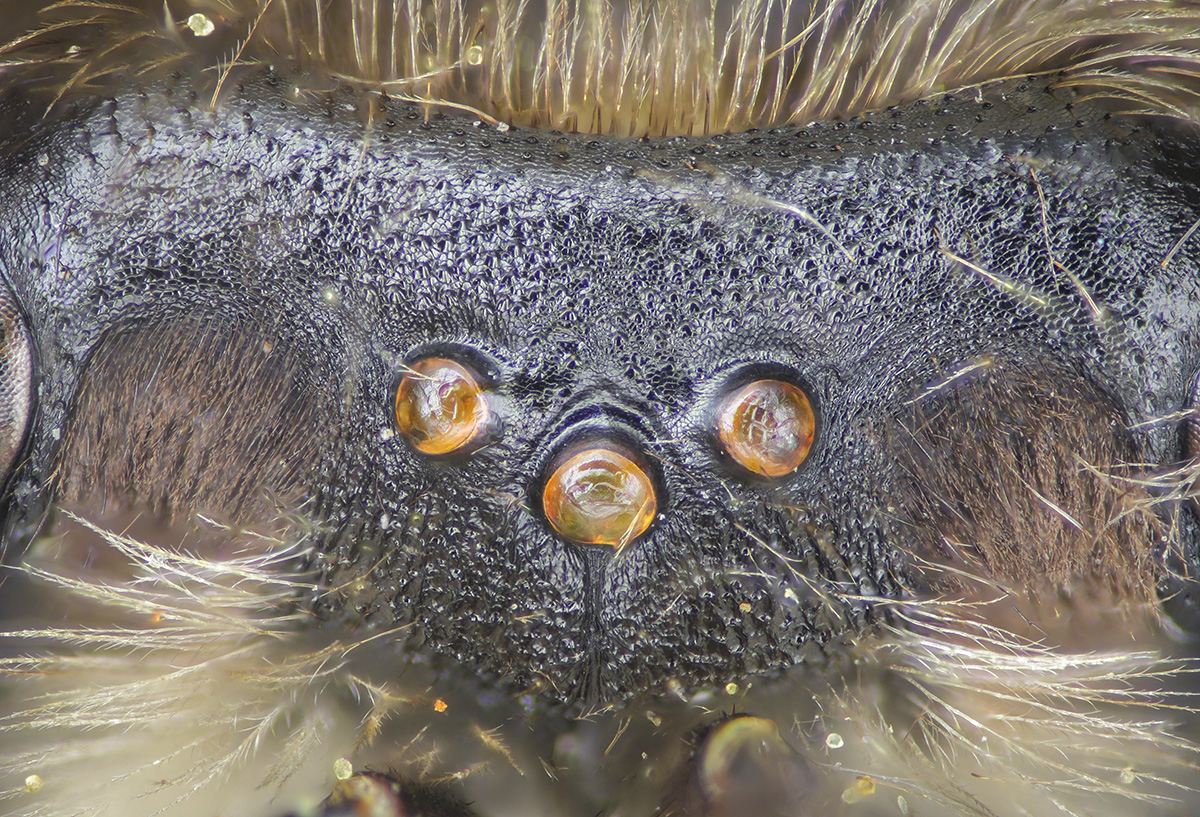
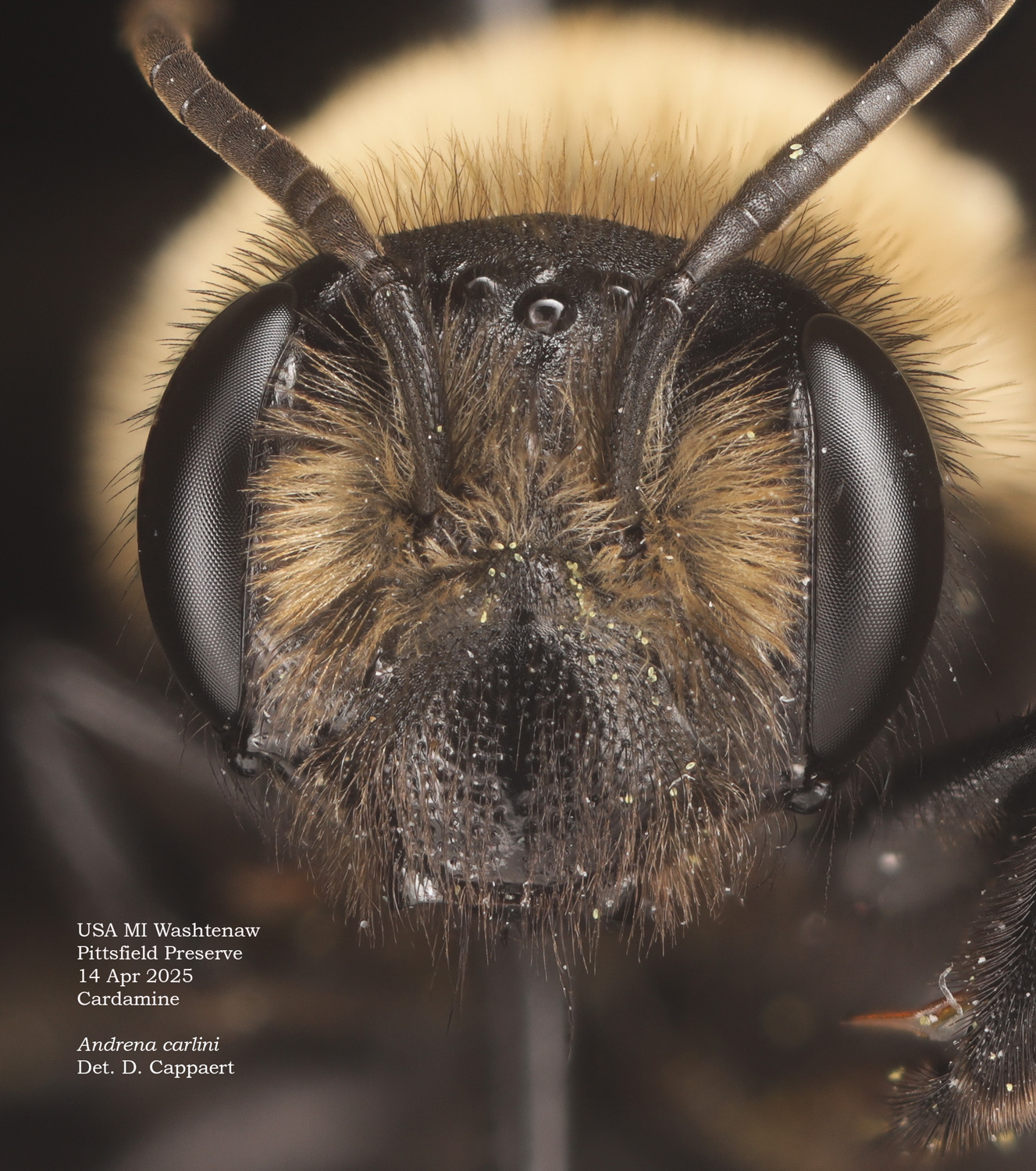
Fovea dark above (at least). Match for A. carlini, not for A. vicina (all pale). [But see Washington A. vicina below]
|
Above: Vertex=2ocd. Excludes milwaukeensis and thaspii.
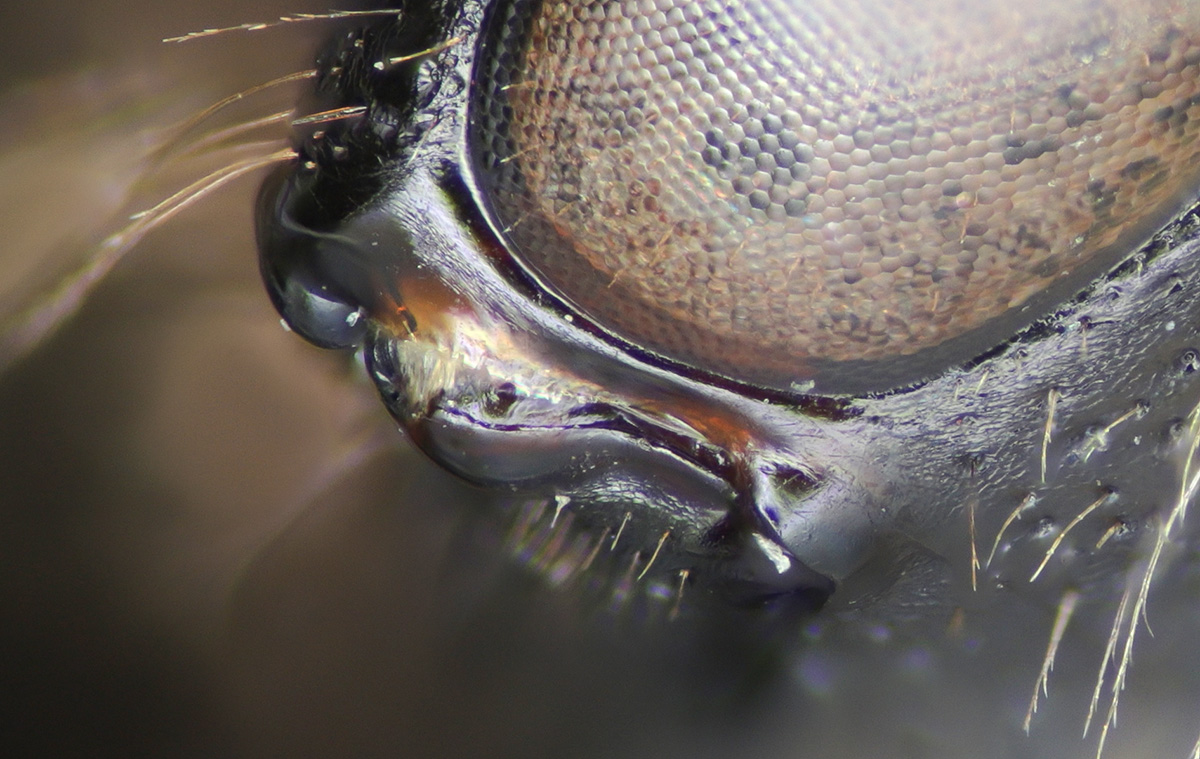
Below: Very short malar space. A. vicina would be short or moderate. |
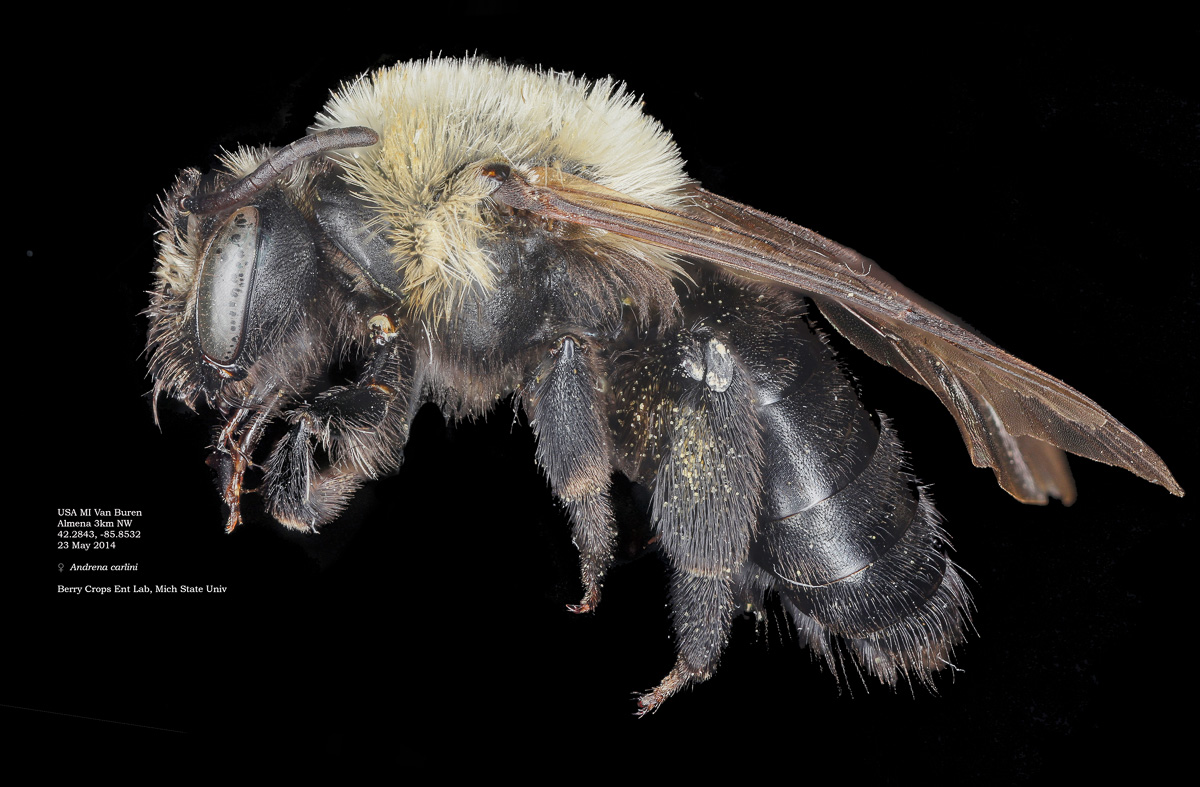
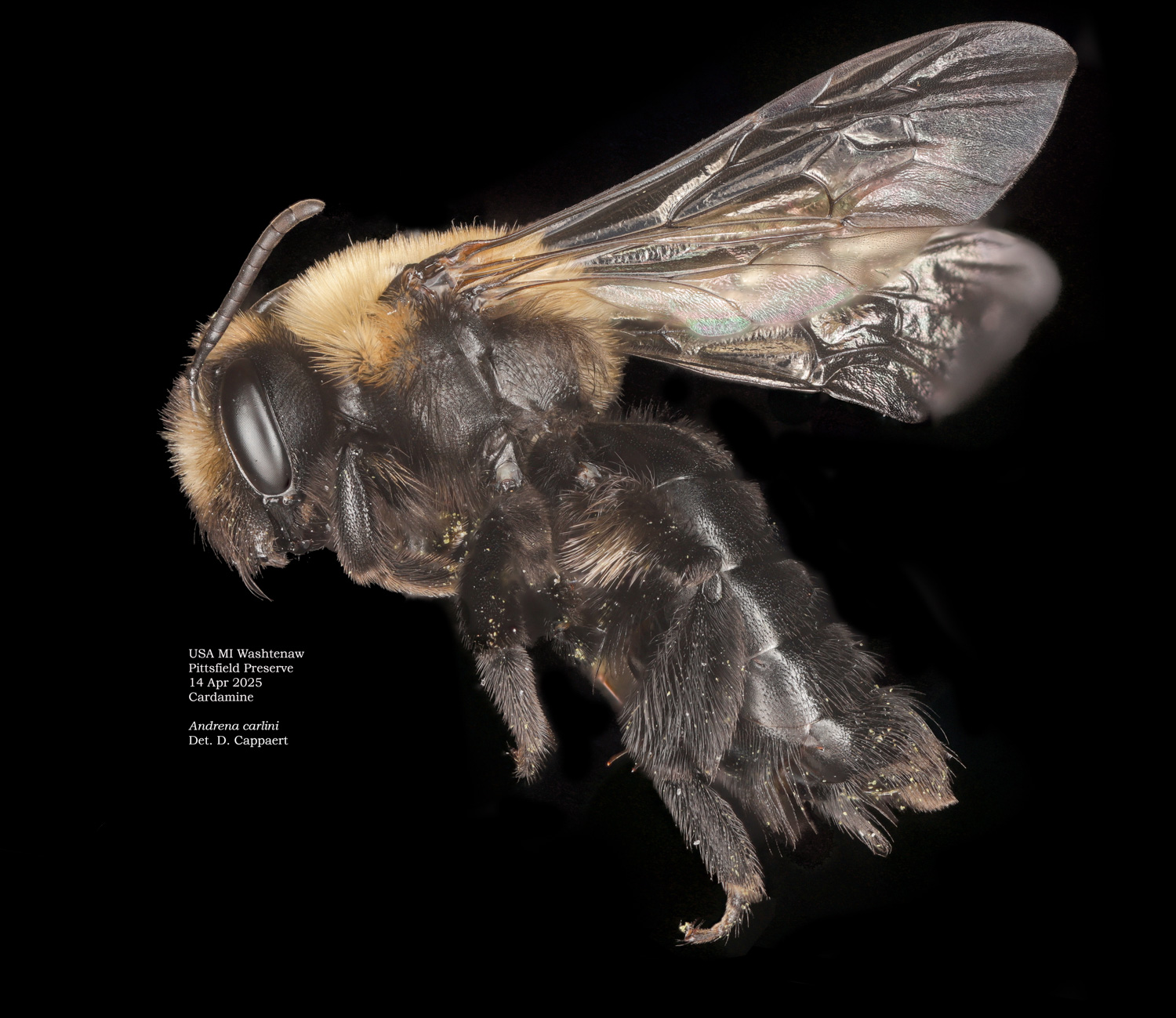
| An additional specimen at right. The mining bees of Minnesota (unpublished manuscript by Joel Gardner): "Andrena carlini is one of the most common Melandrena in Minnesota and easily recognized in the female by the hair of the head and thorax being bright yellow-white dorsally and black ventrally. Most other Minnesota Melandrena have the head and thorax with completely light hair." The exception would be A. vicina. I can't rule that out for this specimen. LaBerge: differs from A. vicina by "a [more] distinct median clypeal impunctate line with crowded punctures on either side." The A. carlini flocculus, not visible in photos, would be complete, but partial for vicina. |
![]() |
![]() |
Easy calls:
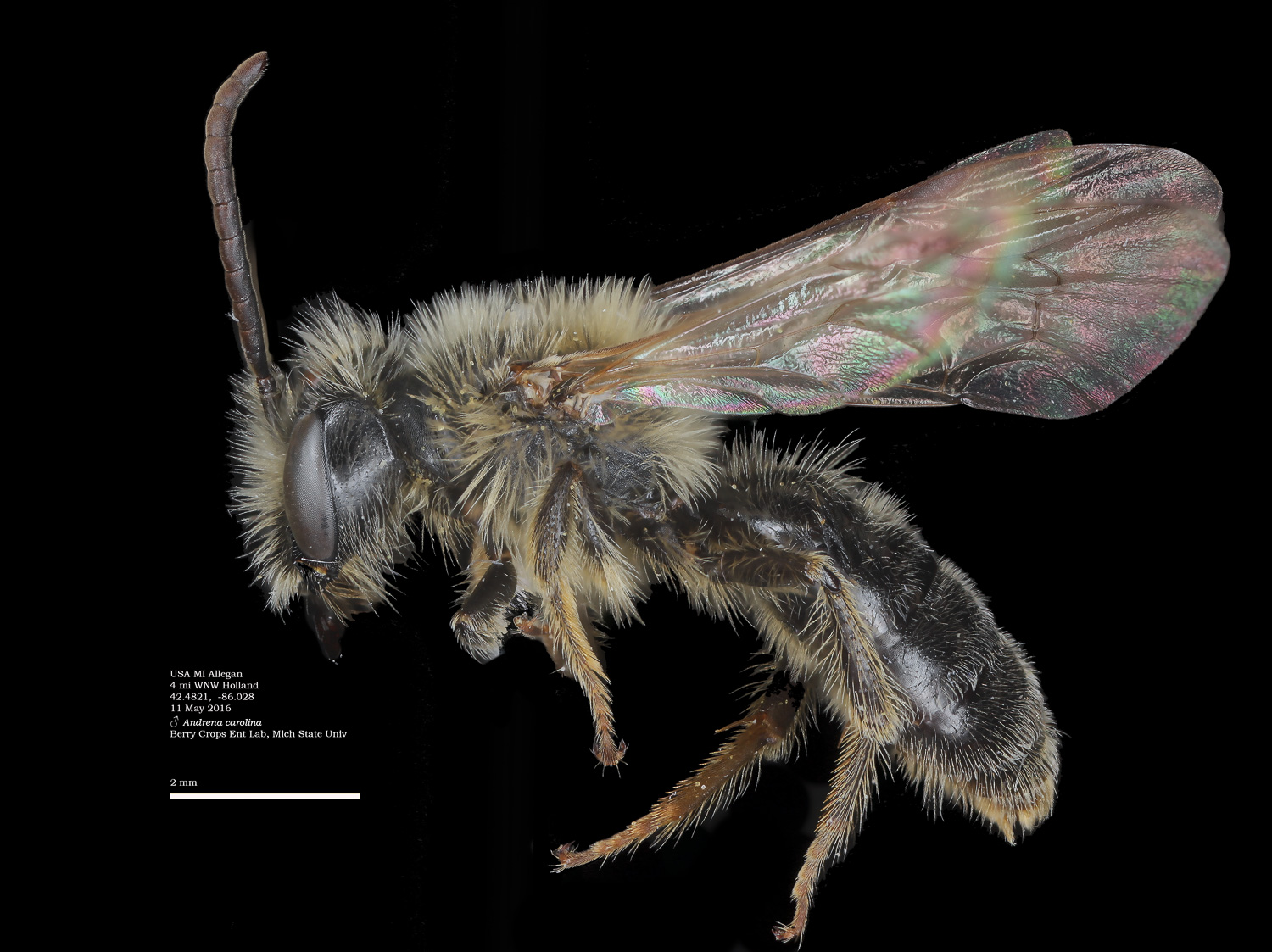
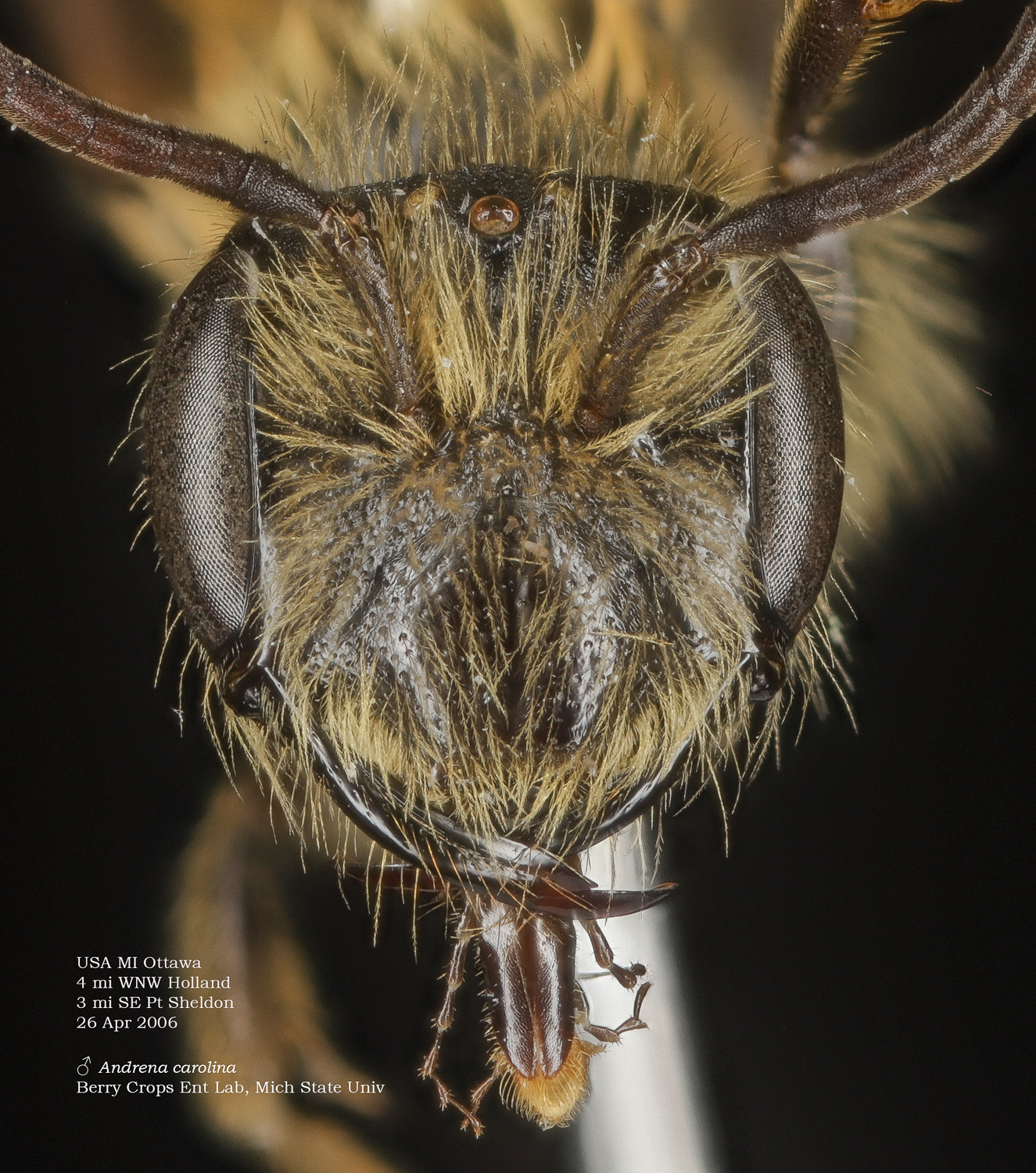
These 3 species cannot be distinguished in DL. A. carolina is far more abundant, and associated with blueberries, likely the case for this specimen. |
|
Quadrangle longer than broad. Tawny hairs. Clypeus shiny-dull, punctate except midline. Decussate mandibles. Max palp exceeds galea by 2 segments.
|
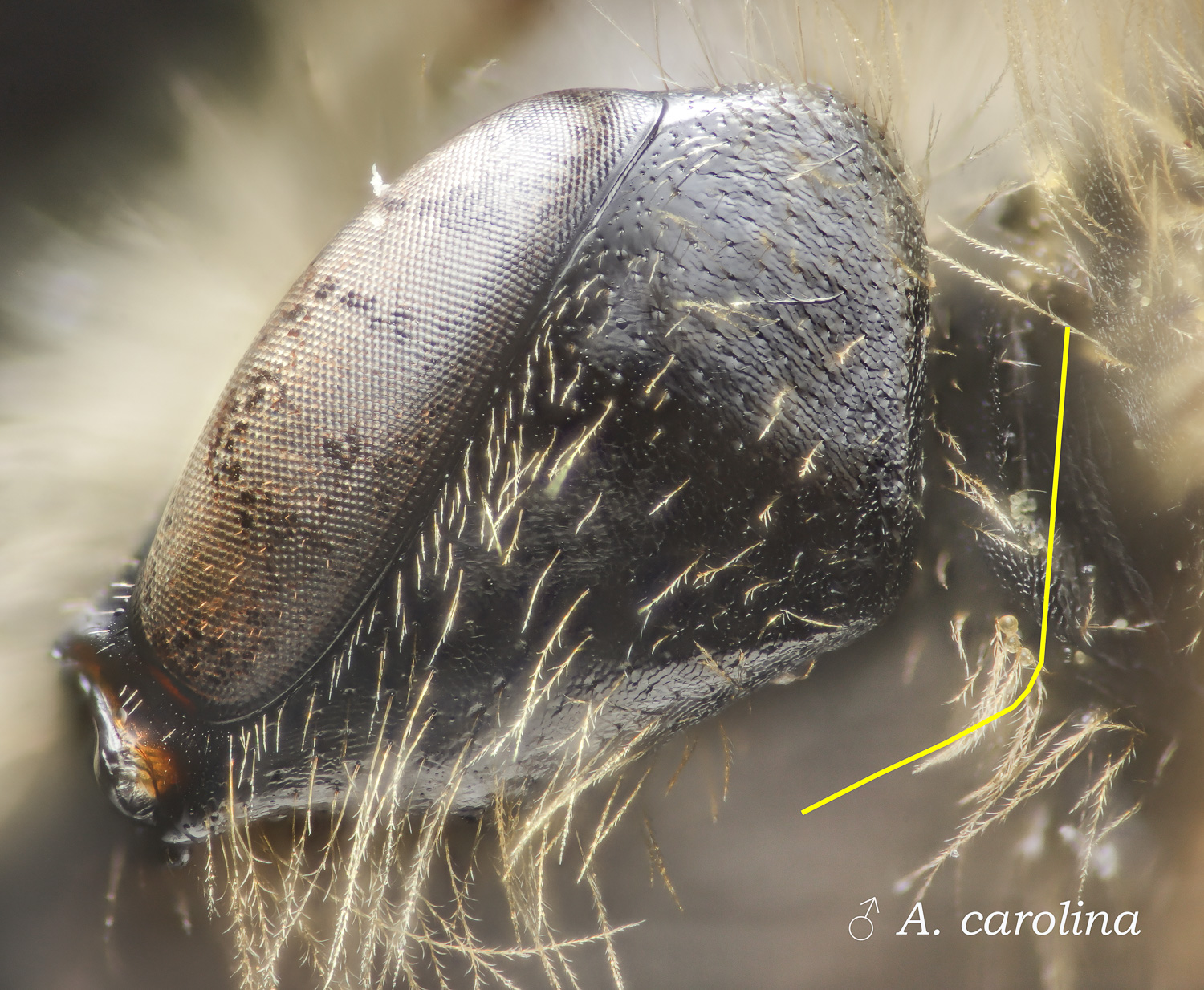
Cheek 2X as wide as eye. From DL: With distinct angle of 90 degrees or more along lower rear margin breaking the curve from top to bottom.
|
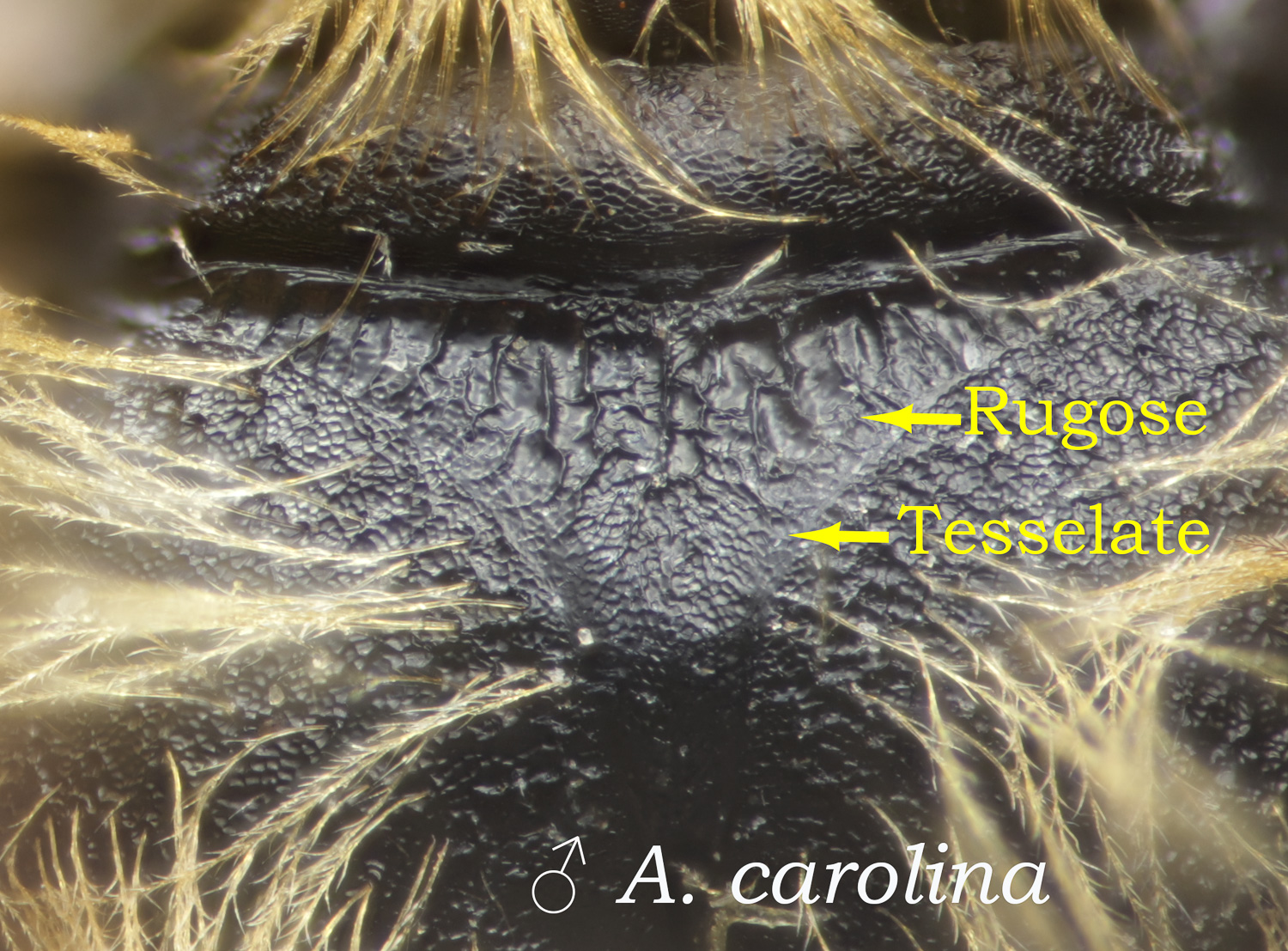
Above, from DL: UNCOMMON: With longitudinal rugulae in basal half, tessellate or smooth at apex
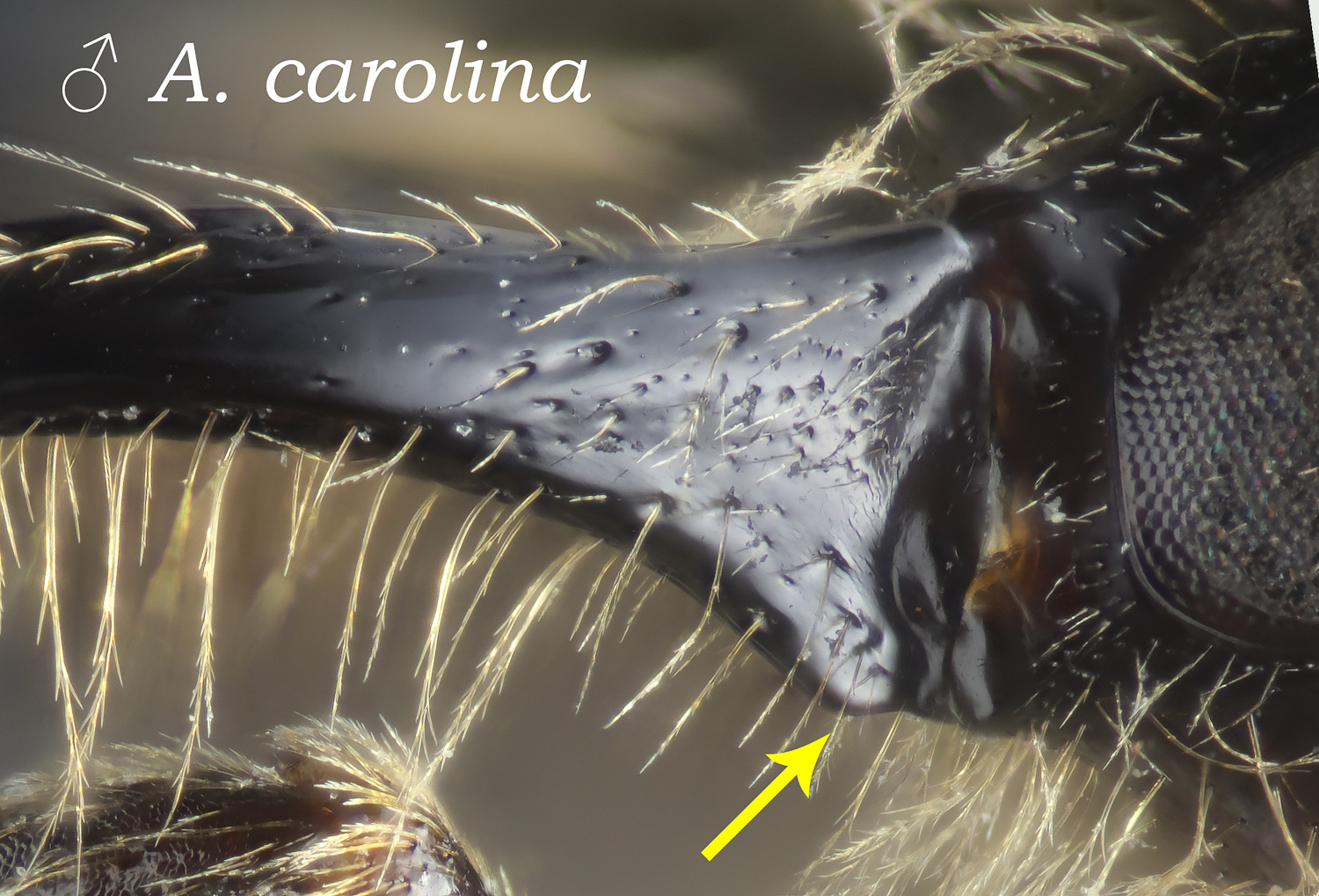
Below, from DL: DL: weak tooth not projecting below level of mandible articulation. |
Easy calls:
|
|
|
|
Easy calls:
|
|
A. amphiloba does not match. We would expect dark hairs on the tibia, a normal tibial spur, and a fovea like Trachandrena.
|
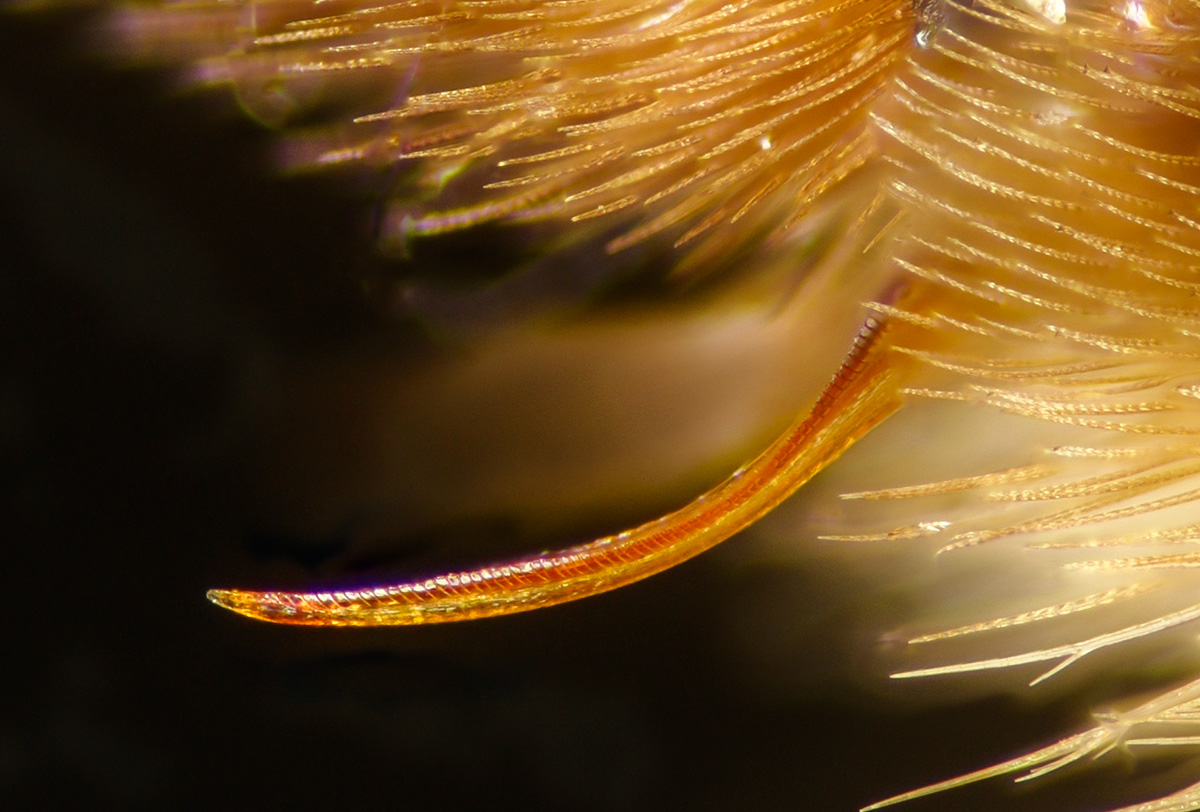
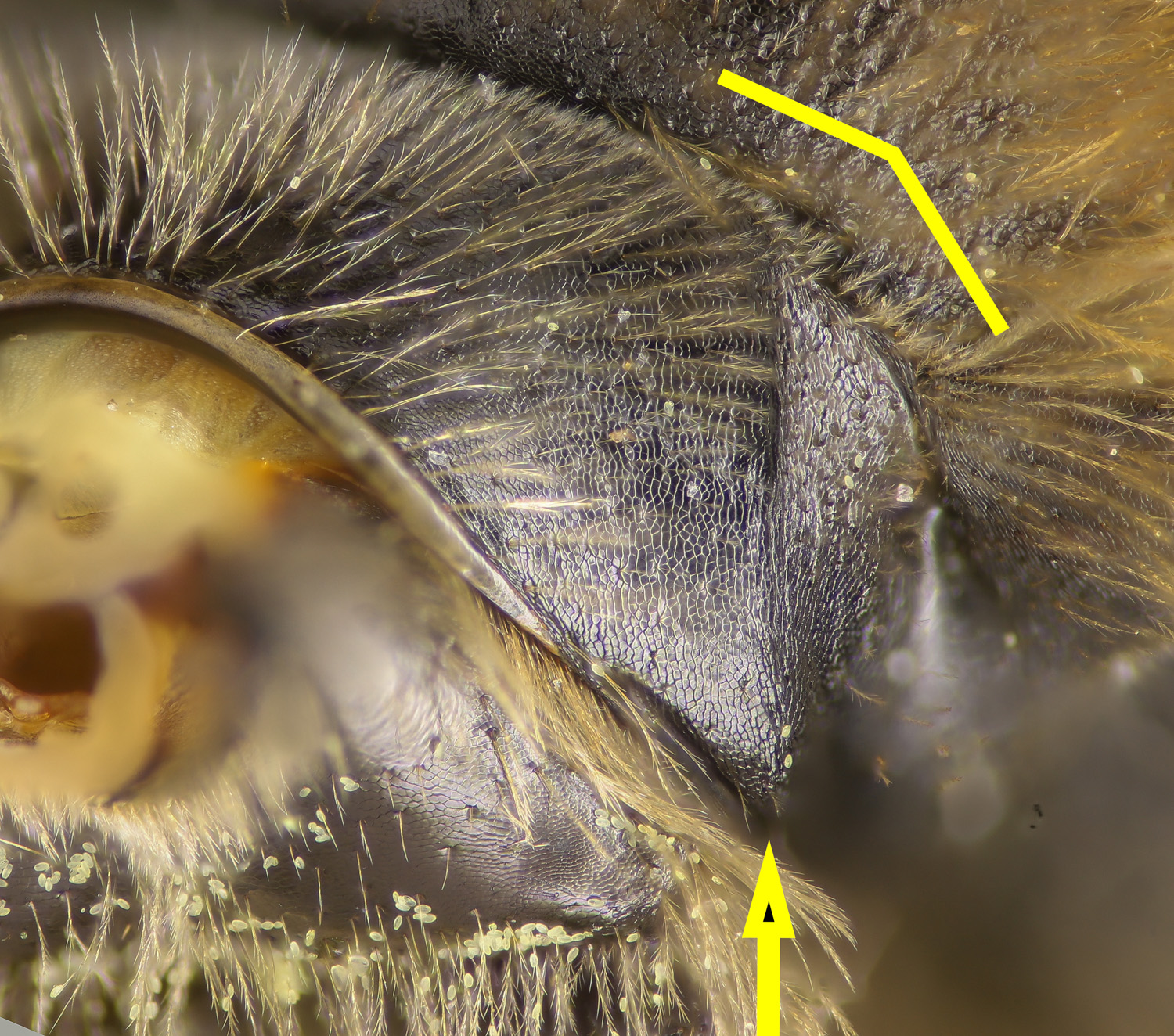
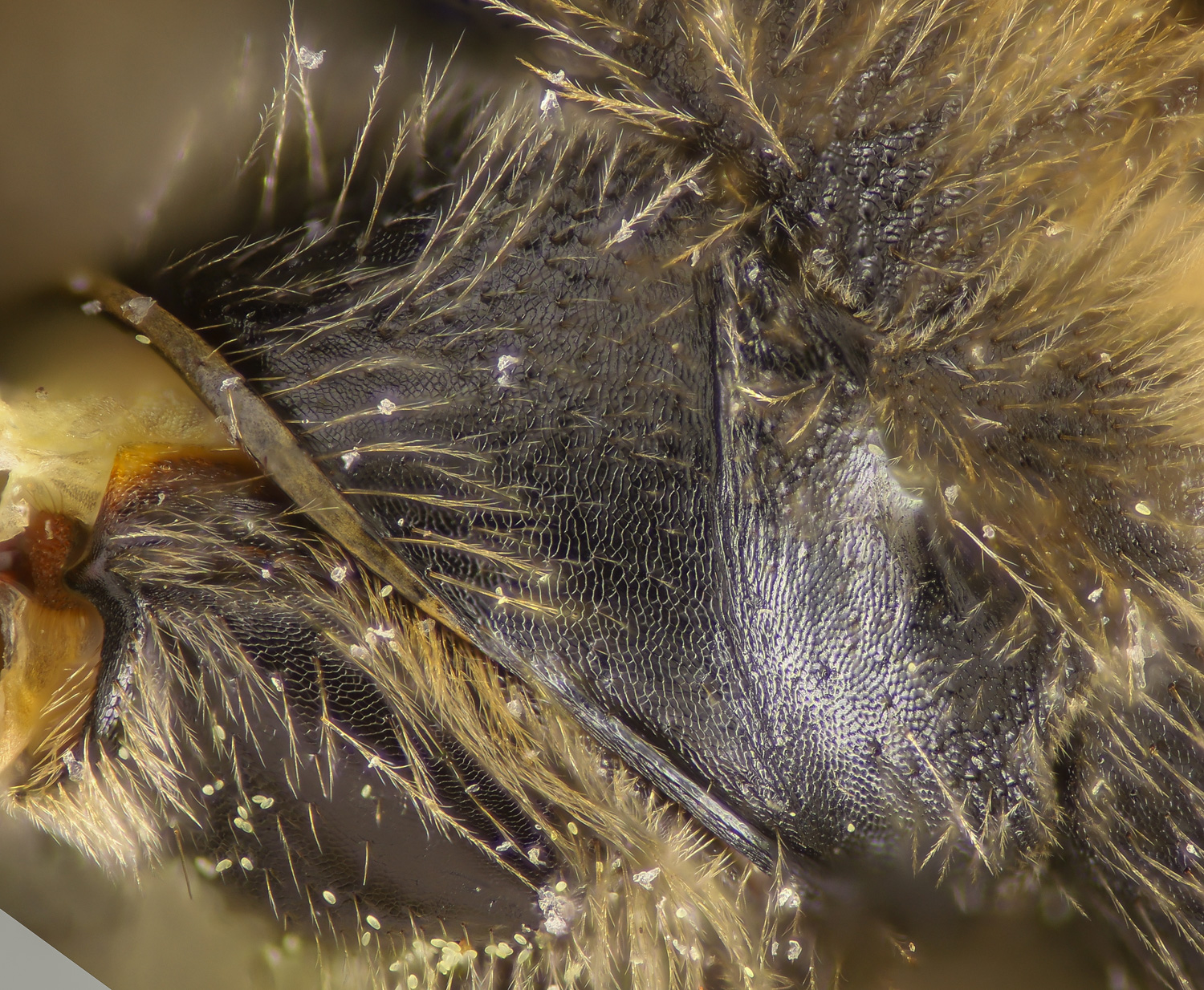
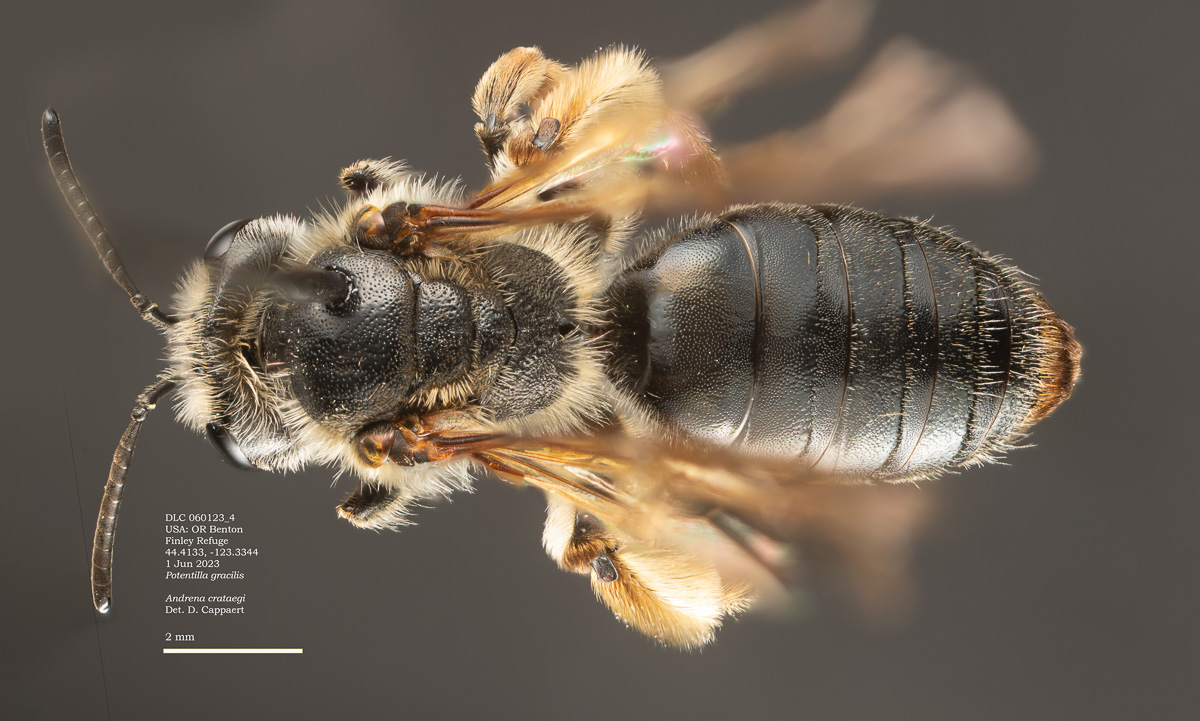
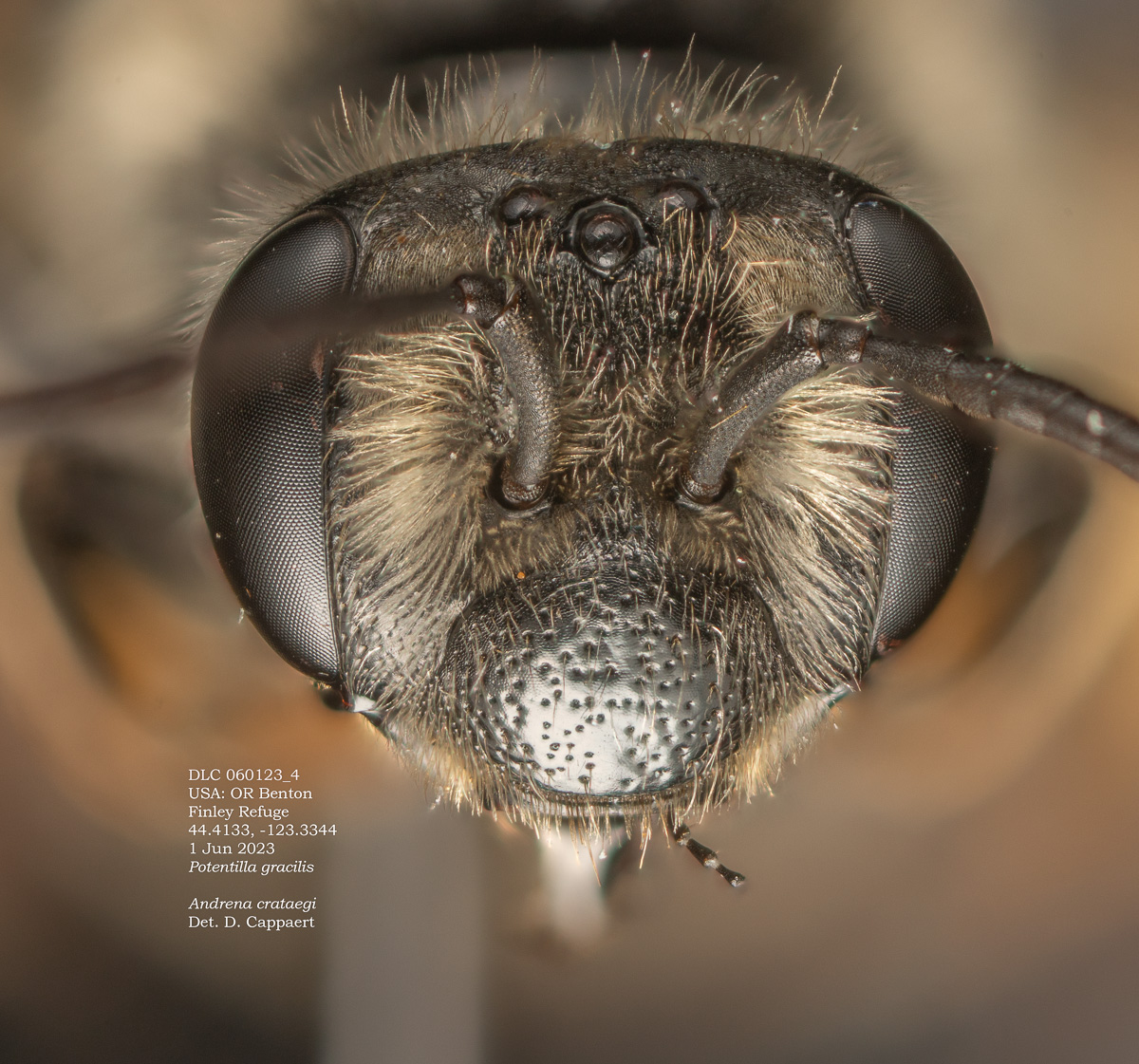
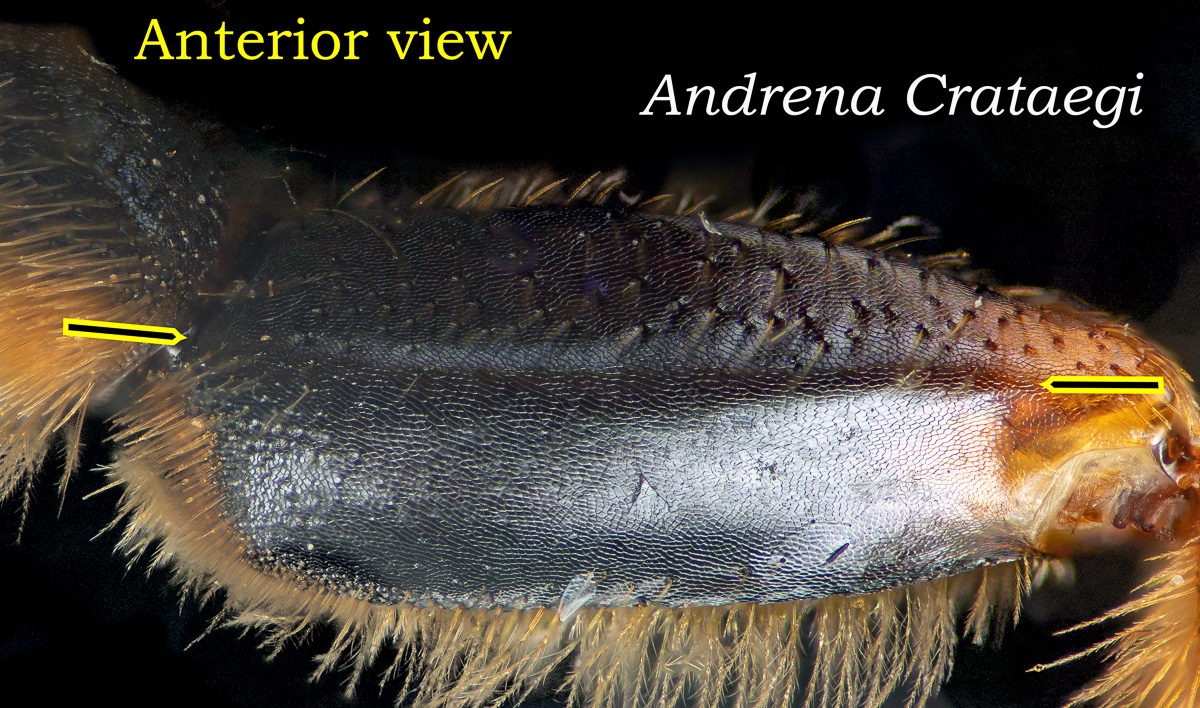
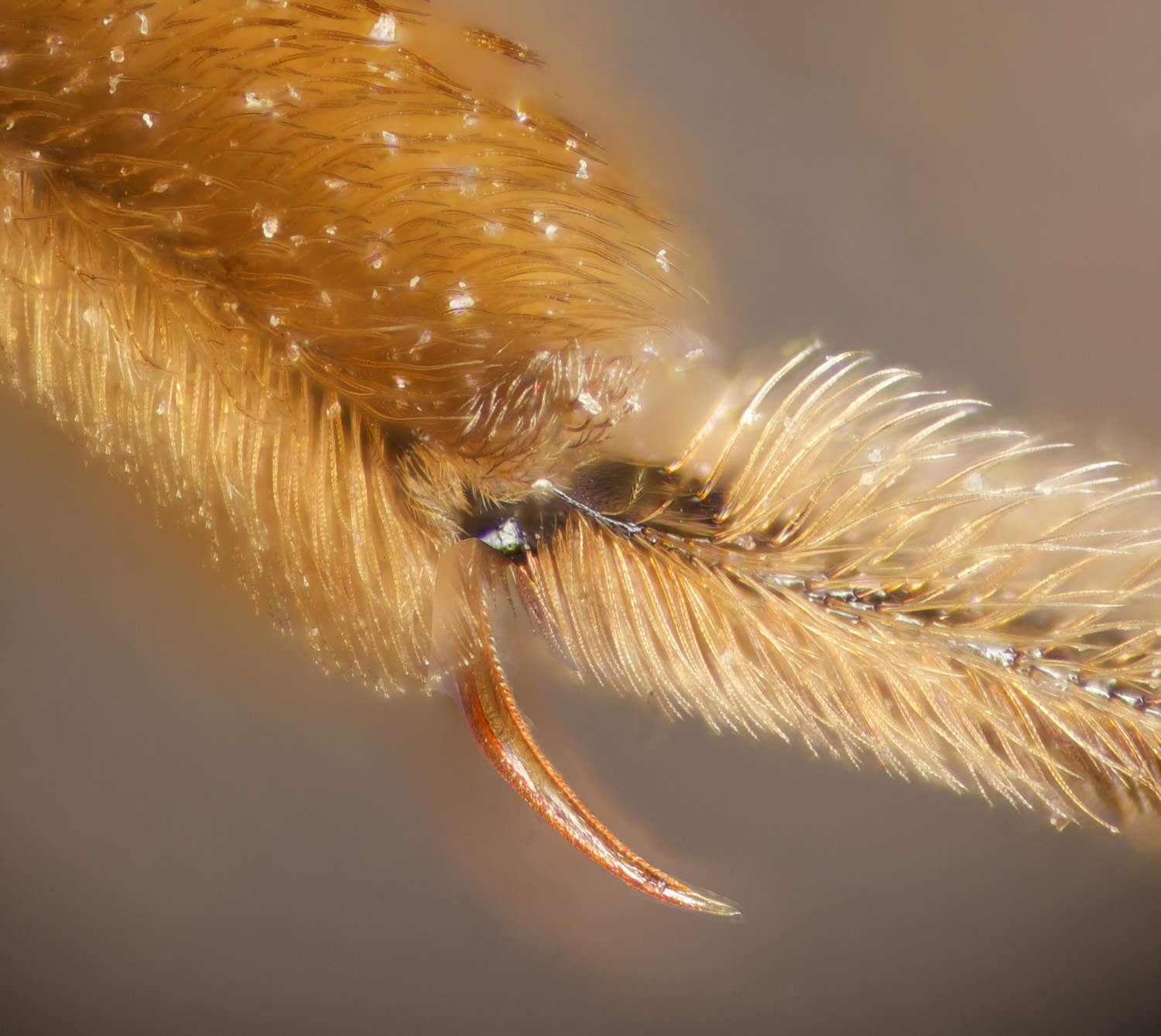
Above: "Noted for coarse propodeum and curved and thickened inner hind tibial spur."
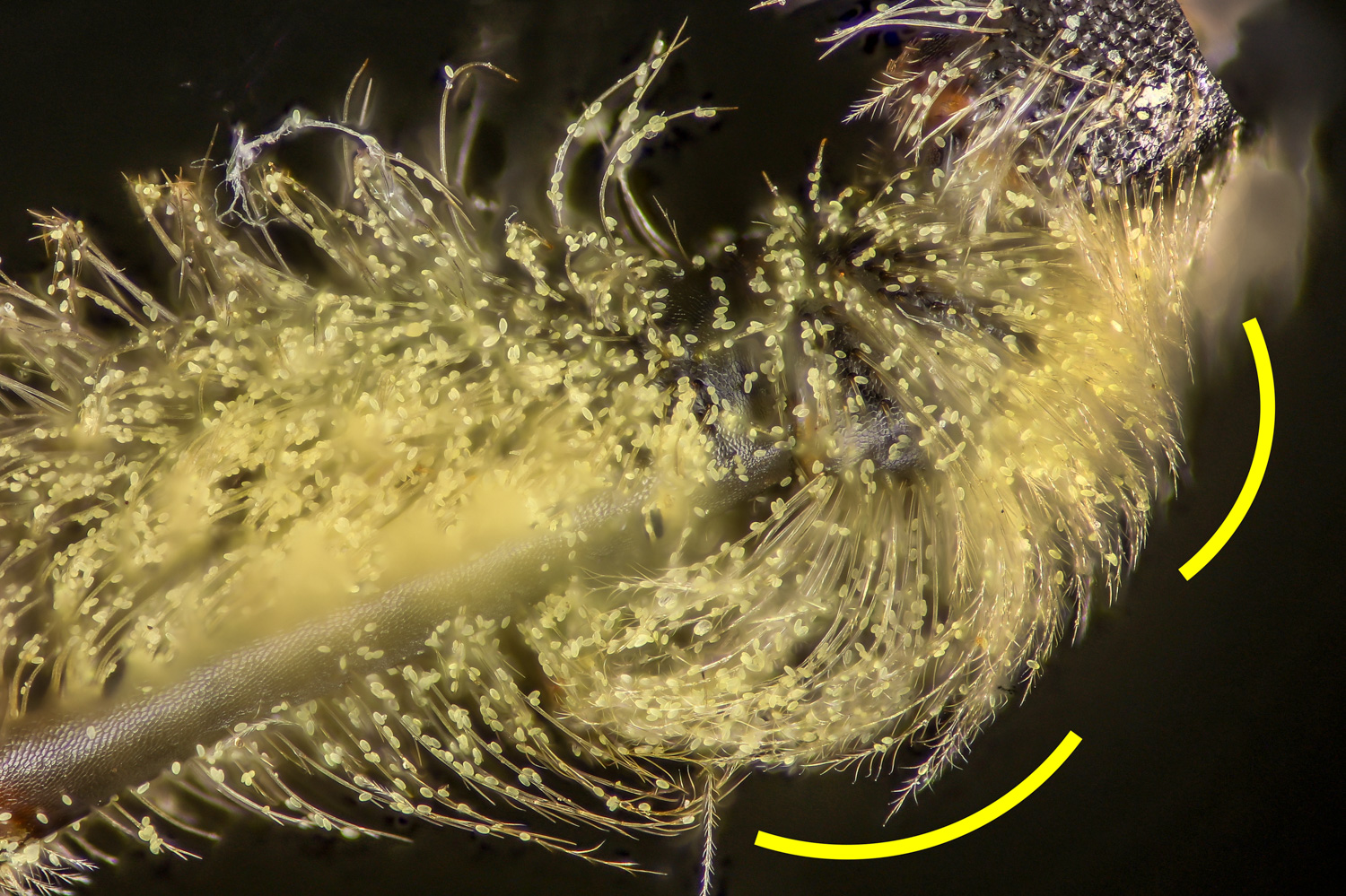
Below: Distinctive carinate ridge of hind femur--a crataegi thing. |
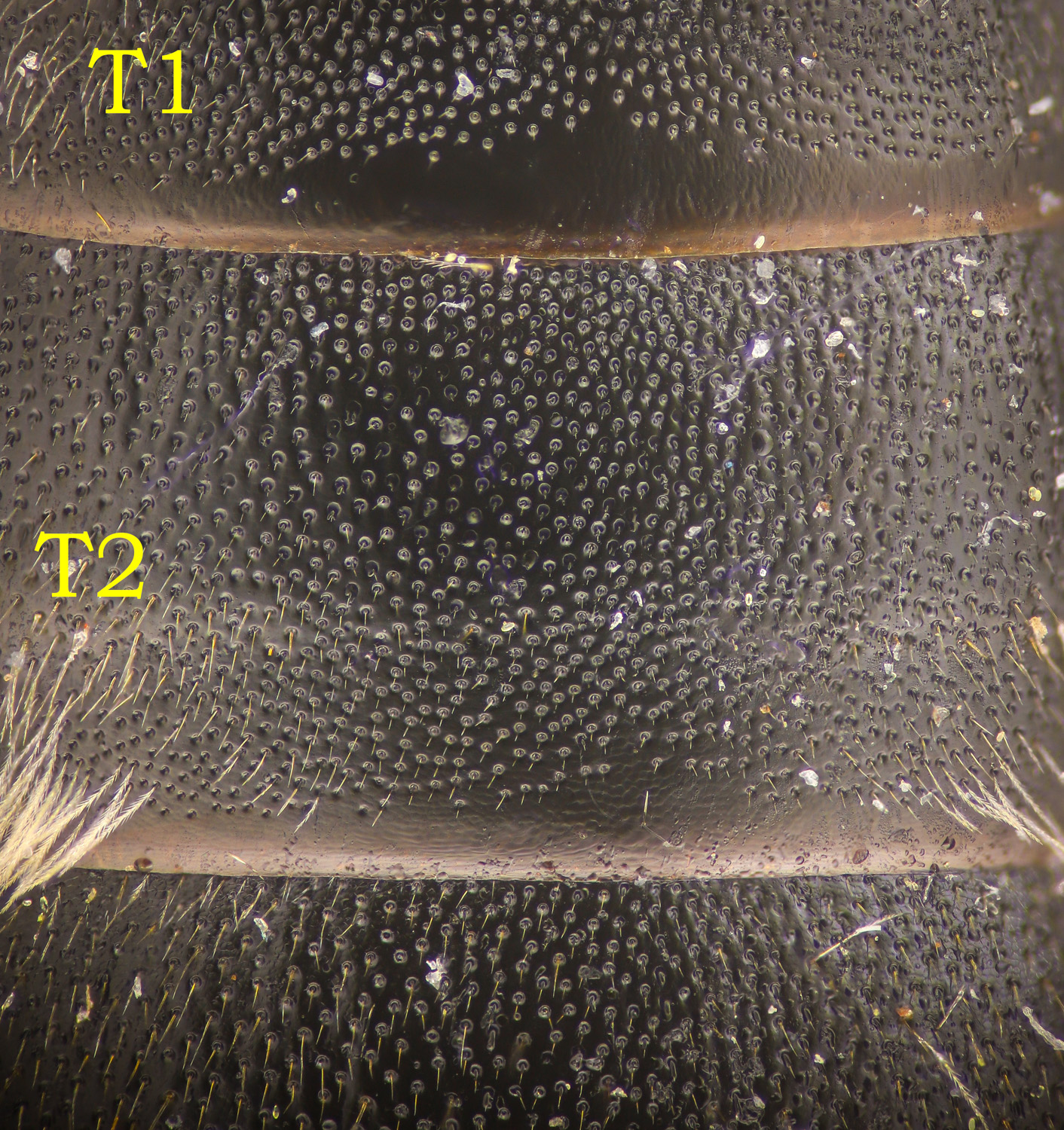
| Shortcut: At a glance, this Michigan specimen is a look-alike to the preceding Oregon A. crataegi. Not shown here ..,. but it exhibits the same deep sculpturing of the delineated propodeal triangle-- a possible Trachandrena. One feature separates this one from any similars in Michigan: strongly curved hind tibial spur. If I am right about both the OR and MI specimens, I can infer common features as typical of the species. E.g., remarkably orange tibial hairs. |
|
|
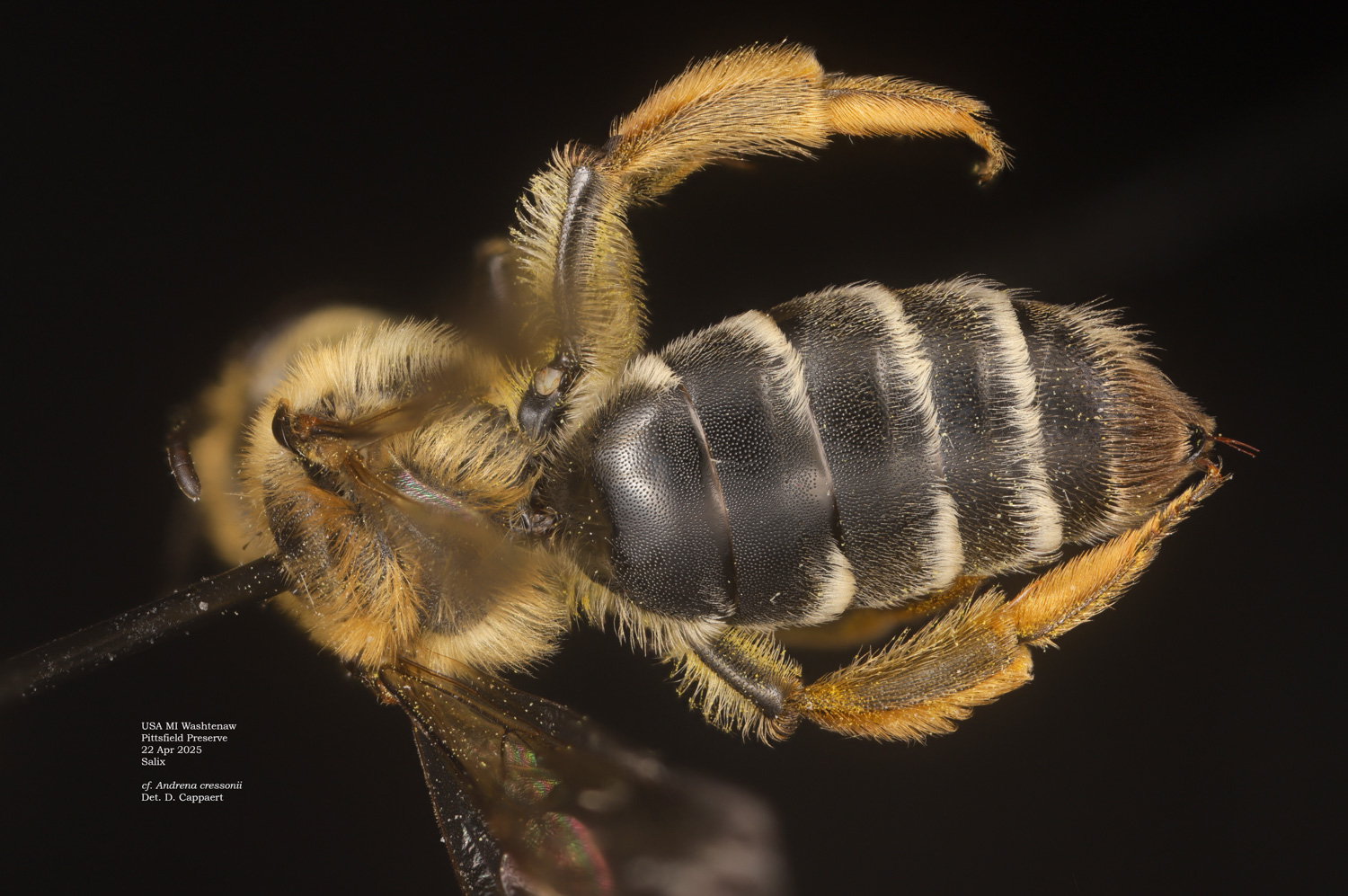
See wilkella diagnosis. Many of the same traits apply. But evaluate wilkella vs cressonii:
Another way that I get to A. cressonii: working through the subgenus key (In LaBerge, and Joel Gardener's key for MN mining bees), this specimen is a Holandrena. A. cressonii is the only member of the subgenus present in MI. |
Shining tergae, incomplete corbicula, simple tibial scopa.
|
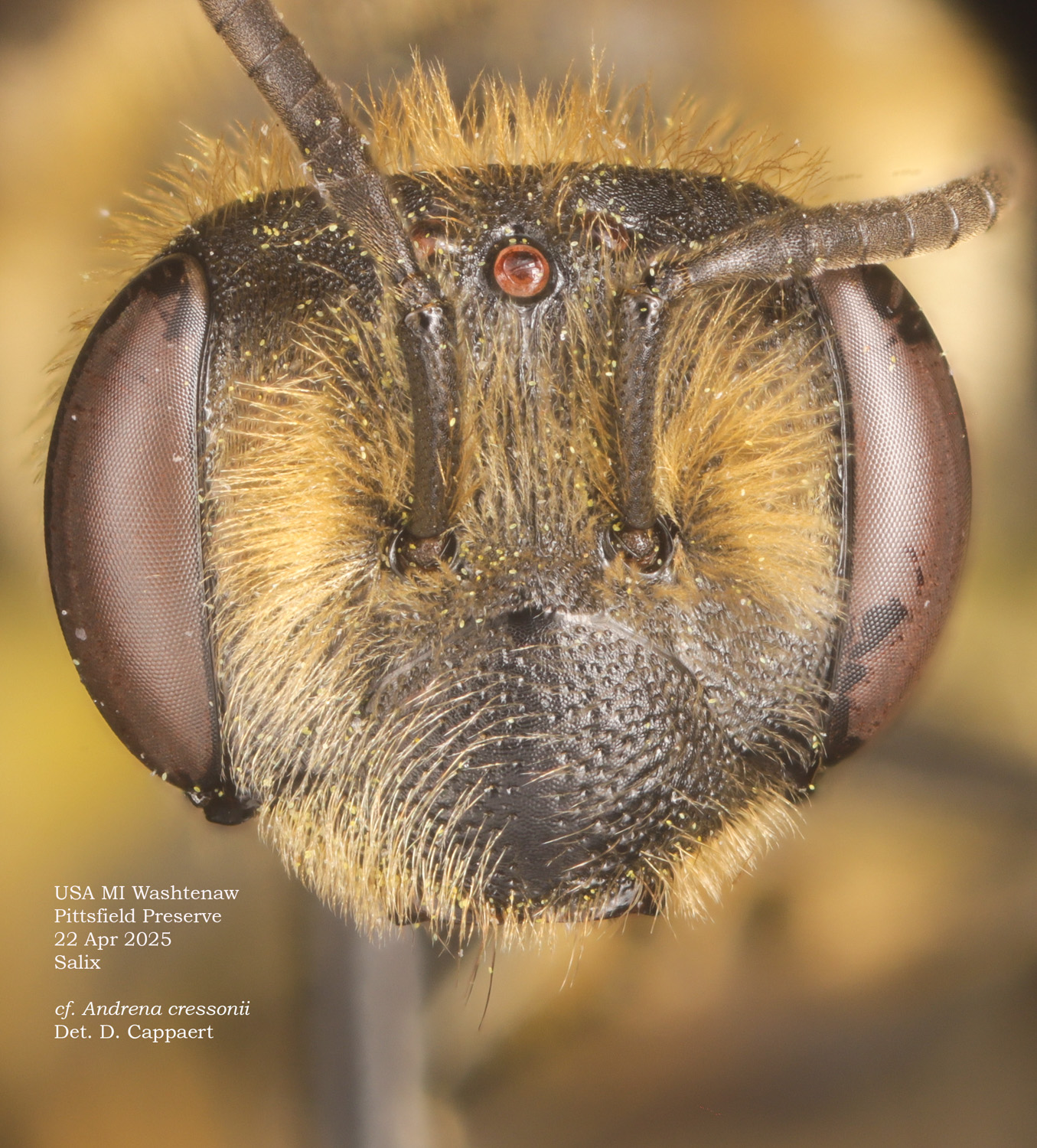
Clypeus dull, with unpitted median. Clypeus normally rounded.
![]() |
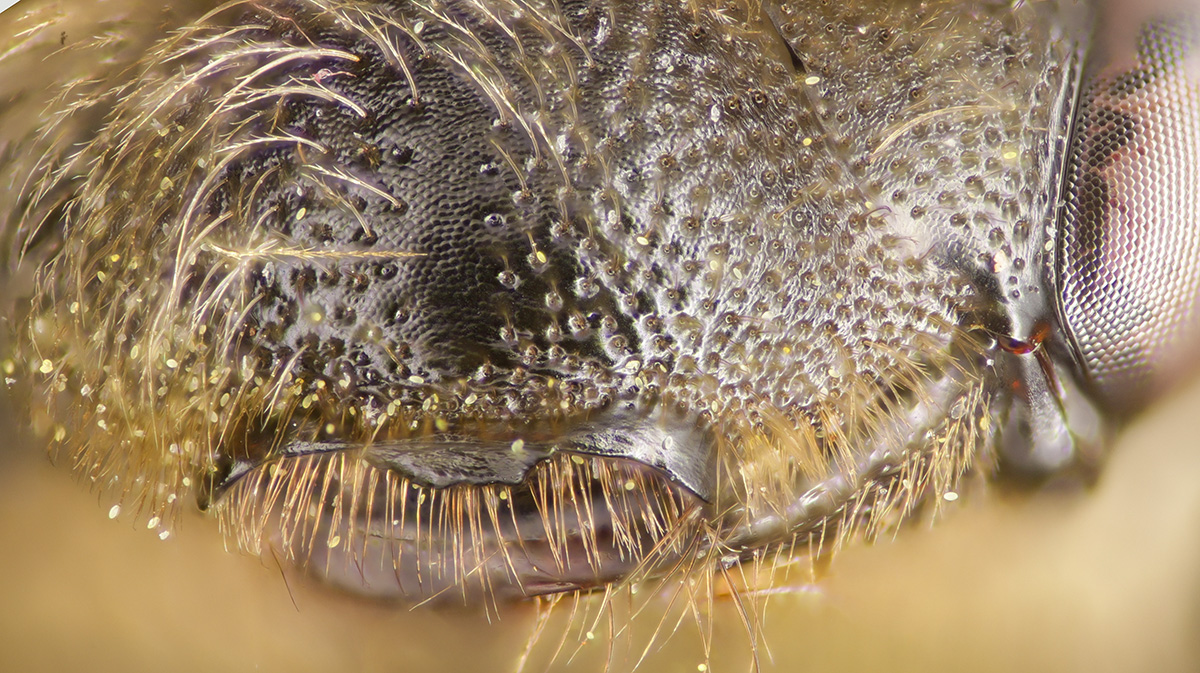
A. cressonii-like labral process. Rounder clypeal punctures, unlike for wilkella. |
Follow-up ... I re-examined to evaluate a couple of traits that required dismantling the specimen. These support the diagnosis of A. cressonii.
A. cressonii should have a "trochanteral flocculus incomplete, basal half with short hairs." The mess of hairs and pollen makes this a little hard to evaluate, but I think I see this in the photo.
|
Distinct humeral angle and pronotal ridge, in anterior view.
|
Distinct humeral angle and pronotal ridge, in lateral view.
|
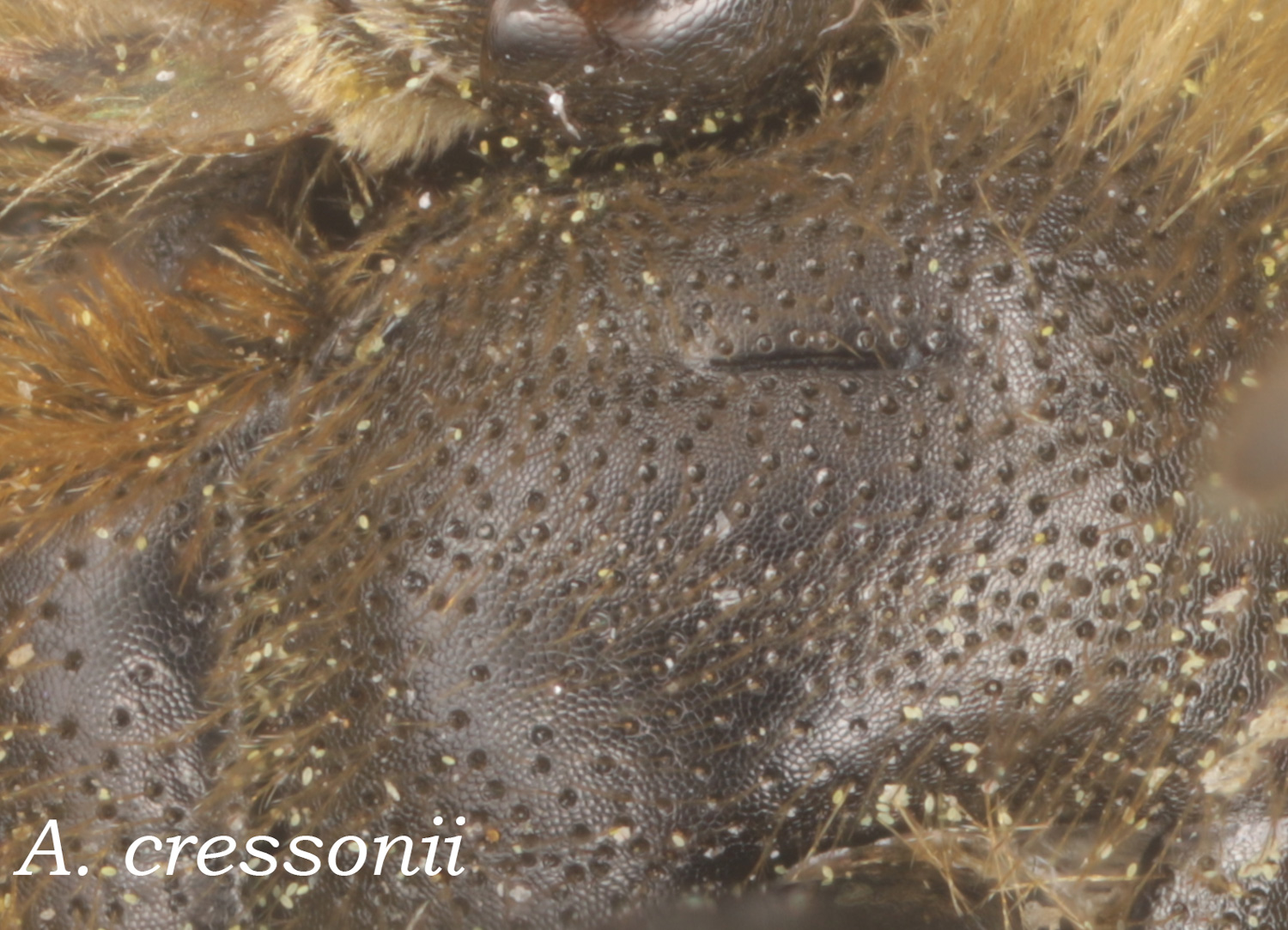
Shiny surface, dense pitting of T2.
|
Easy calls, based on images at right:
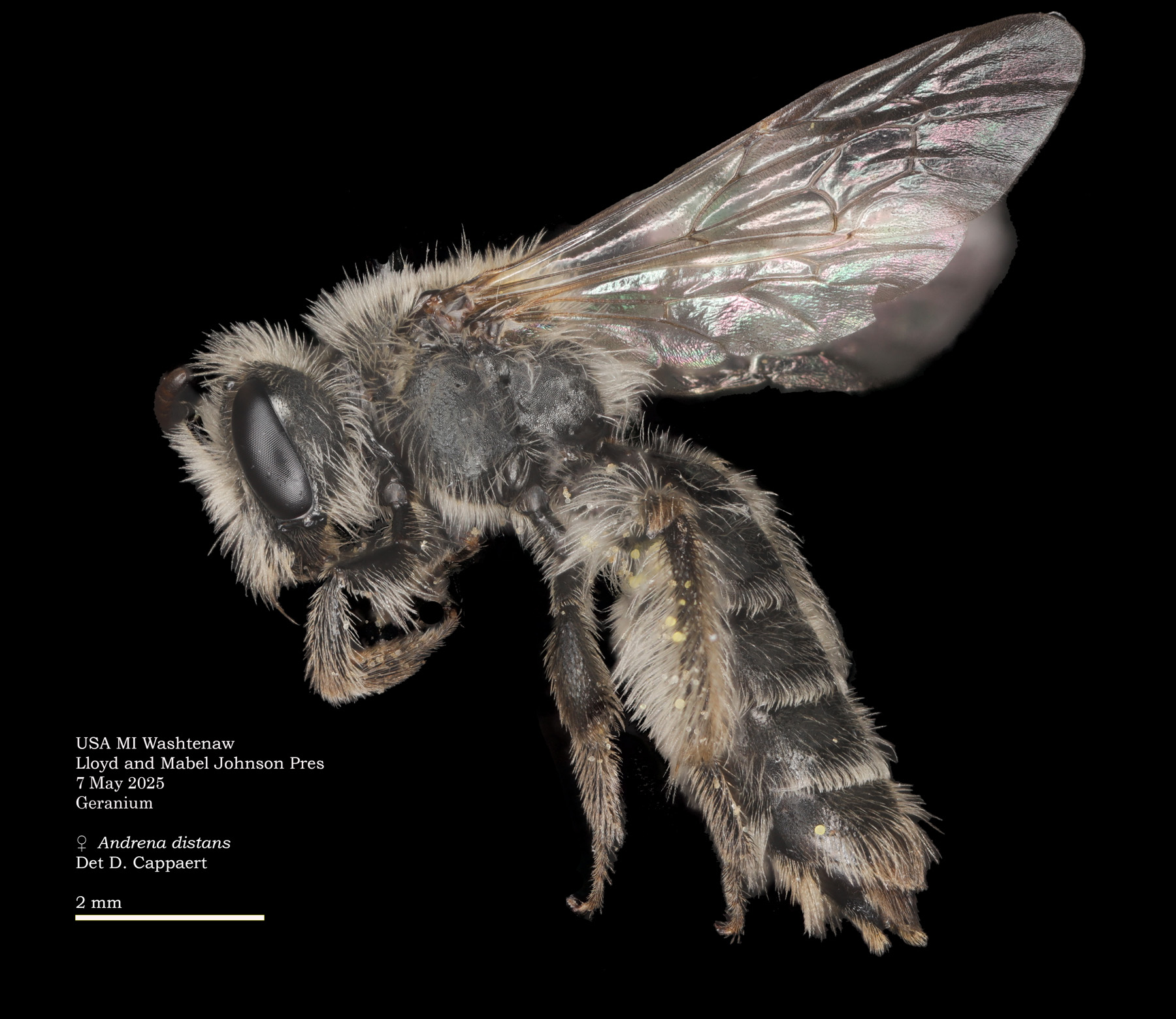
There are several characters that will exclude A. persimulata. My specimen, A. distans, has no propodeal sculpturing, and "variable" trochanter hairs. Also: persimulata "Easily identified by the presence of a large projecting knob or large swelling at the bottom of the lateral face of the mesepisturnum." |
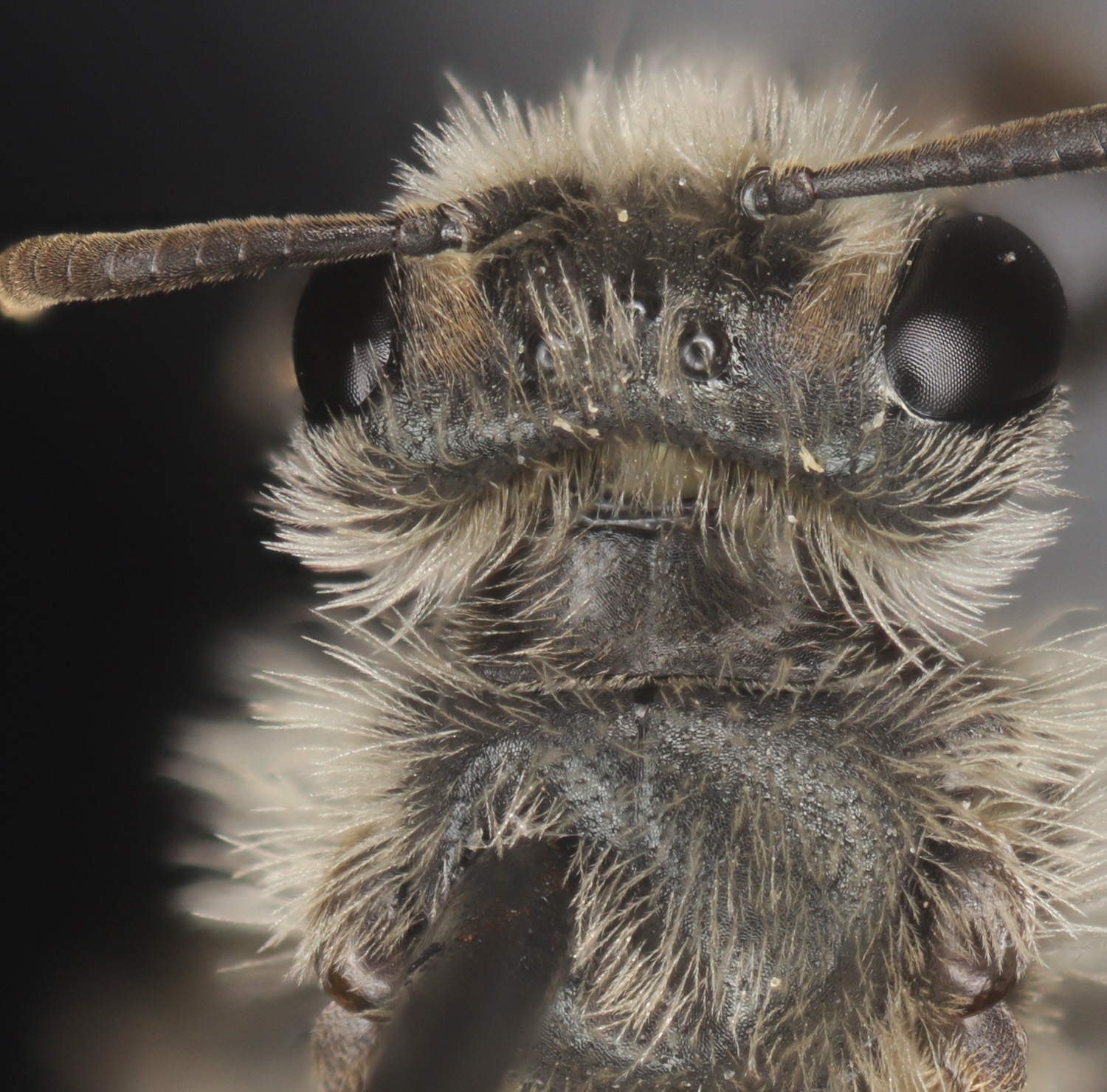
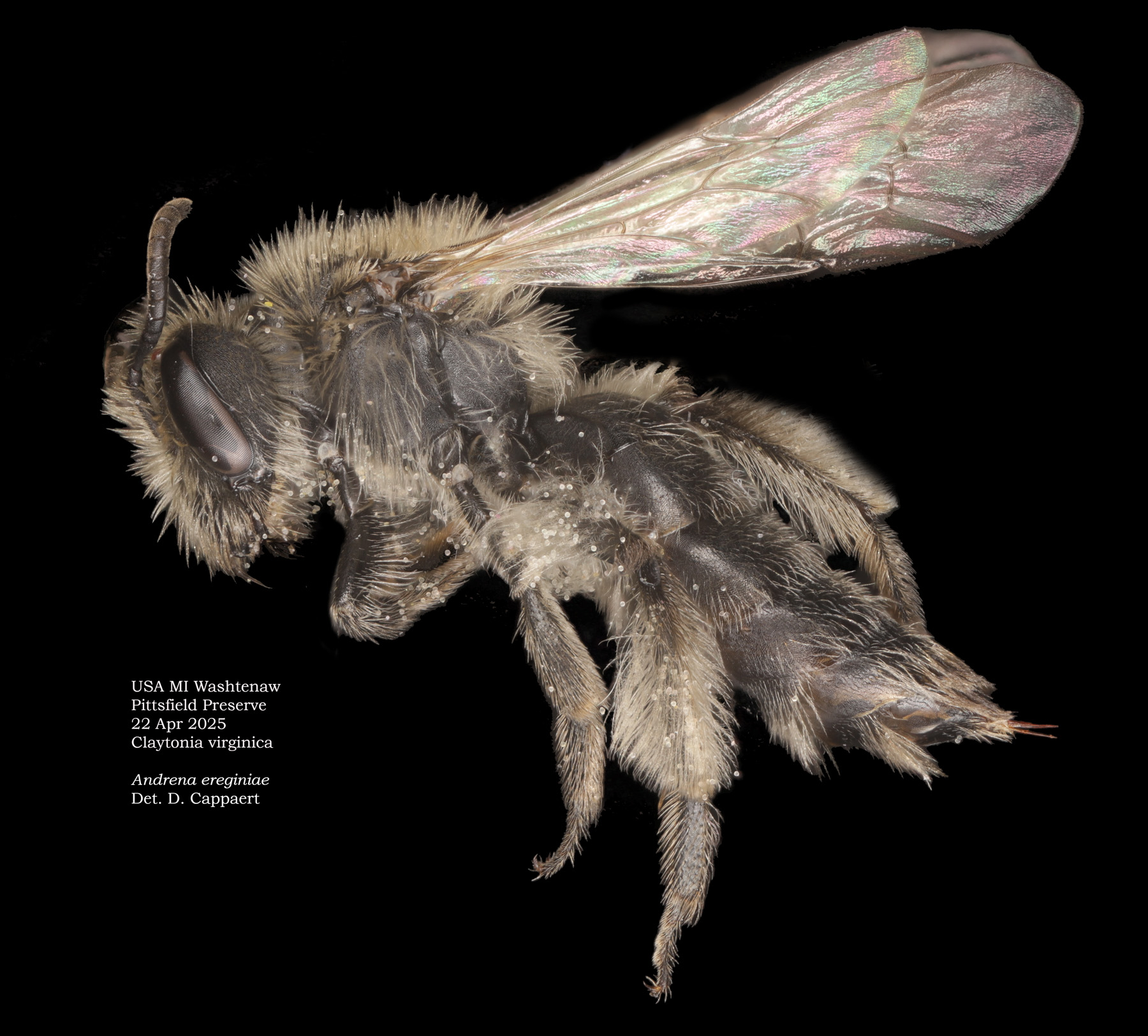
Notable: Resemblance to A. erigeniae. Small, incomplete corbicula, plumose scopa.
The extra evidence: specimen collected from Geranium, on which A. distans is a specialist. |
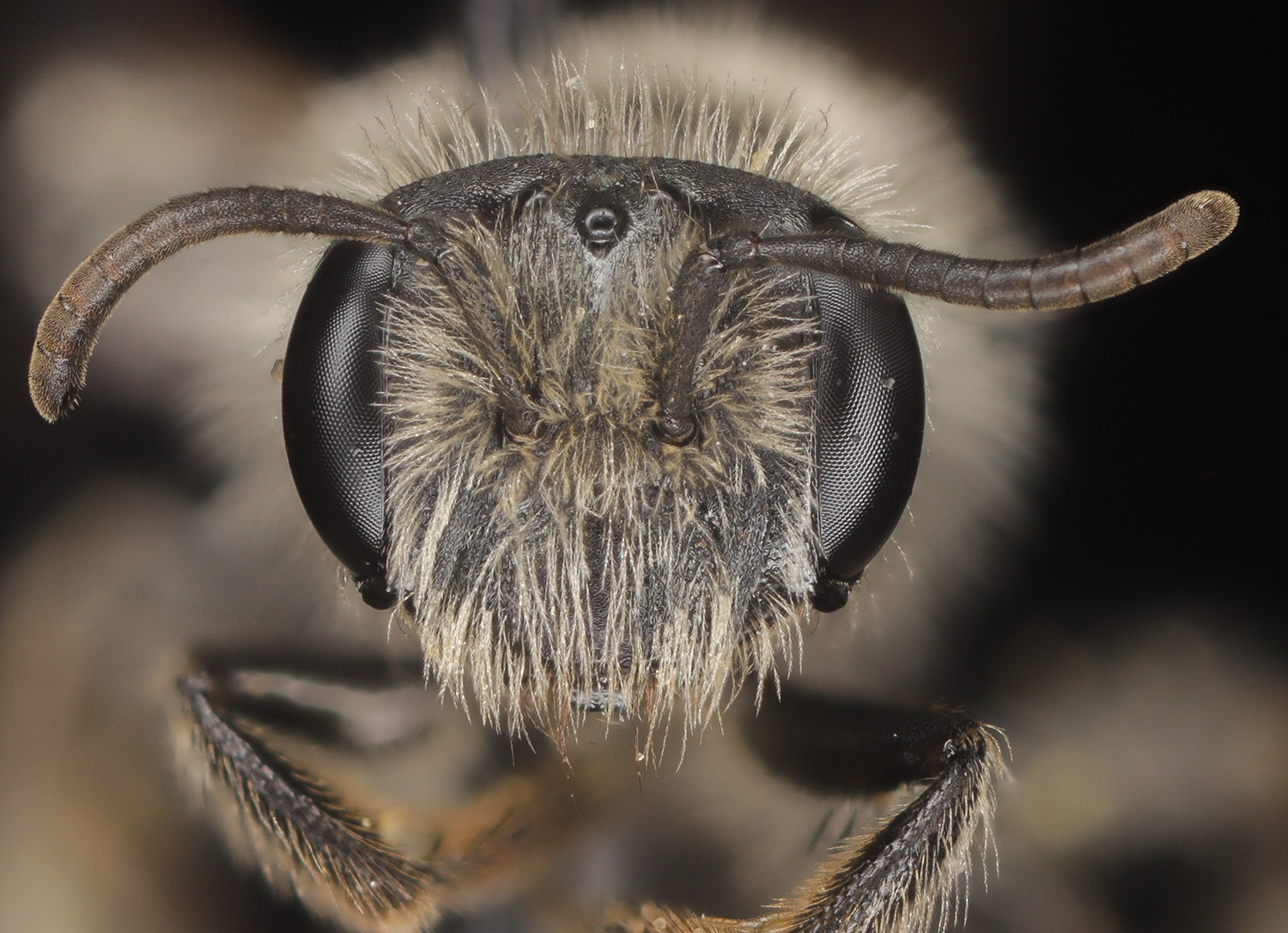
Clypeus dull, hairy, plumose. F1 long.
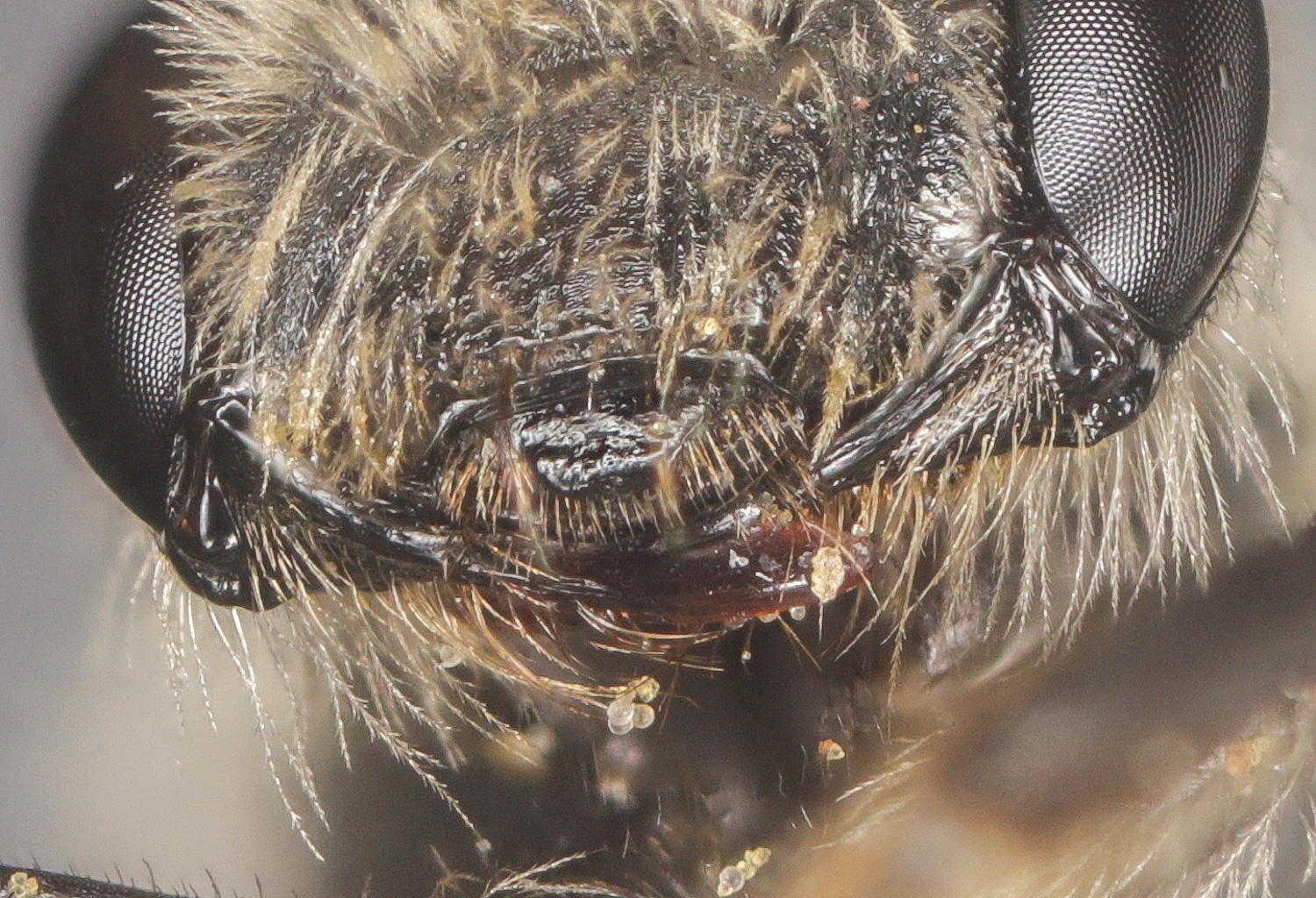
Labral process entire, long. Malar space short. ![]() |
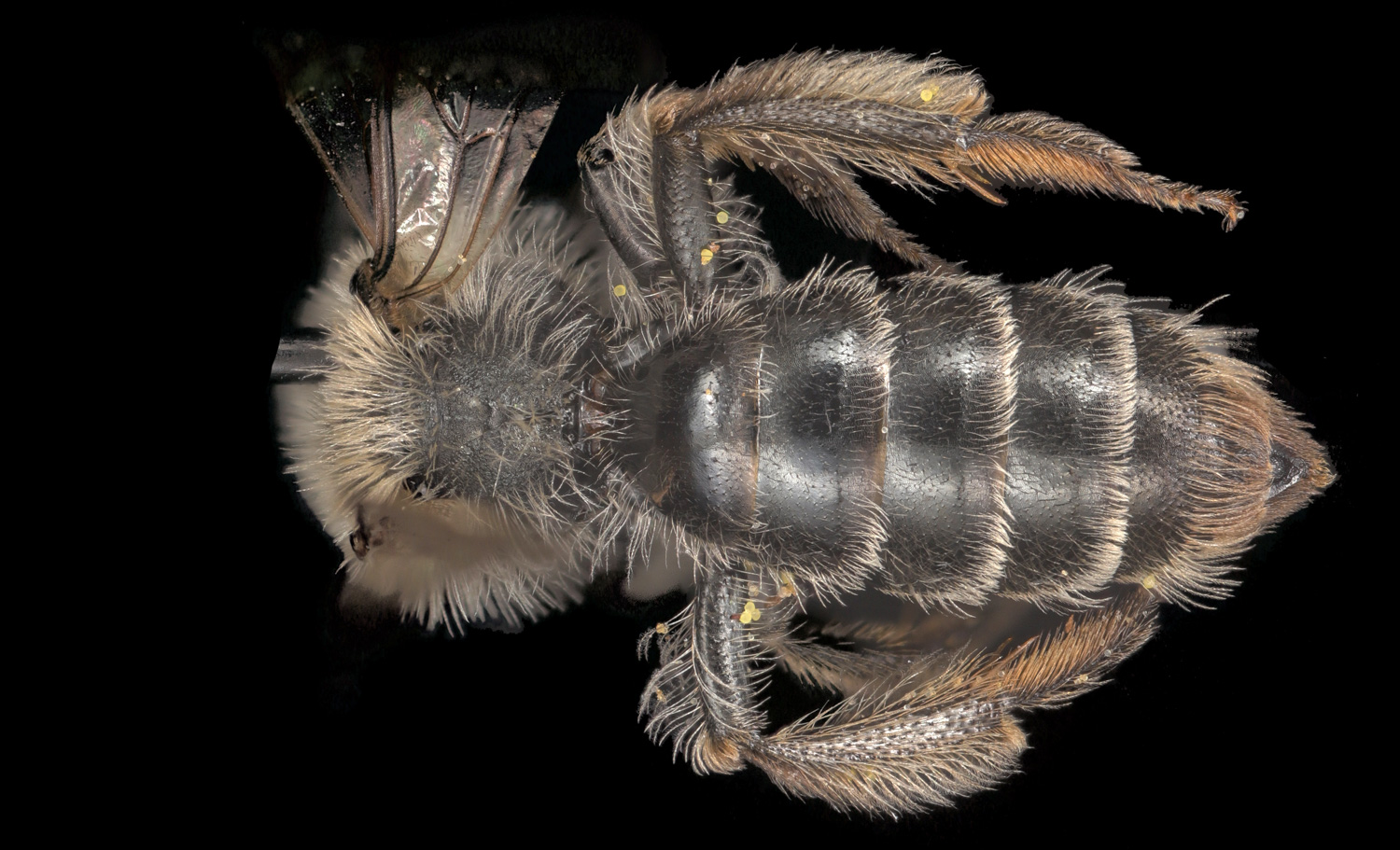
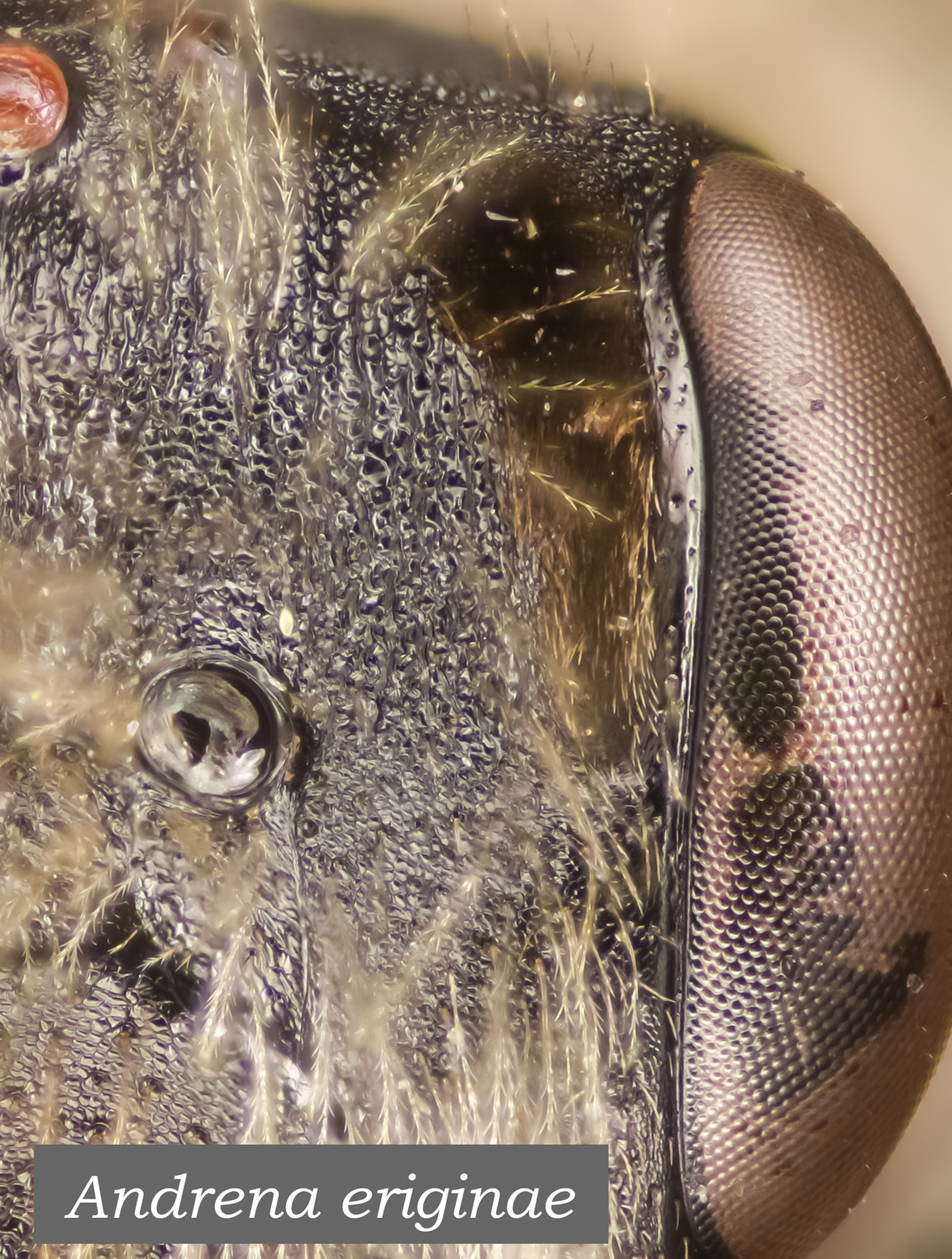
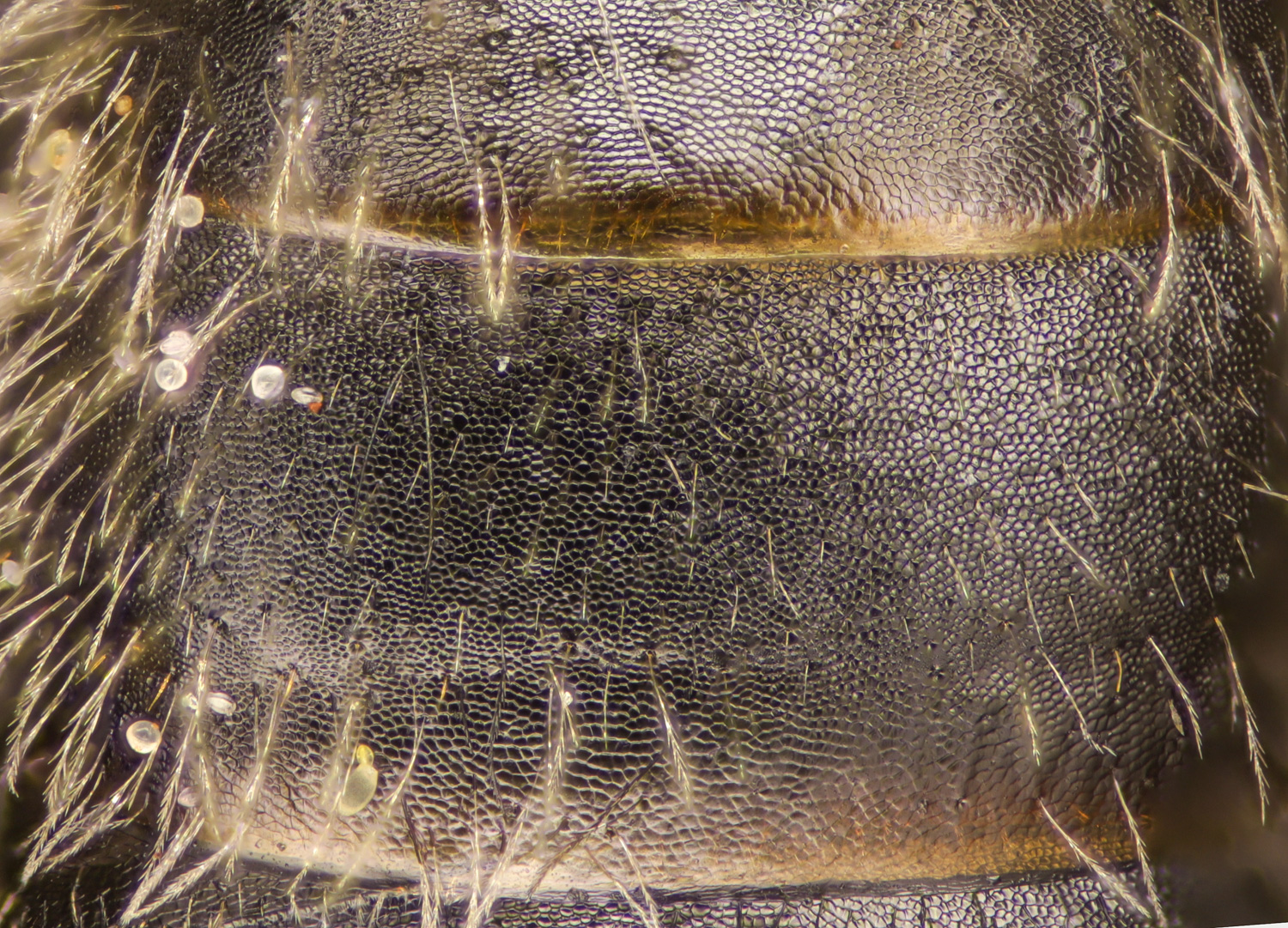
Above: DL scores T2 as granular, or shiny, and pits absent or present. Reasonable because this one is hard to call. The propdeal triangle - appears to me to have no, or weak and uniform sculpturing. Frizzy plumose hairs on narrow tibia.
Below: Vertex about 1 ocd. Scutum pits moderate. There is a humeral angle. |
Easy calls, based on images at right:
|
Notable: Slender, sparse hairs.
The key character is the unusual frizzy-plumose tibial scopa. Another determinative datum: the was specimen collected on spring beauty (Claytonia virginica) for which A. erigeniae is a specialist pollinator. Additional note: spring beauty has many other pollinators in the sites I follow. |
Clypeus dull. Fovea narrow. NOTE: the fovea appear dark. This is partly a trick of the lighting. But also, LaBerge says: "facial foveae with tomentum often pale brown or yellow in upper half or more." The DL guide scores for pale, and "dark above, pale below."" I might add "all dark" to the scoring. |
Above: DL scores T2 as granular, or shiny, and pits absent or present. Reasonable because this one is hard to call.
Below: frizzy-plumose hind tibia. On the flying insects, the reflectivity is noticeable. |
Easy calls, based on images at right:
|
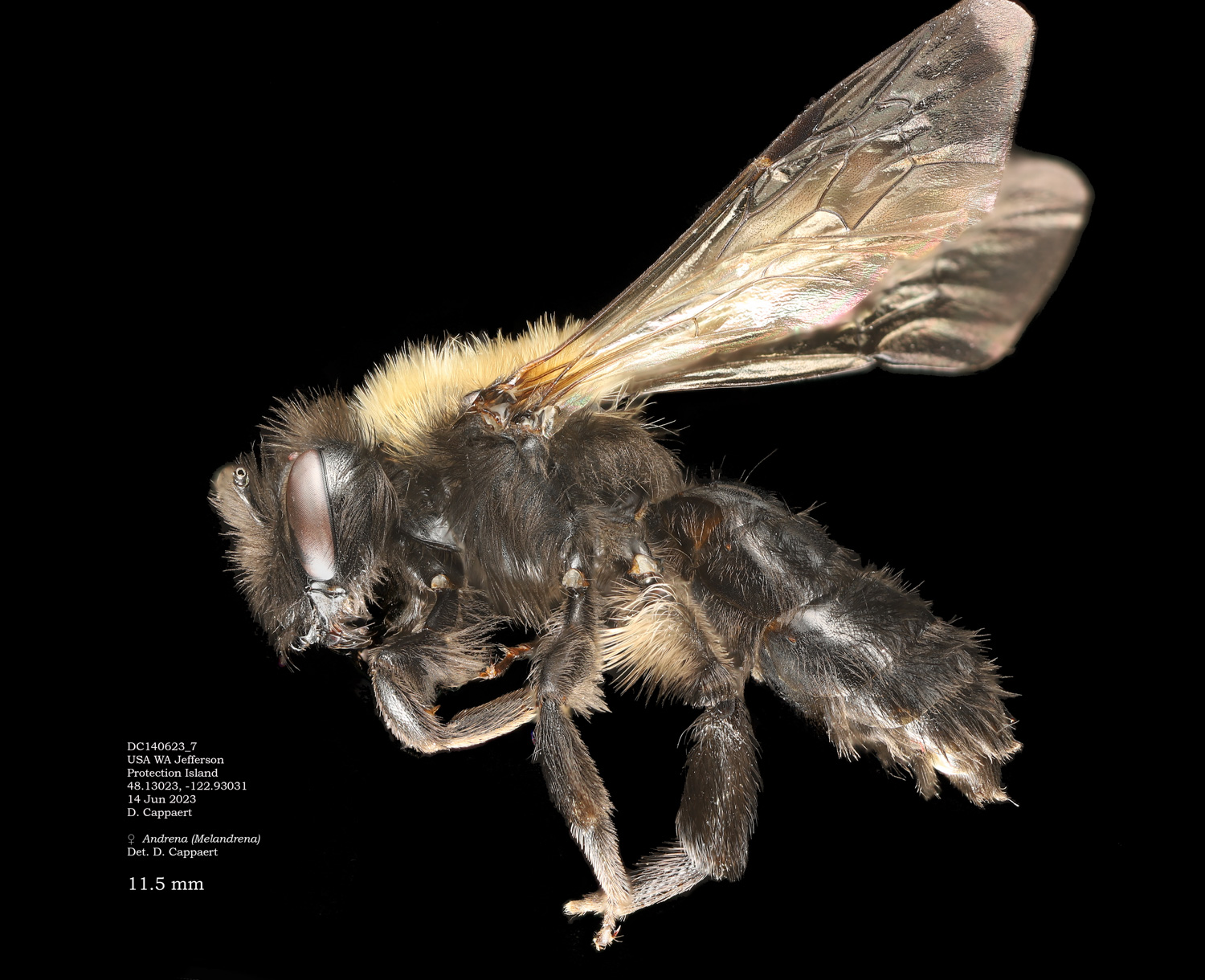
Notable: Abundantly hairy. Integument dark--more black than brown. Complete corbicula. Scopa pale + dark hairs. 11 mm length.
A priori, I believe this is A. erythronii. One, because it was collected in the vicinity of trout lily, a typical associate. Two, because this was suggested on iNat by Max McCarthy. Three, because a single unusual trait--flattened clypeus--is seen in MI only for A. erythronii and A. accepta (easily rejected). In any case, I get A. erythronii and just two alternatives with the basic traits listed at left. Rule out A. barbara: "Pits on basal area of T2 distinct and crowded, separated by FAR less than 1 pit width ..." Rule out A. thaspii: "Labral process BIDENTATE." So far so good: erythronii. However, DL can easily take me down a different path, if I choose trait conditions that I see in these images, that DL does not assign for A. erythronii. One is the faint but definite pitting on T2. However DL (and LaBerge) indicate an impunctate T2. Two, I see a nearly complete hair band on T2; DL scores erythronii as having broadly interrupted, or no T2 band, LaBerge says: "terga 2-4 with weak apical pale fasciae interrupted medially on terga 2 and 3." If I have A. erythronii here, DL would probably fail to get a diagnosis. If this is NOT erythronii, DL can't say what it actually is. |
Clypeus shiny, with wide impunctate band. Key: the central disk is flattened (confirmed with side view). True for only two MI species (if I choose "only" in the HAS menu option)
Long weakly emarginate labral process, with transverse striations.
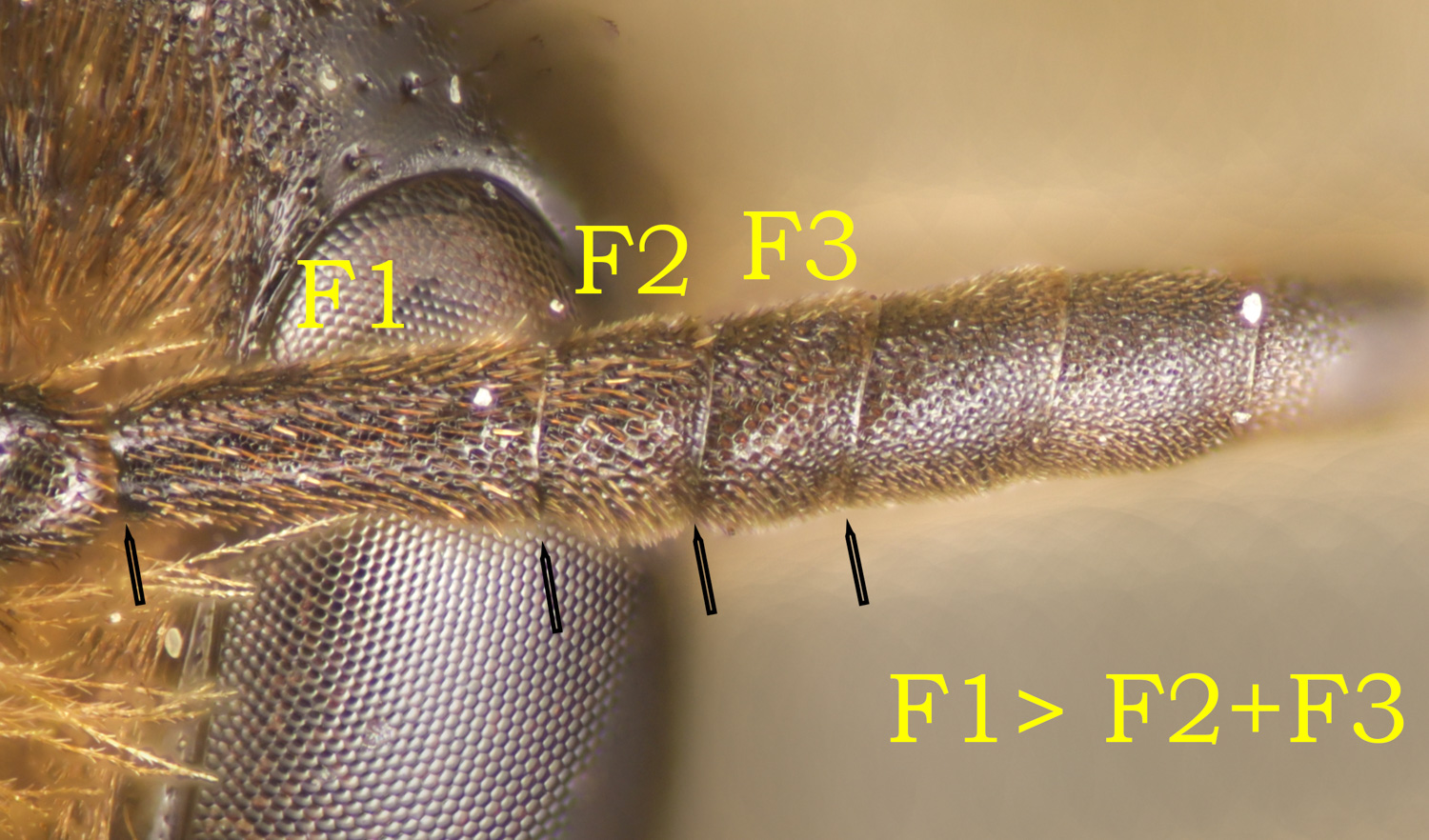
F1>F2+F2. |
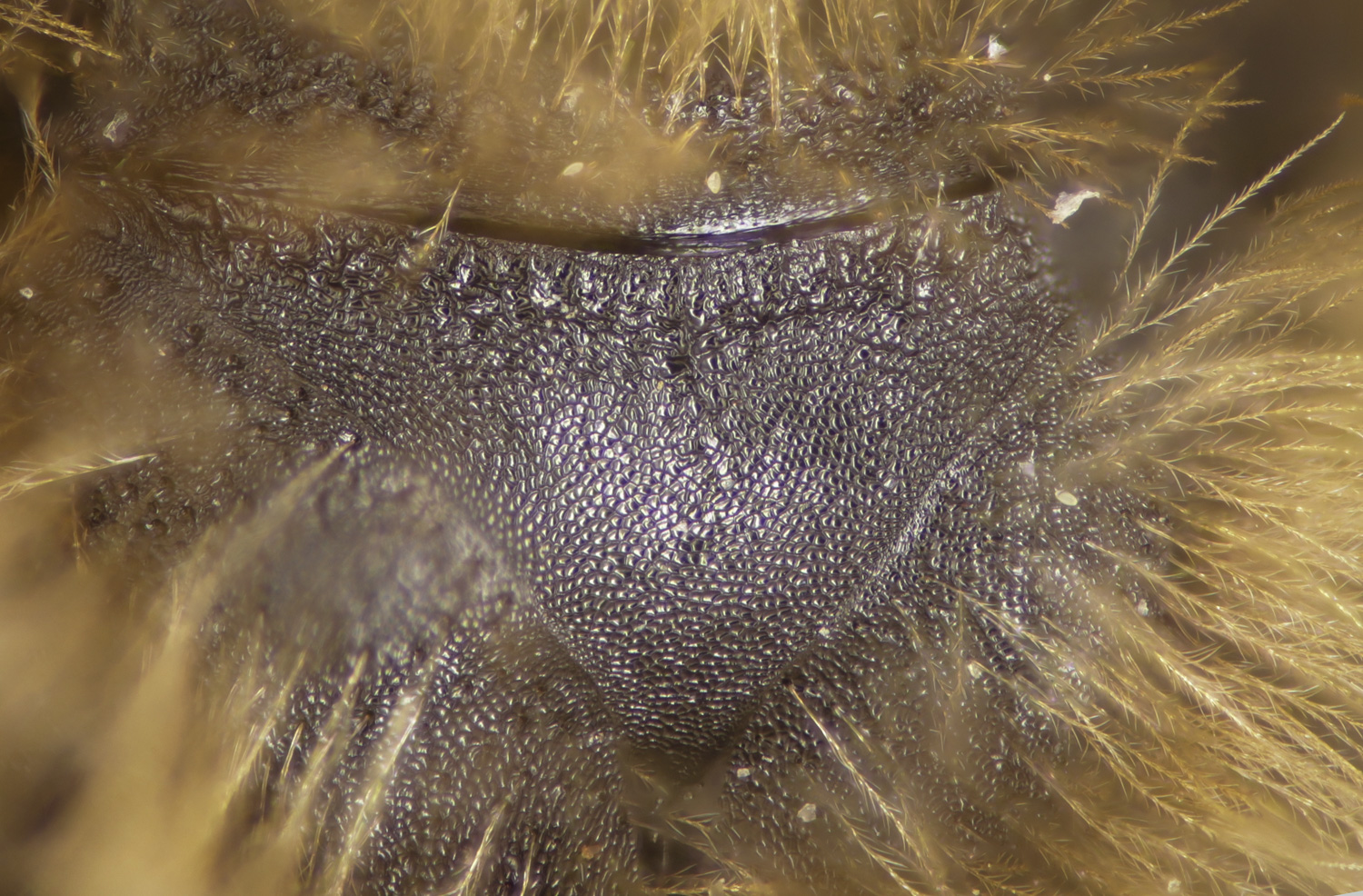
Propodeal triangle, weakly sculptured.
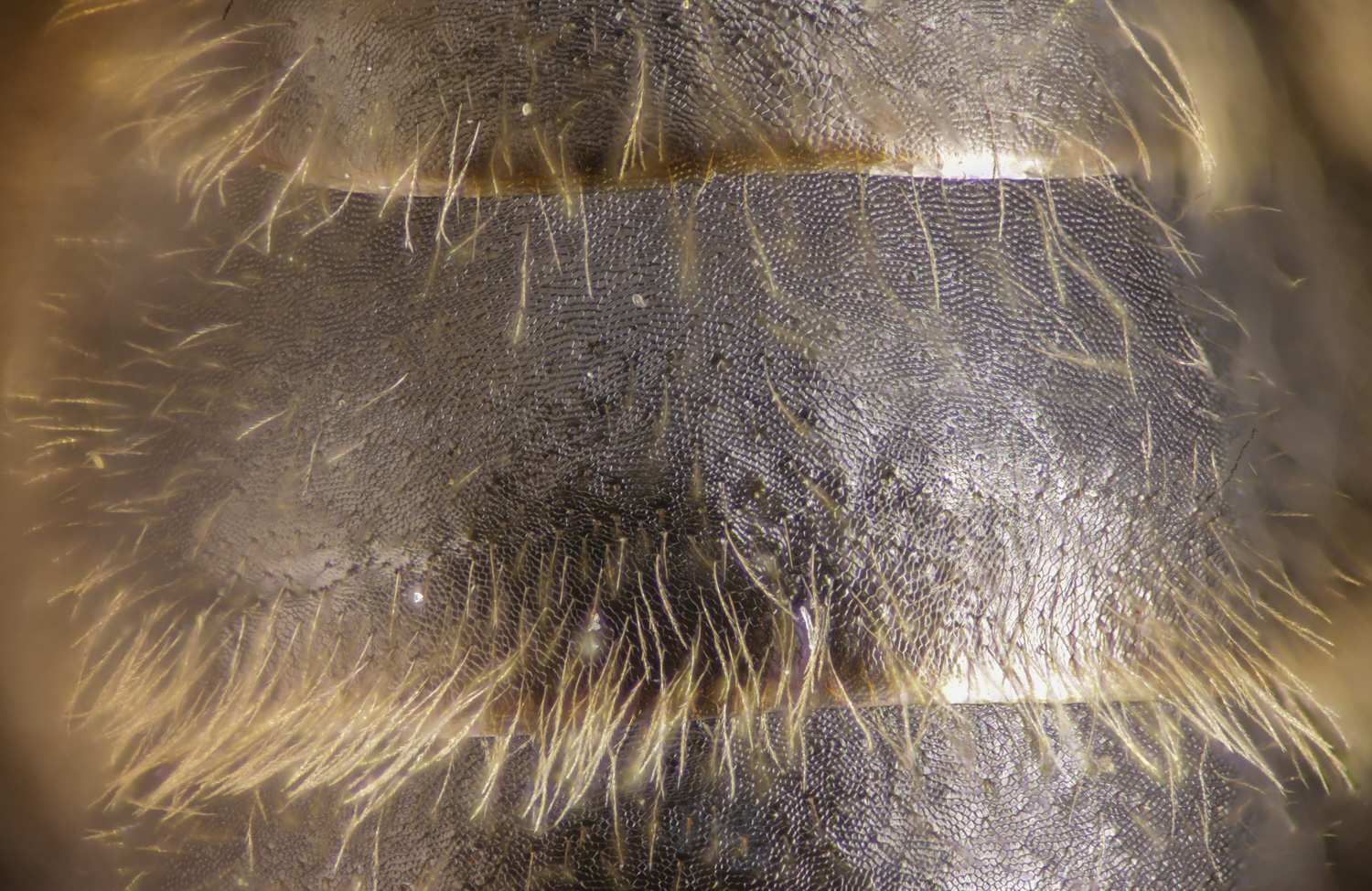
T2 surface dull. Punctate? Hair band? See discussion.
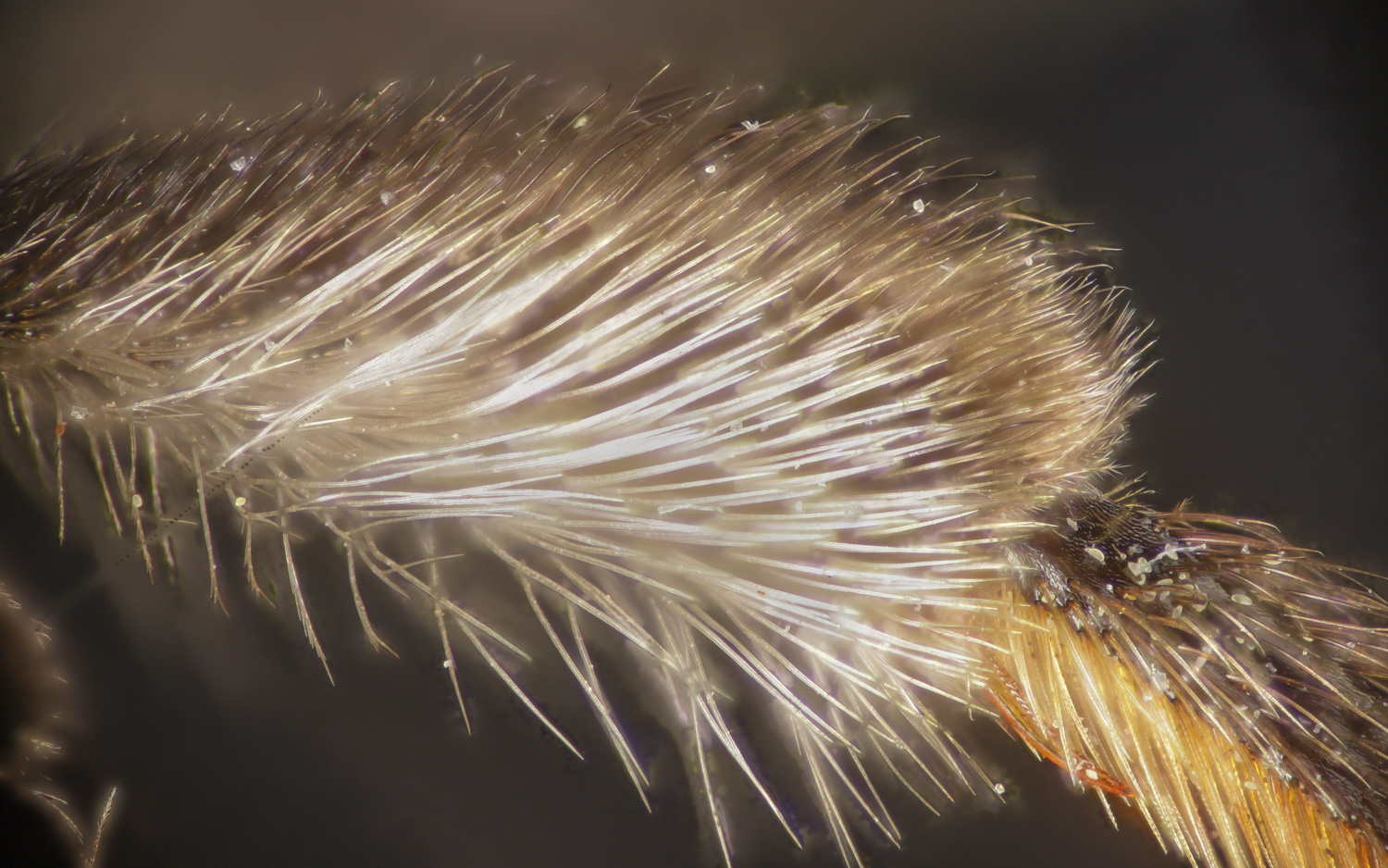
Tibial hairs are lush, but simple.
|
Easy calls:
These two species are both reported as specialists on Agoseris sp (though this specimen was collected from Microseris laciniata, a different aster). According to LaBerge: "This species is most closely related to A. chalybioides from which it is distinguished by its more coarsely sculptured propodeal enclosure, darker colored anal fimbria, and lower and less sharply defined dorsolateral angles of the pronotum. These two taxa are allopatric and may later be found to be distinct only at the subspecies level." I don't have both species to compare, so I defer to H. Ikerd's determination. |
|
|
|
Easy calls:
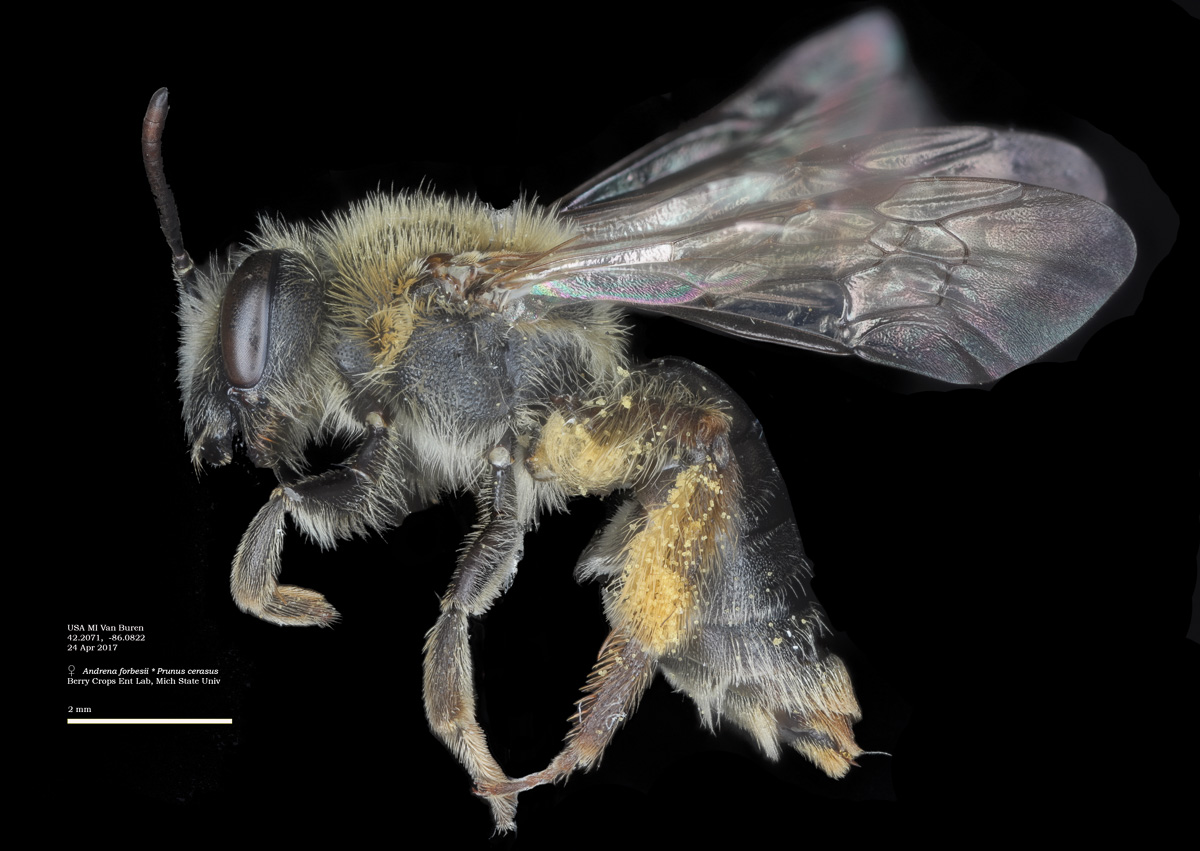
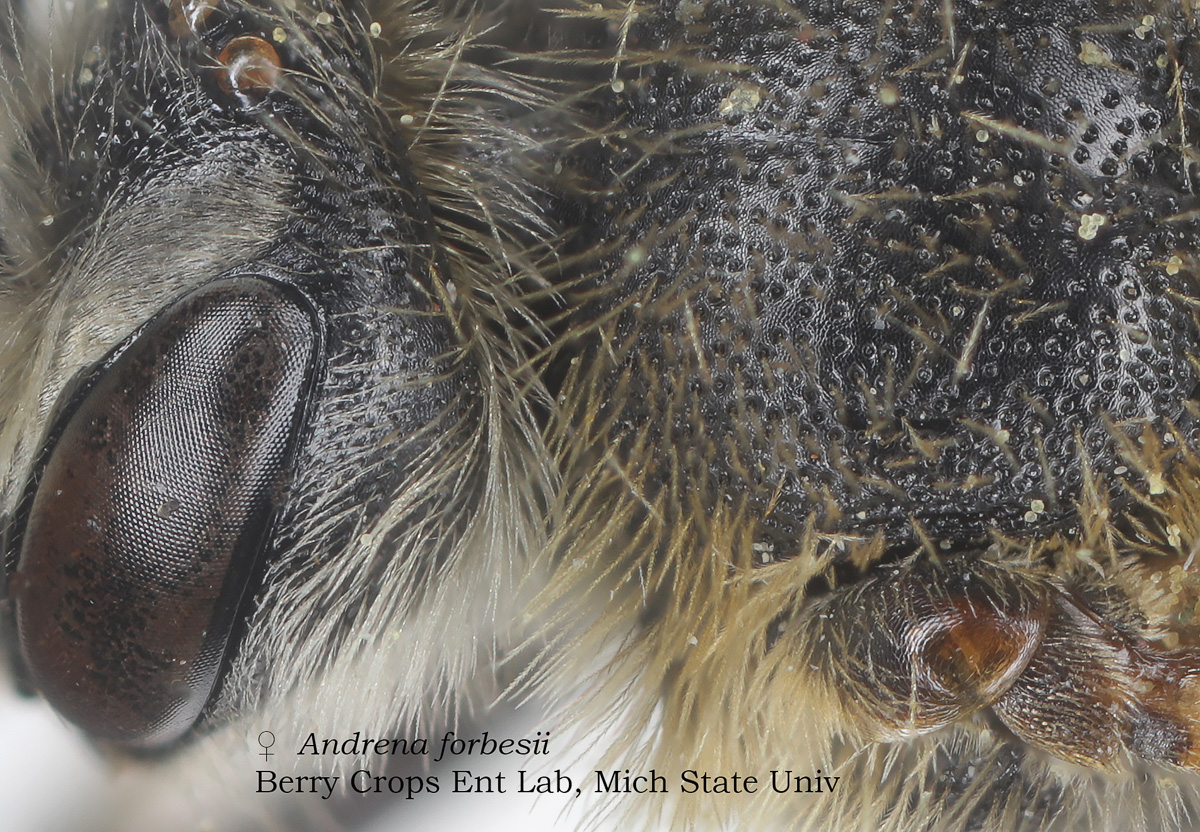
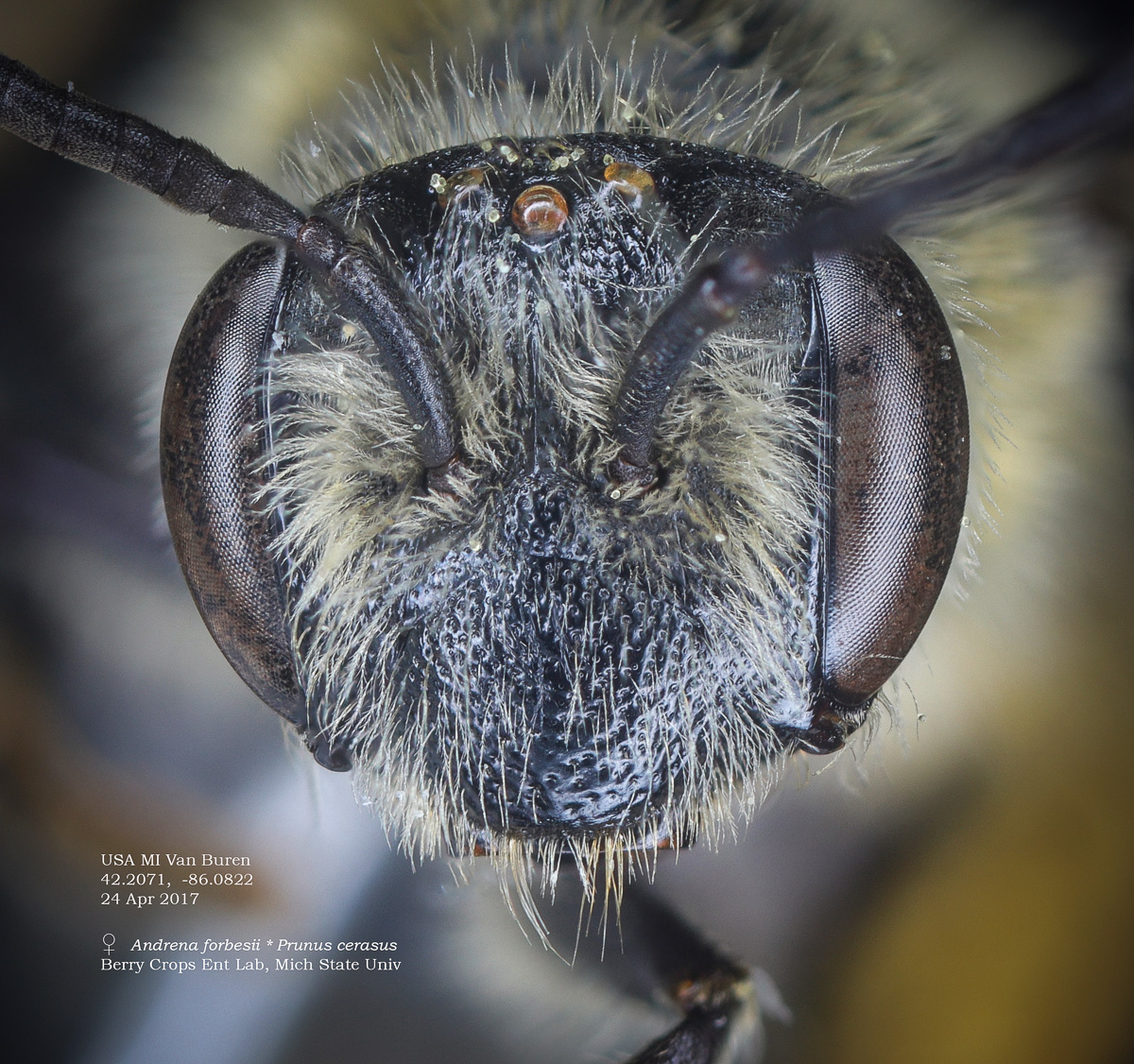
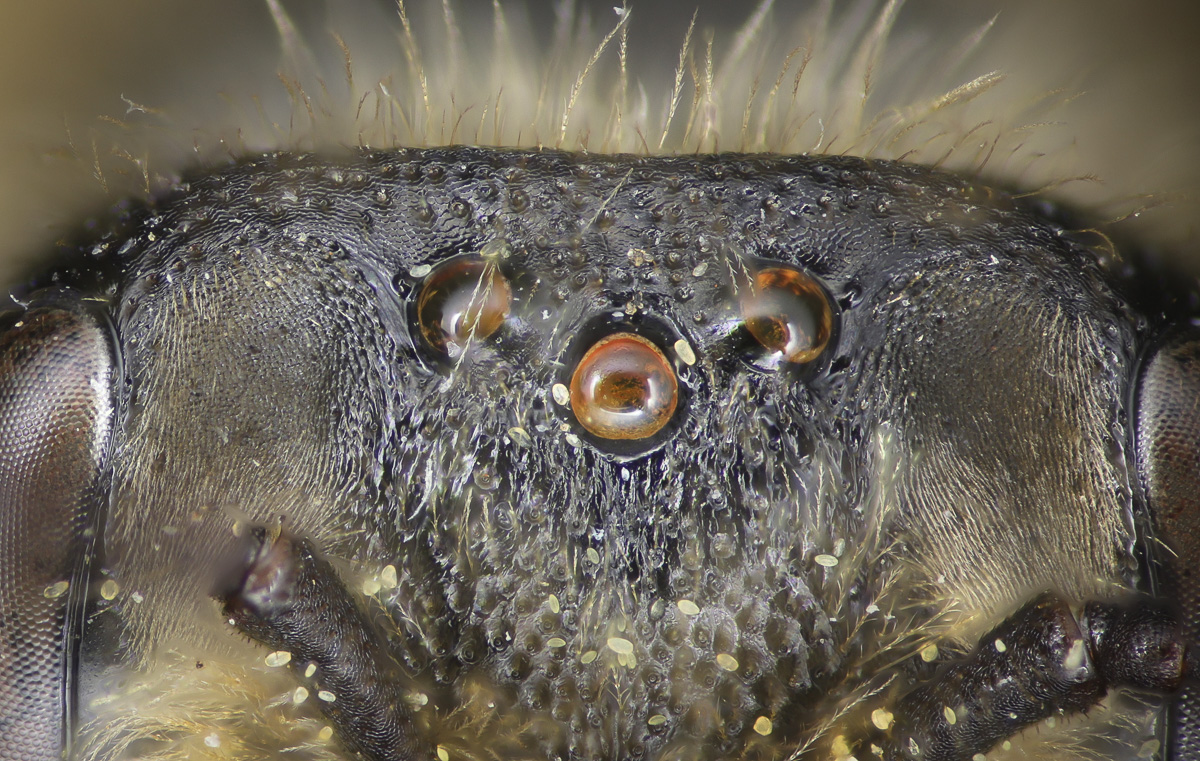
All matches are subgenus Trachandrena, as described for A. salicifloris. The list does not include A. forbesii, so I take issue with DL. My support for the A. forbesii diagnosis: 100 specimens from the Rufus Isaacs lab, many with J. Ascher dets. |
Below: DL scores A. forbesii with ocellus-fovea distance greater than 1 od. In this pic, and close-up at right, the distance appears less than 1 od. If I ignore the DL score for fovea-ocellus distance, A. forbesii matches in DL.
|
Above: Clypeal impunctate medial line indistinct. Crowded punctures below ocelli, and weak rugulae. Also, normal hind tibial spurs--excludes A. sigmundi.
|
Above: Not miranda, described as unique among this group with "Propodeum with triangle without ridged sides, boundaries indistinct, adjacent areas often sculptured nearly as coarsely as triangle." My specimens: "propodeum distinctly finer outside than inside triangle" A. miranda or A. rugosa would also have tergum 2 with depressed apical area occupying three-fourths or more of midline" (about half for my specimens).
DL comments specific to A. forbesii: Face below ocelli duller than parocular area, with weak rugulae longitudinal or lacking, with punctures separated mostly by 0.5 puncture widths or less - Vertex above lateral ocelli equals 1.5 ocellar diameters or slightly less - Scutum hairs normal, long, erect, usually slender
|
|
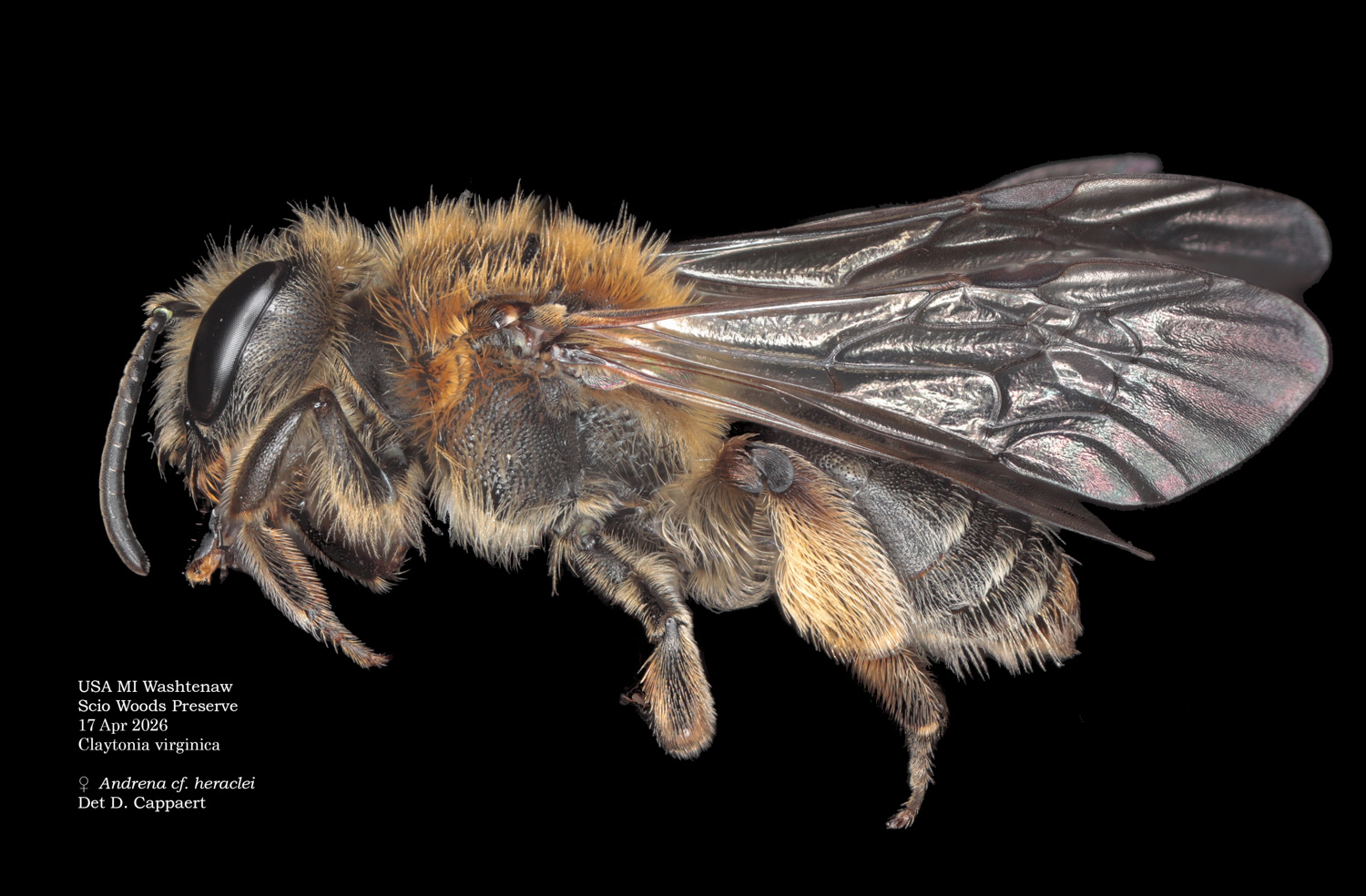
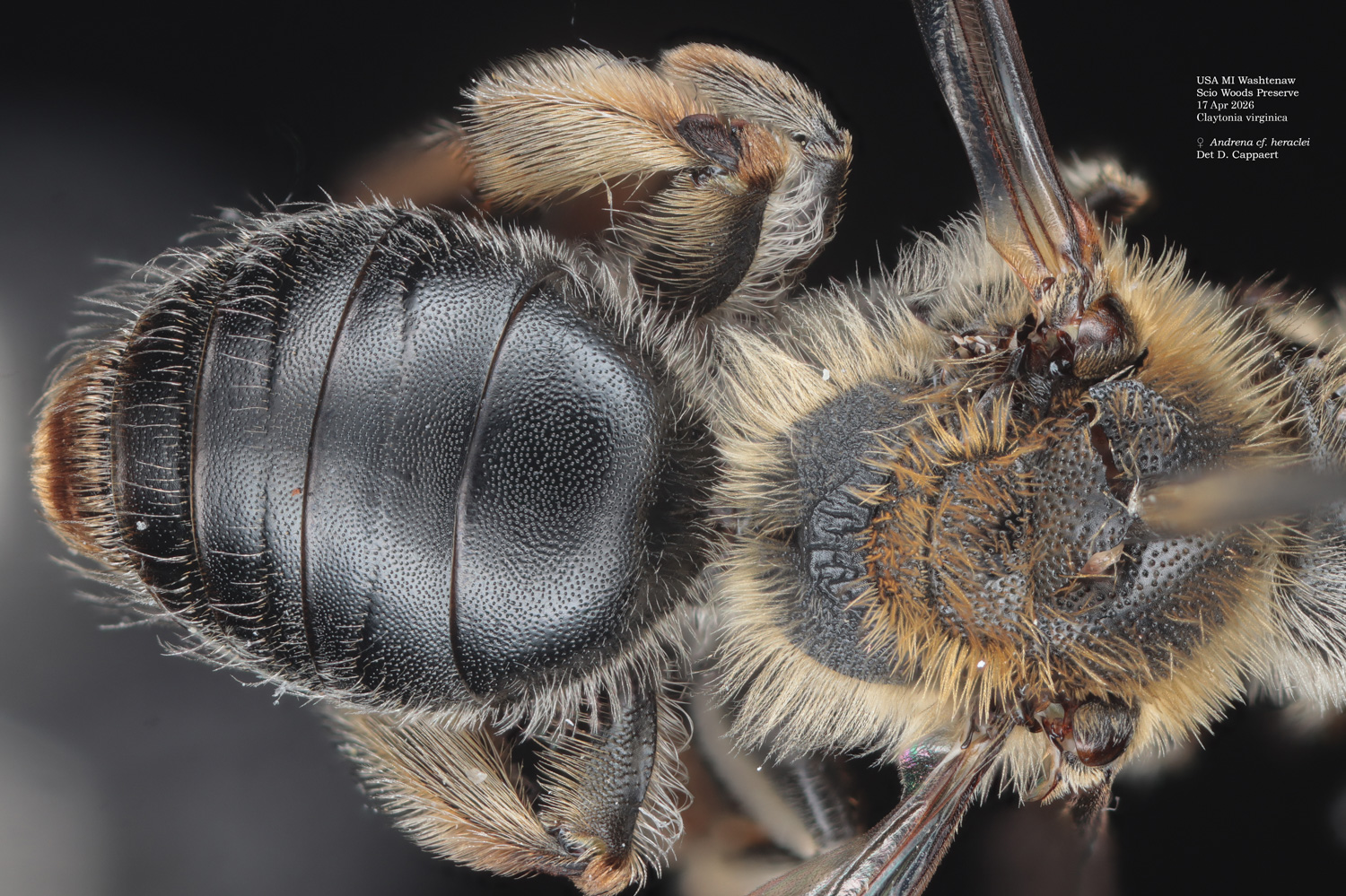
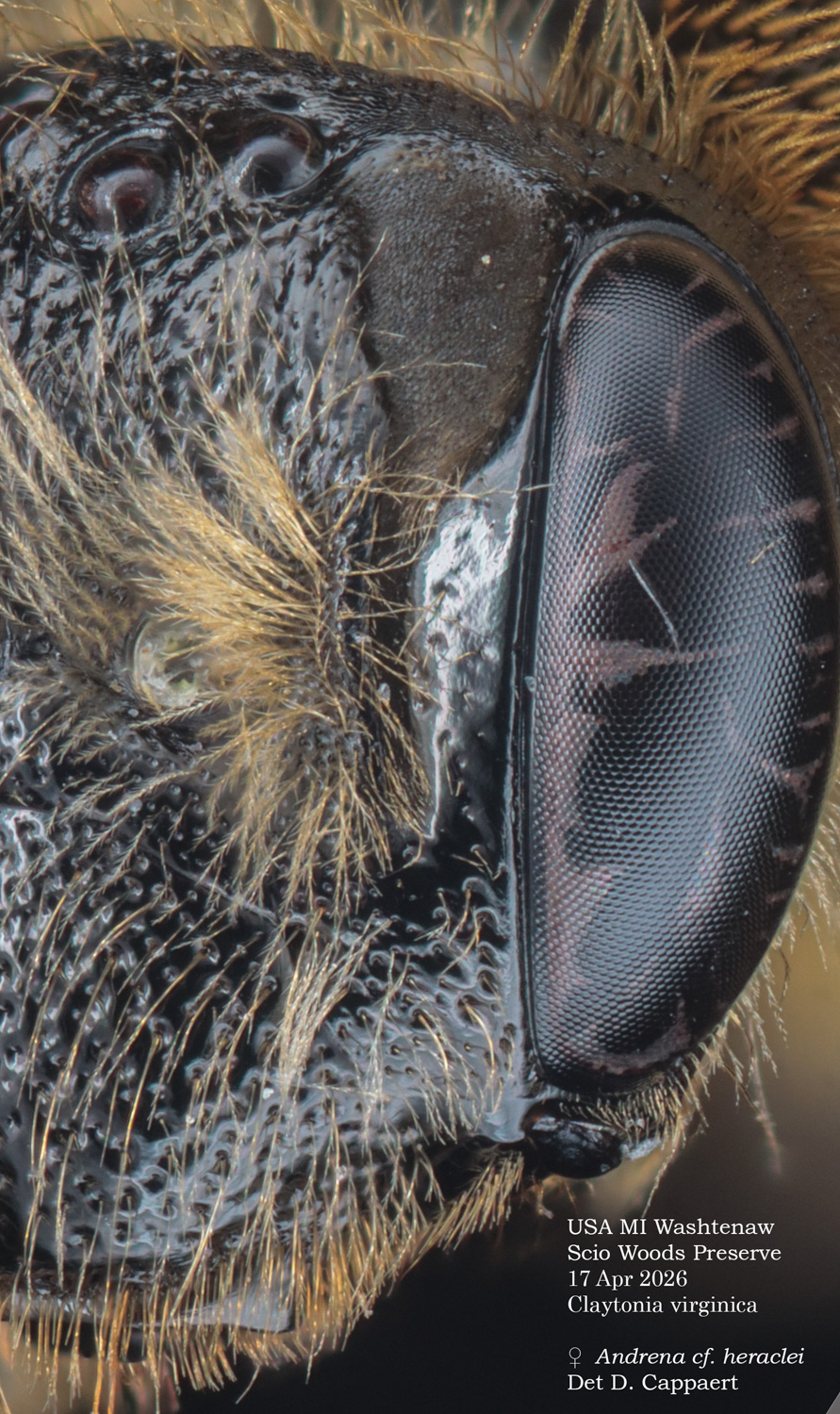
Strongly sculptured propodeum, scutum pits, coarse episternum = trachandrena; 12 species in MI. The conundrum: The LaBerge Trachandrena key yields 2 choices in the second couplet, based on: "facial fovea extremely narrow below and at level of greatest separation from eye space between compound eye and fovea at least twice as broad as fovea at that level." The third couplet differentiates A. rugosa with "face above antennal fossa with distinct longitudinal rugae" from A. heraclei with "face above antennal fossa without rugae." Is this A. heraclei? DL offers A. ceanothi as having "Very end of facial fovea extremely narrow almost just a slot," which would seem to ALSO fit LaBerge couplet 2. In any case, I can get to A. heraclei in DL, with the following discrepancies: this specimen has T2 depressed area ~1/2 of tergum vs 2/3 - 3/4 for heraclei; AND this specimen with vertex less than 1 ocd vs 1.5 ocd for heraclei. |
Note the narrow, parallel-sided hind tibia, with plumose scopa.
|
Very broad impunctate band on clypeus. I have other specimens where this is less pronounced.
|
Easy calls, based on 1st 3 images at right:
|
|
Note on image: not clear here that clypeus is shiny in center. But it is.
|
Fovea broader than antennal socket: excludes A. alleghaniensis. Also: alleghaniensis with short scutal hairs.
|
Above: Labral process emarginate [alleghaniensis bidentate, morrisonella entire or weak].
Below: "Propodeal corbicula hairs in anterior half mostly or entirely branched [simple in morrisonella]. |
Easy calls, based on images at right:
|
Notable: Incomplete corbicula, tibial hairs long and dark, moderate malar space. The femur displays a slight blush of light hairs, precisely like the previous specimen.
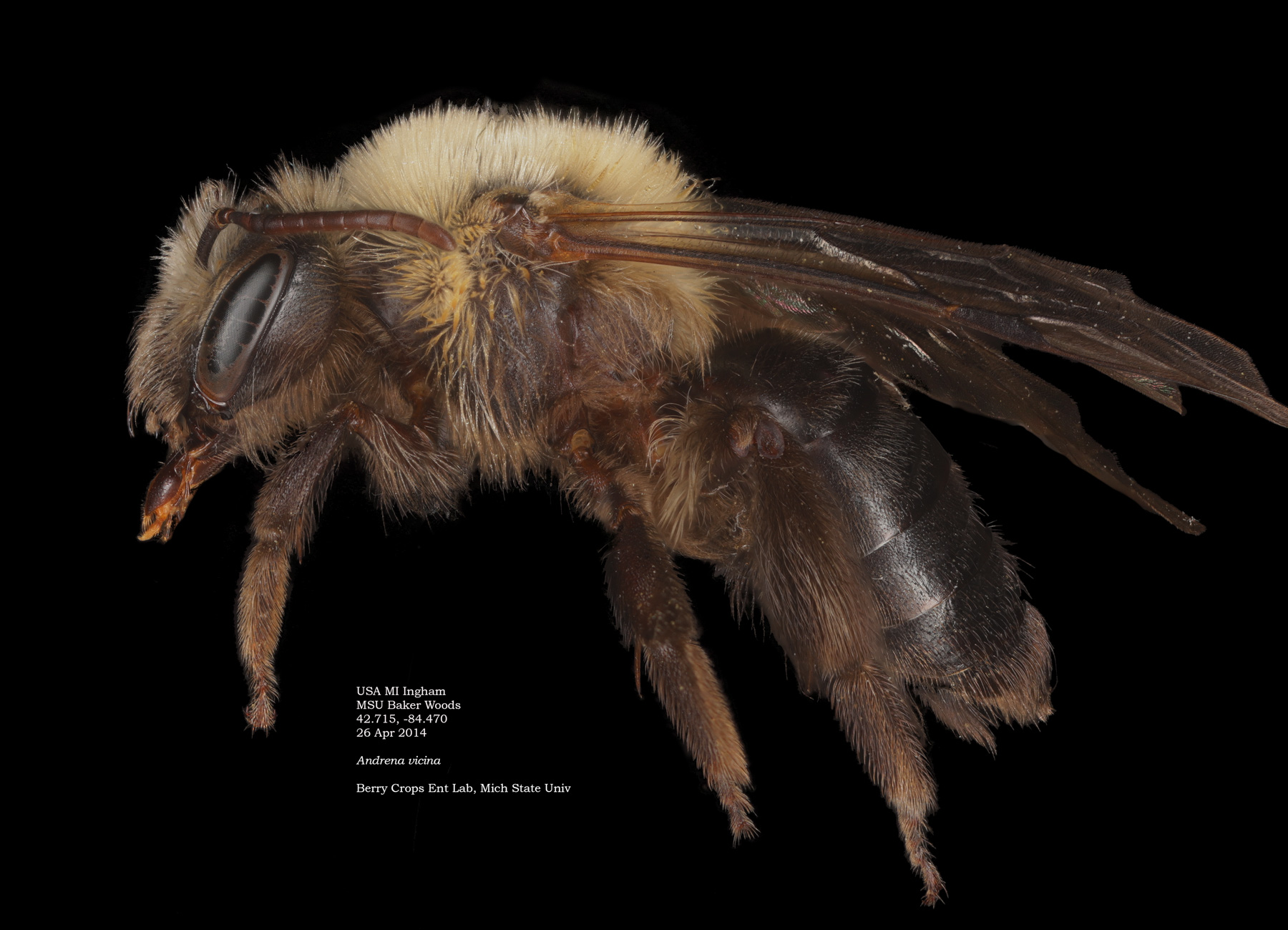
My approach here is to start with: is this specimen NOT A. vicina? A. nivalis problems: scopal hairs (in the east) would be light; vertex would be 2 ocd height (this specimen a little less). A. nigrihirta would have pale/dark thoracic hairs (this specimen all pale). A. regularis would have hind femur hairs pale (this one mainly dark) and "Pygidial plate VERY NARROW forming and acute arrow-head shape" (this one with broad, truncate plate). There is no certainty here. Another approach: use the Bouseman/LeBerge key for melandrena. This gets me, probably, to A. nivalis. The conservative name for this specimen: Andrena cf. vicina. |
See A. vicina specimen. The head exhibits the same trait set. Narrower impunctate clypeal band. Not in photos: labral process entire, labrum with median crista.
|
See A. vicina specimen. The abdomen exhibits the same trait set.
|
Easy calls, based on 1st 3 images at right:
|
Note the narrow, parallel-sided hind tibia, with plumose scopa.
|
Very broad impunctate band on clypeus. I have other specimens where this is less pronounced.
|
White fovea, less than 1 ocd from ocellus. Short vertex.
Labral process entire, wide and long.
|
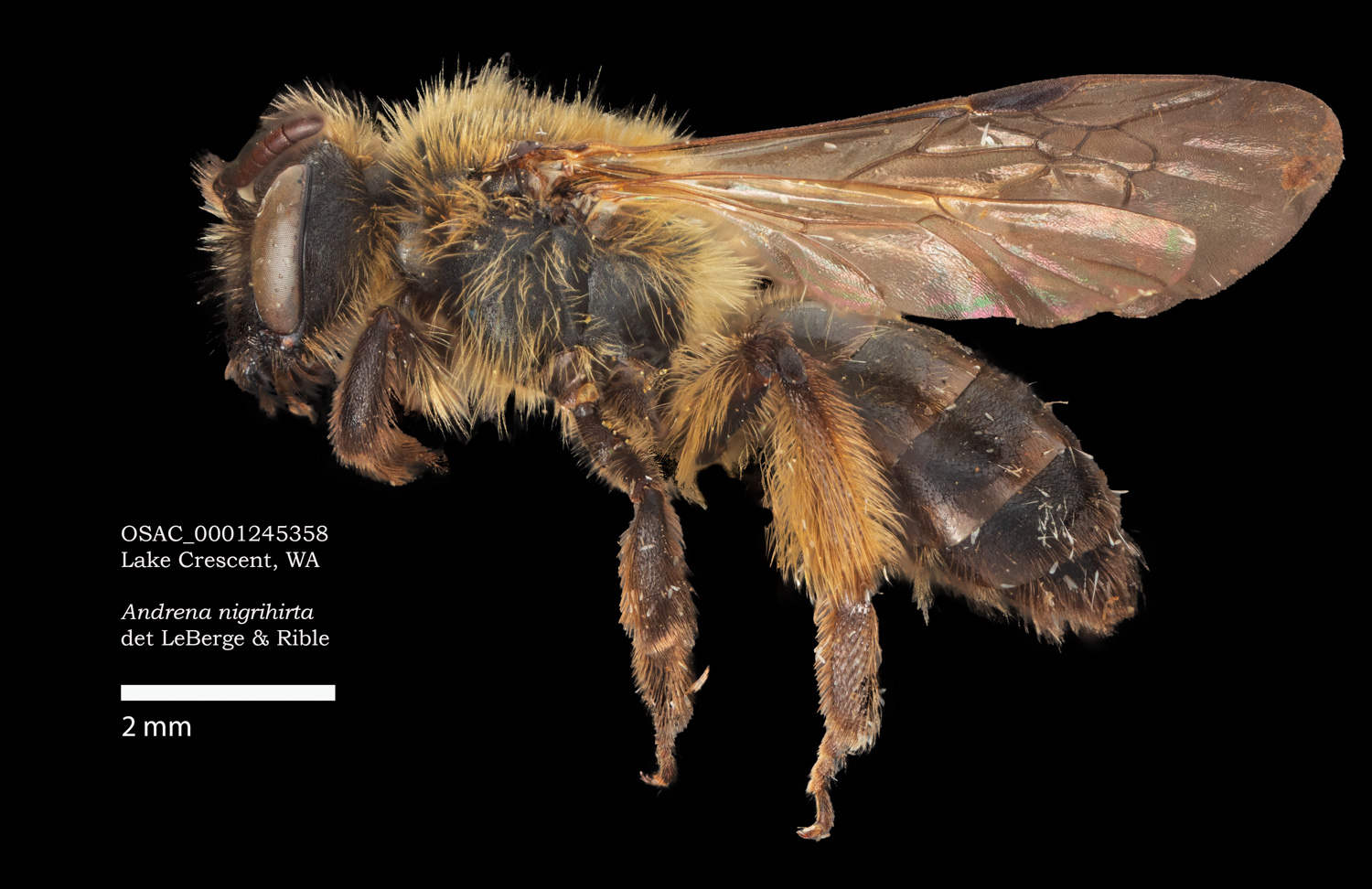
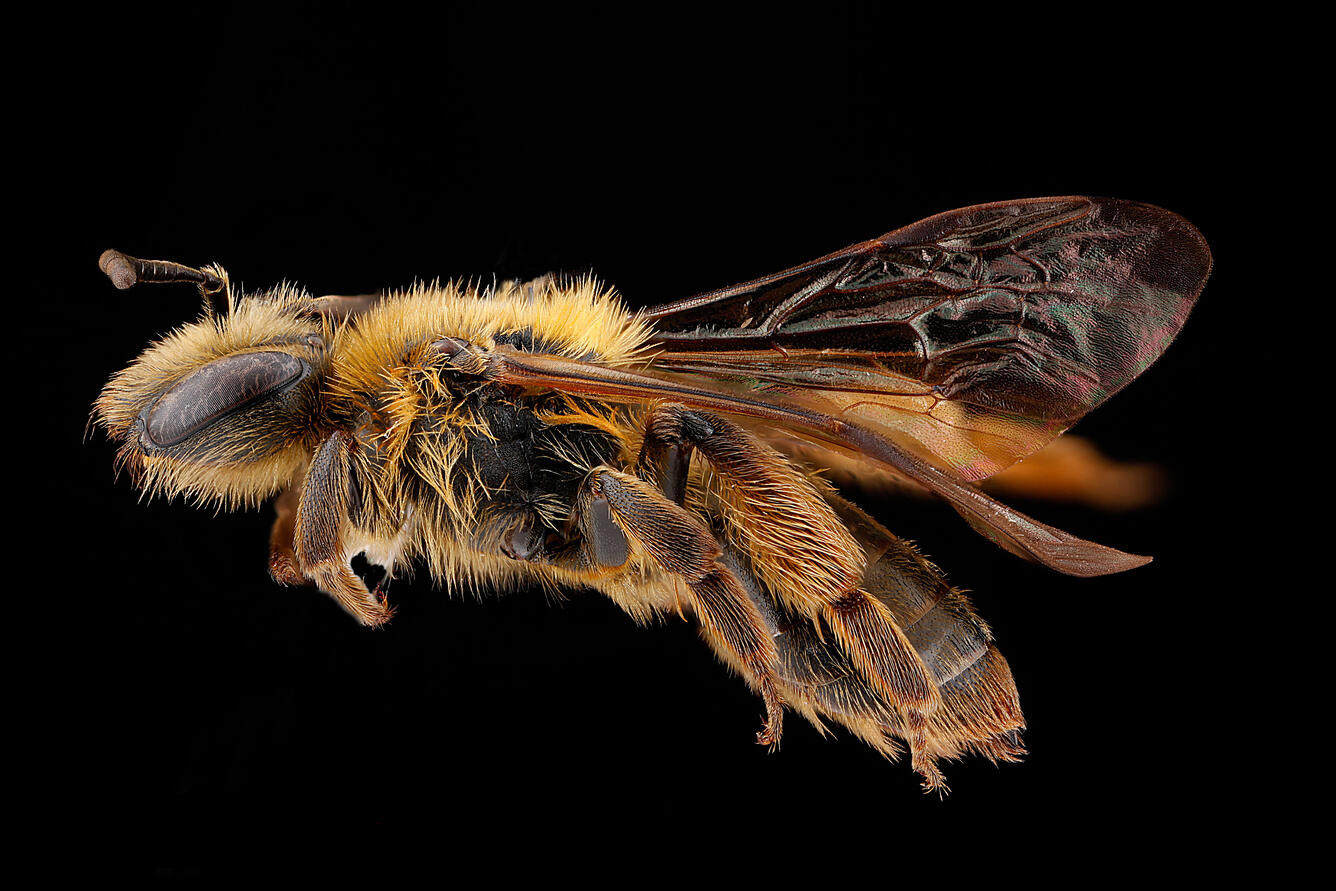
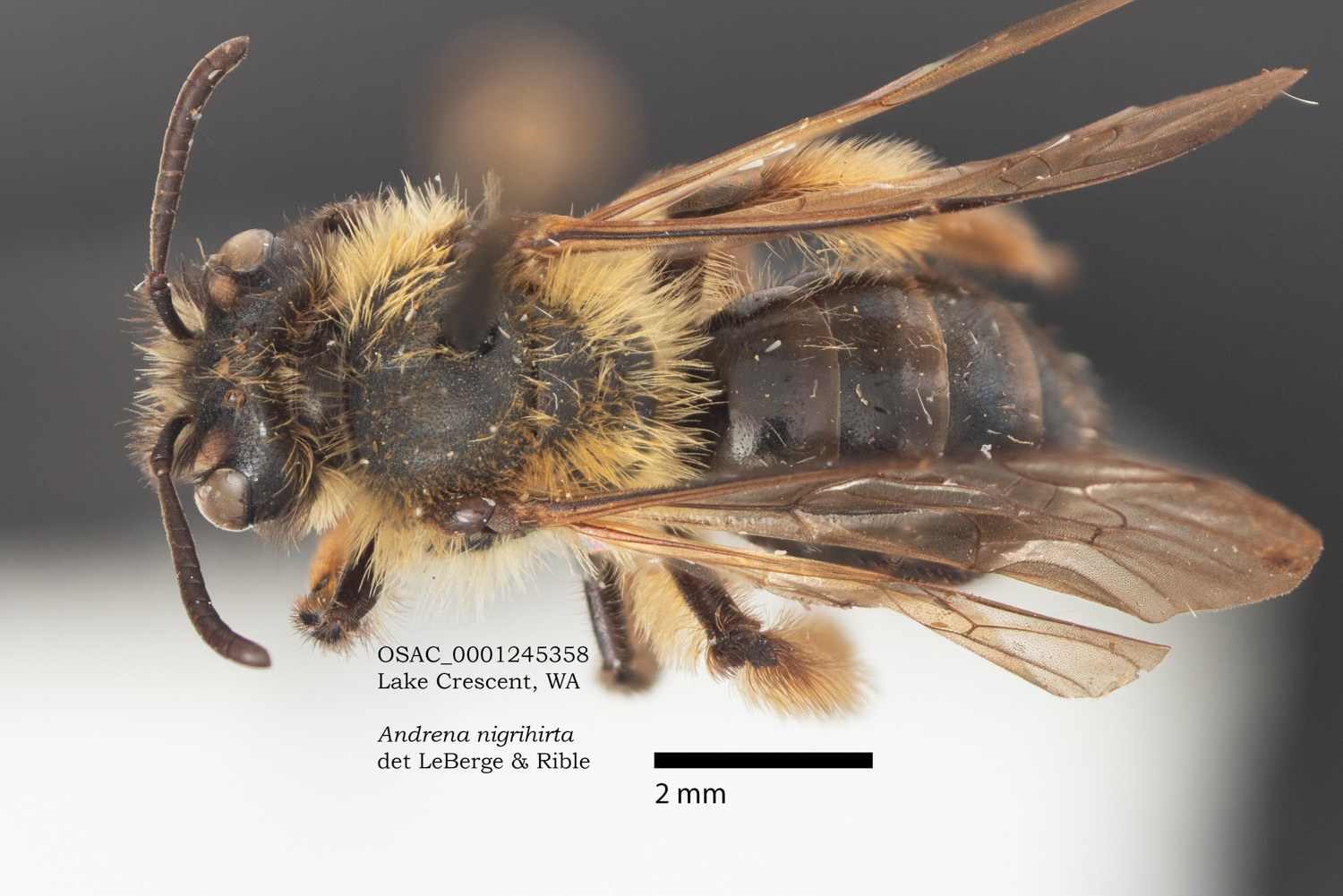
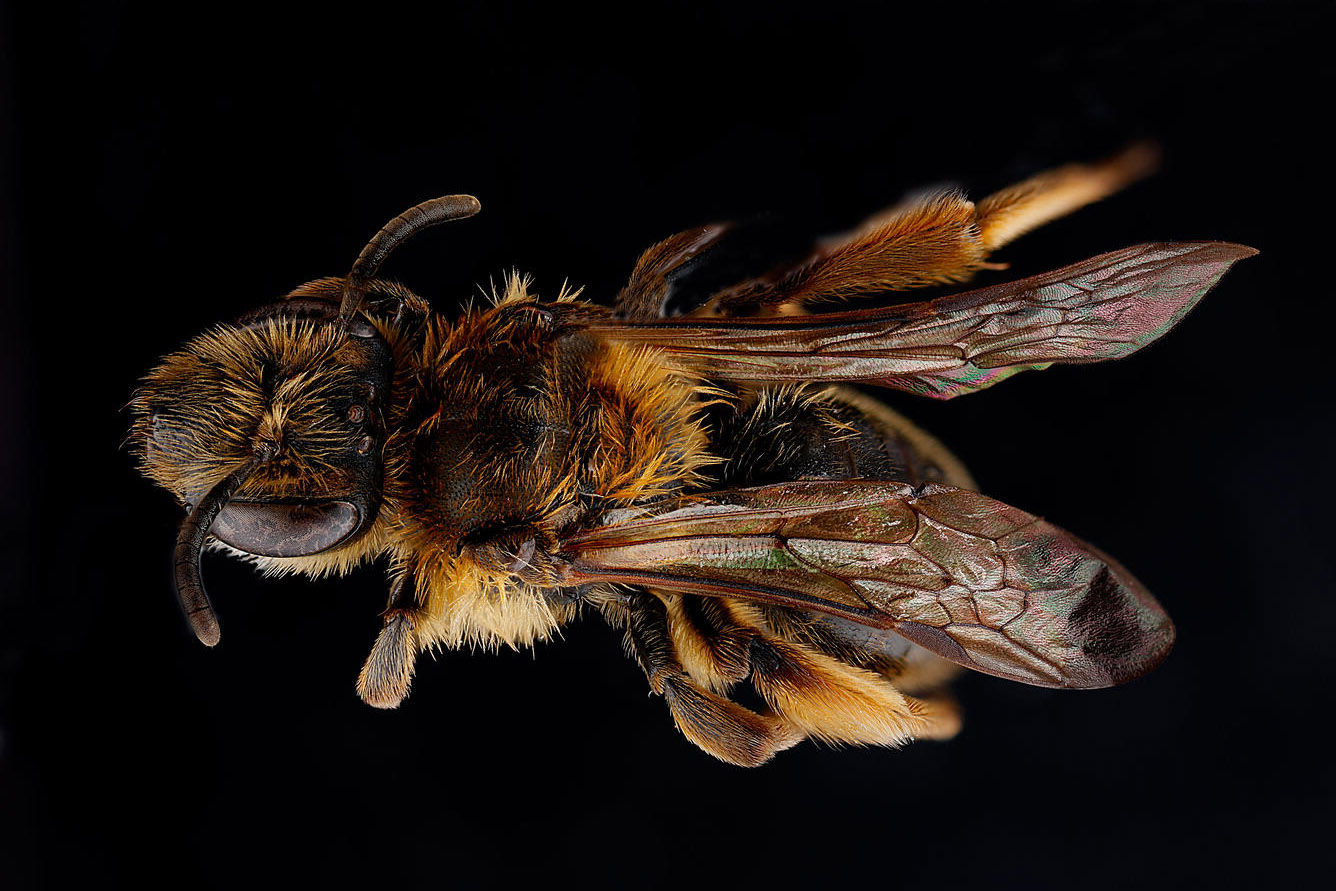
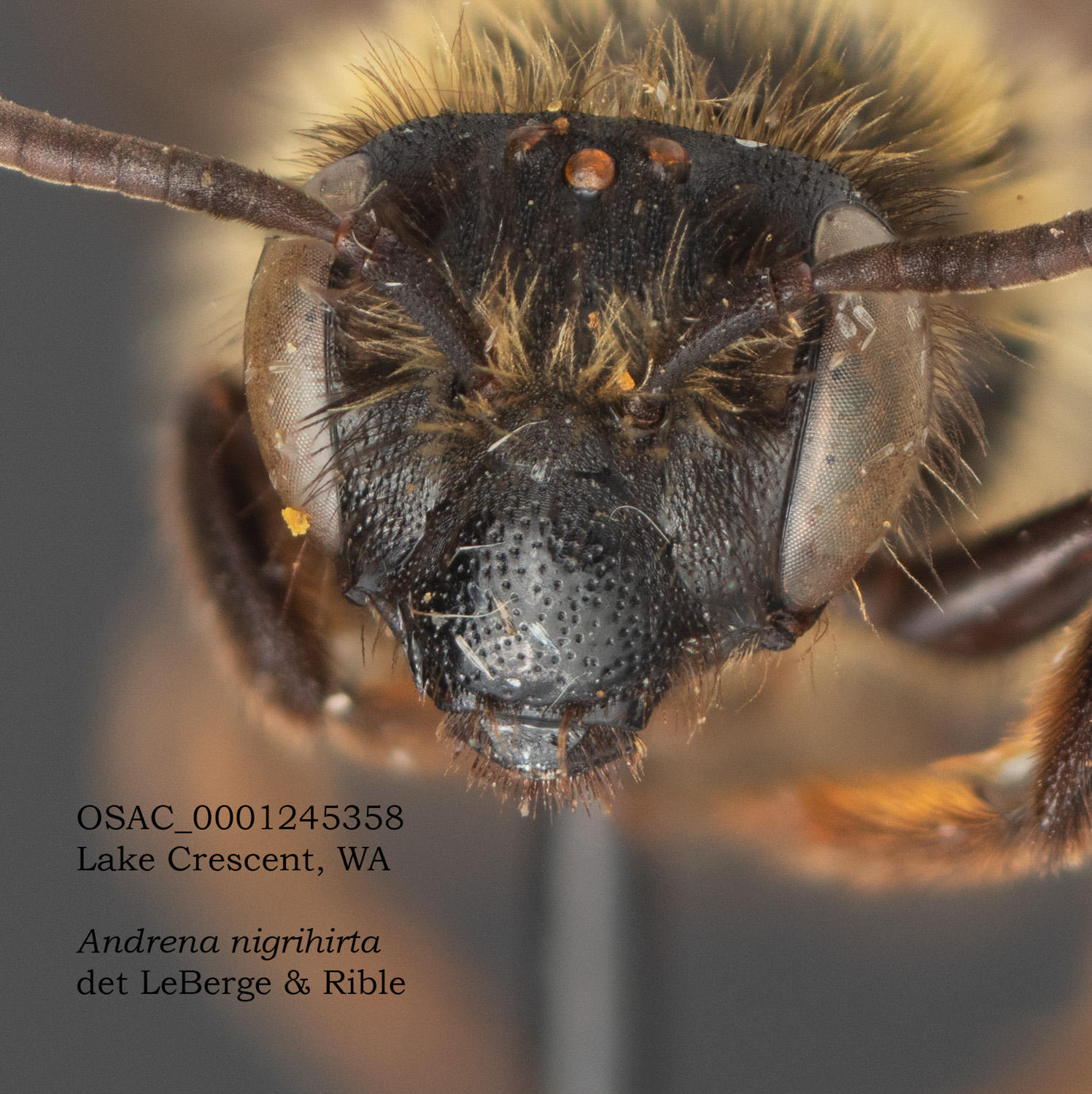
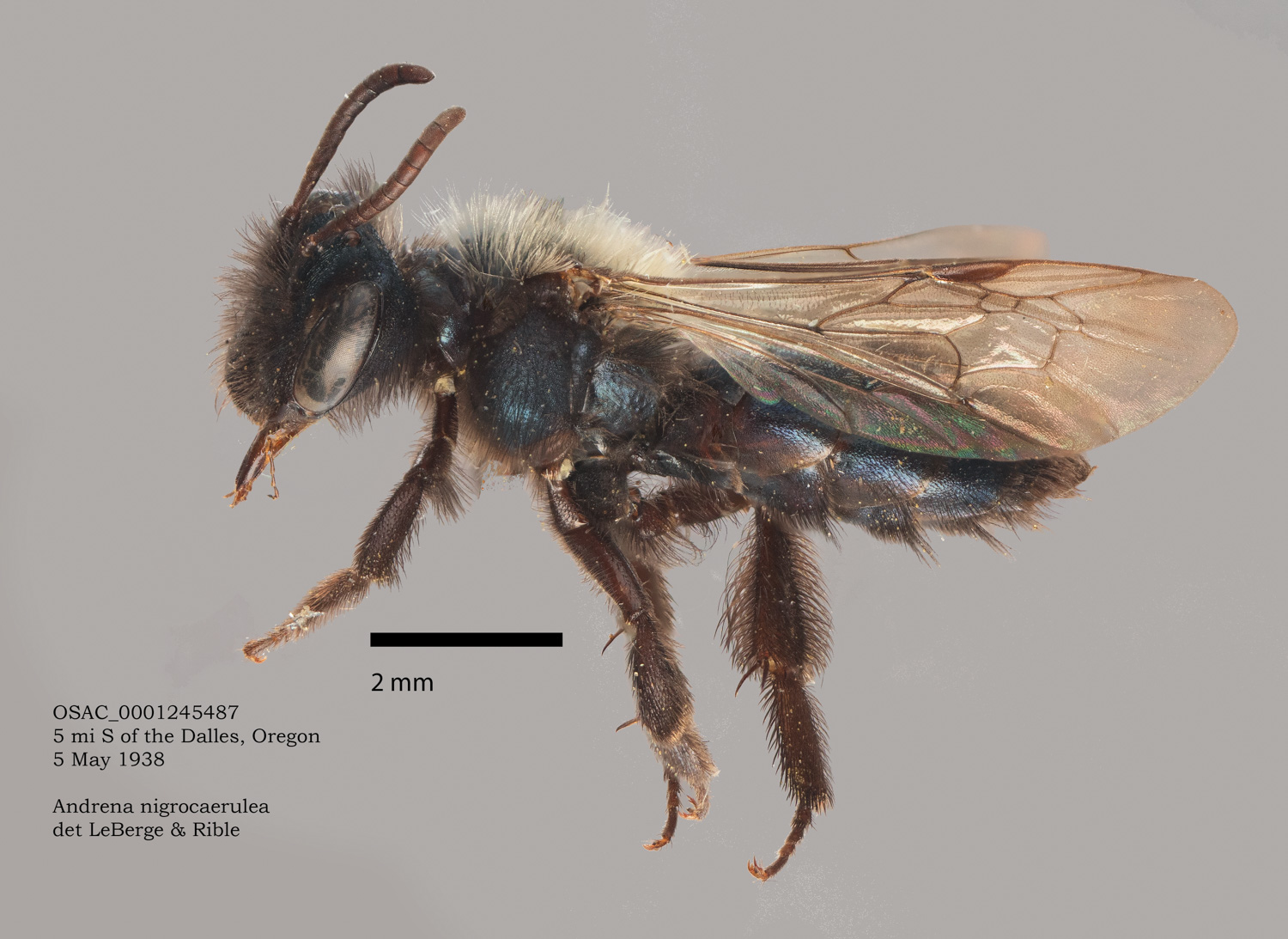
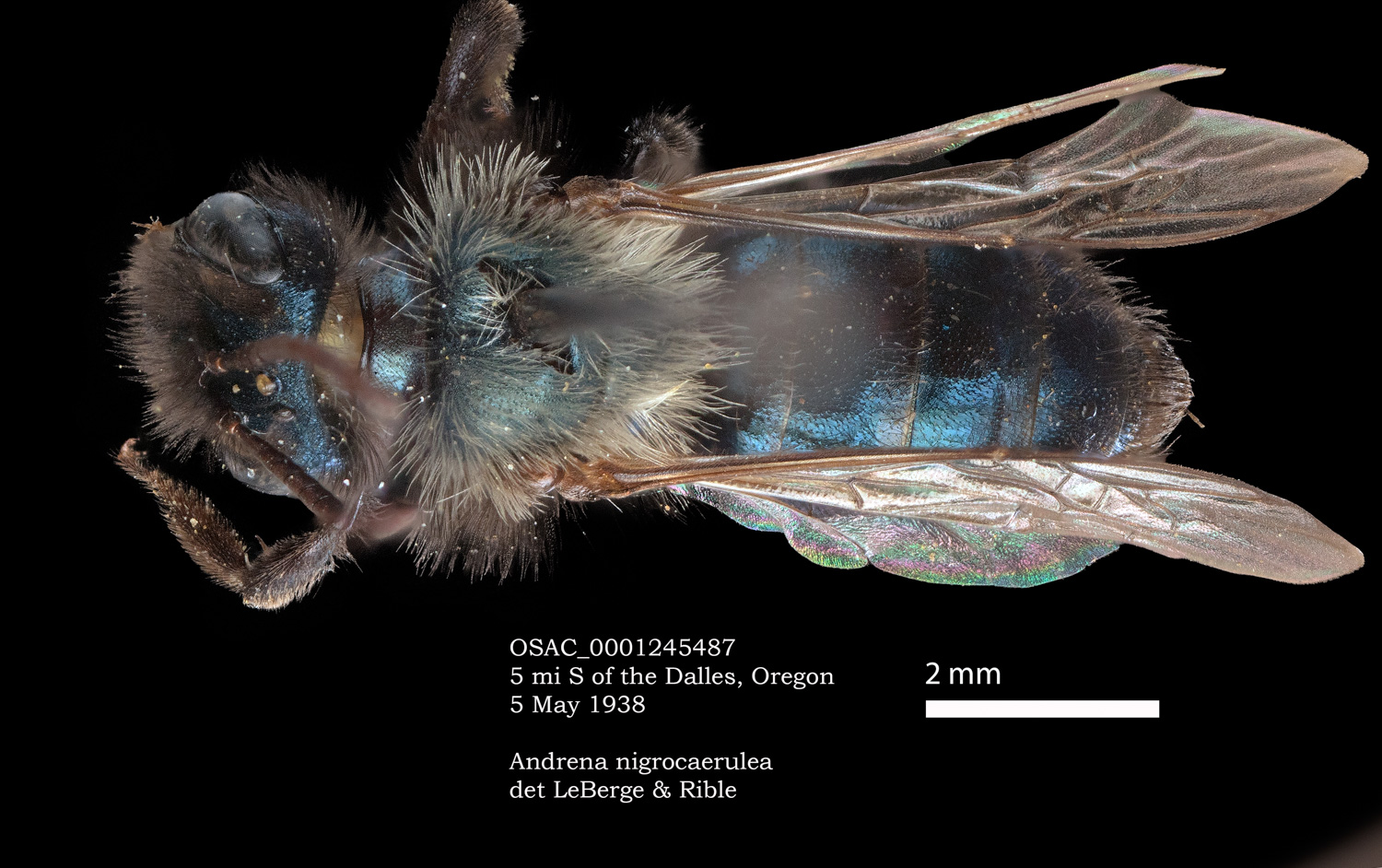
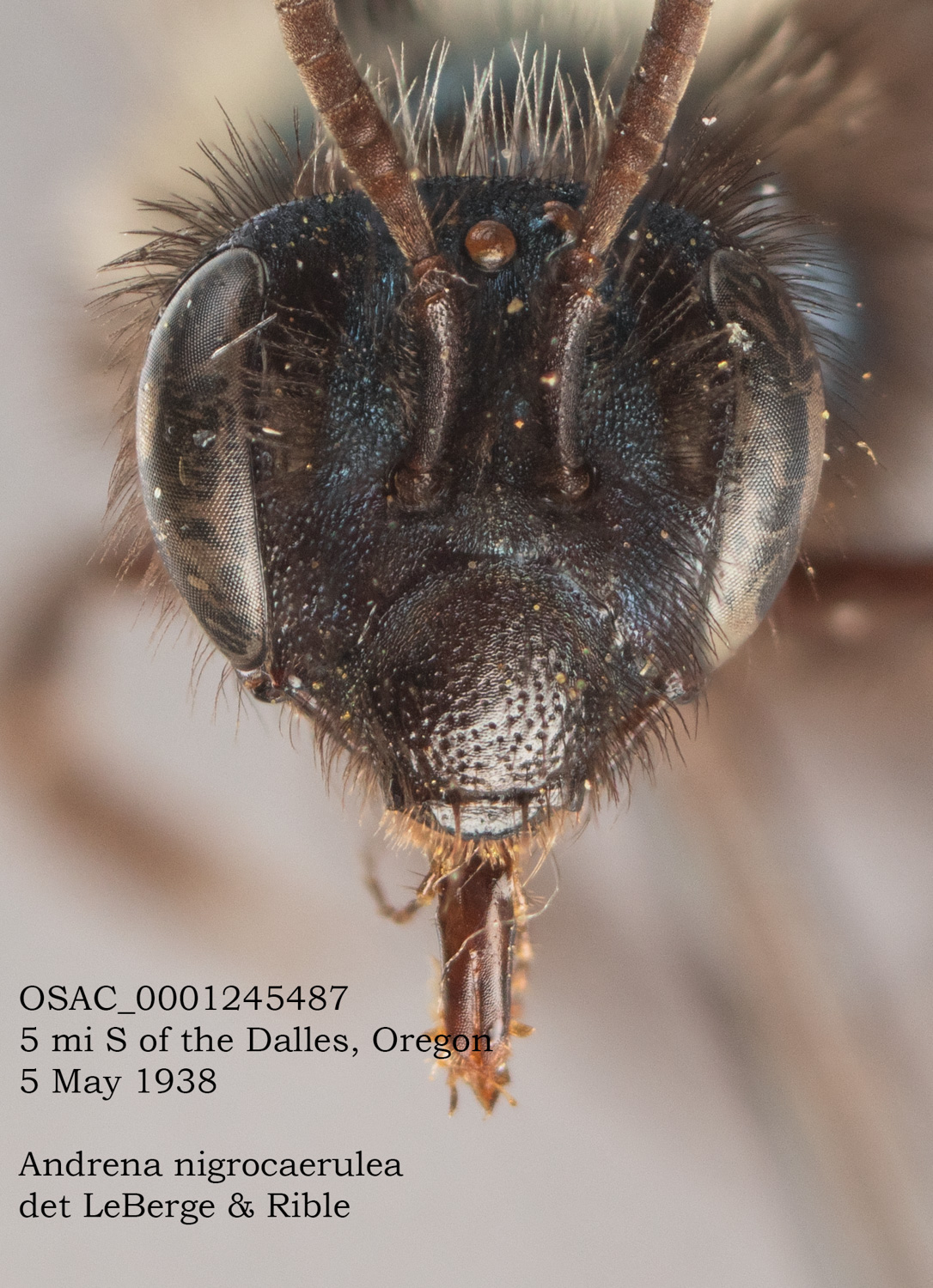
| I can't examine this specimen, but have images I made of one at the Oregon State Arthropod Collection. The determination is by LaBerge/Ribble. Traits evident in the photos do NOT yield A. nigrihirta in Discoverlife ... unless I can be persuaded that lower episternal hairs are dark. |
OSAC specimen above, USGS specimen below. Evidently the same bee, both with light thoracic hairs.
|
OSAC specimen above, USGS specimen below.
|
|
Easy calls:
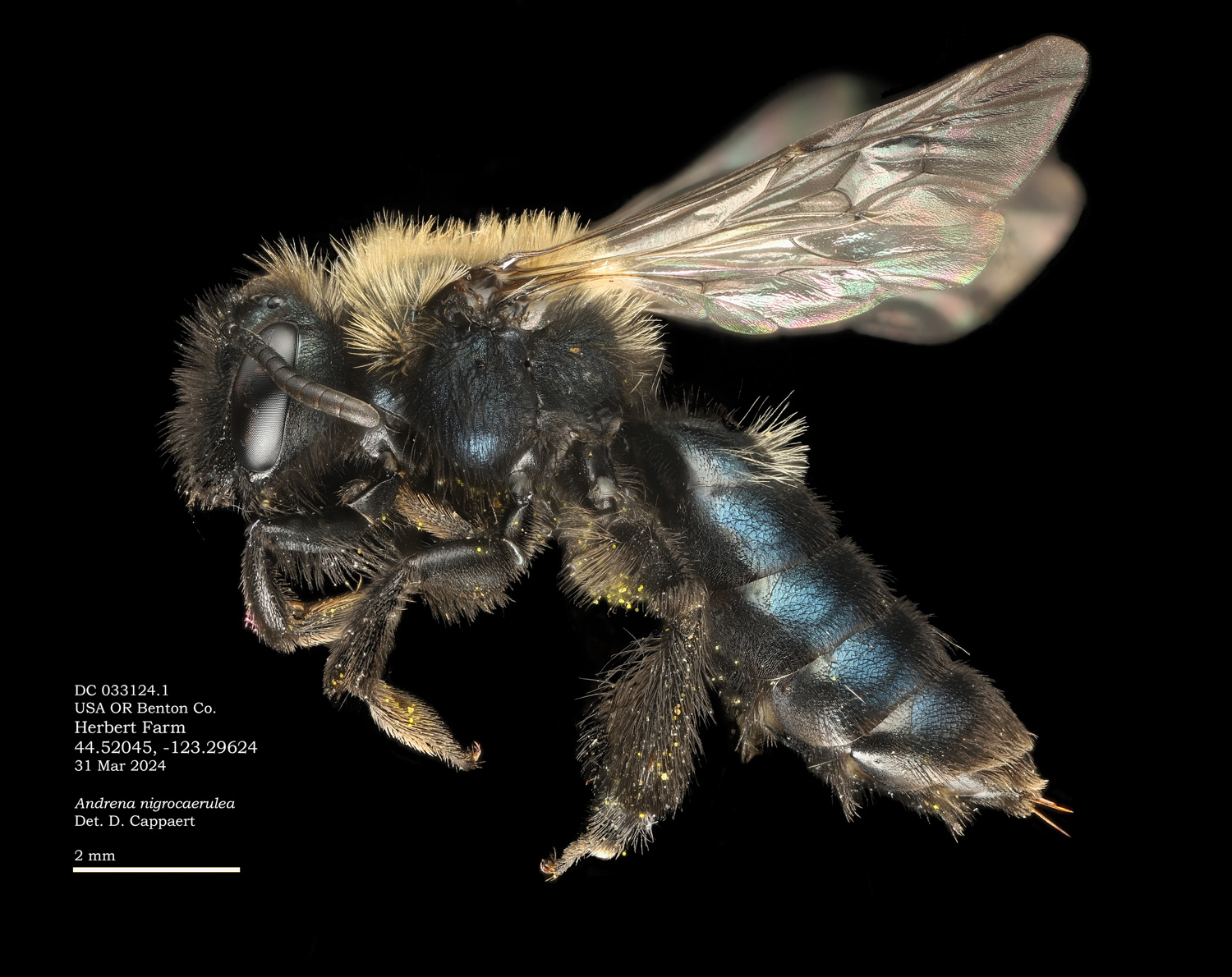
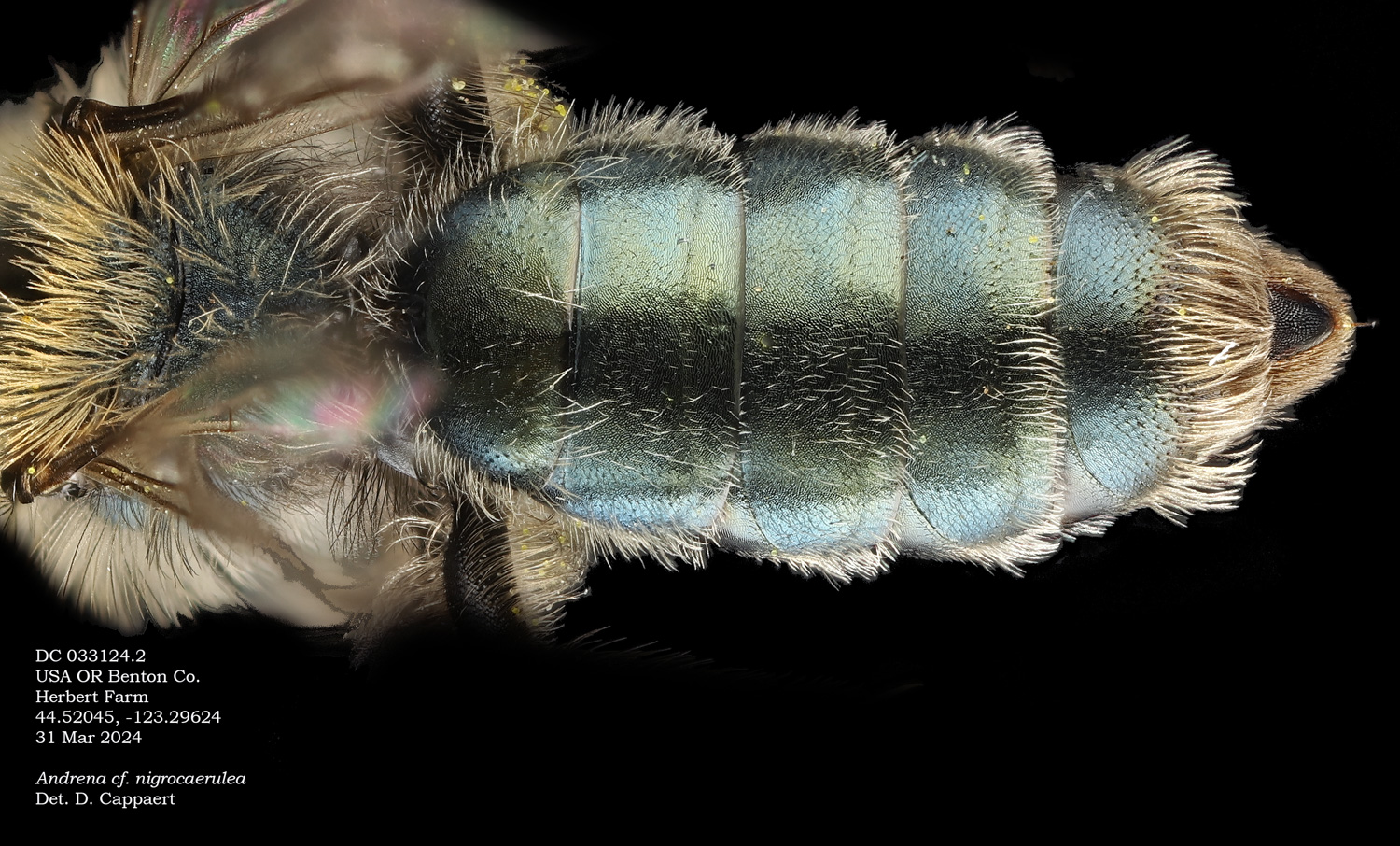
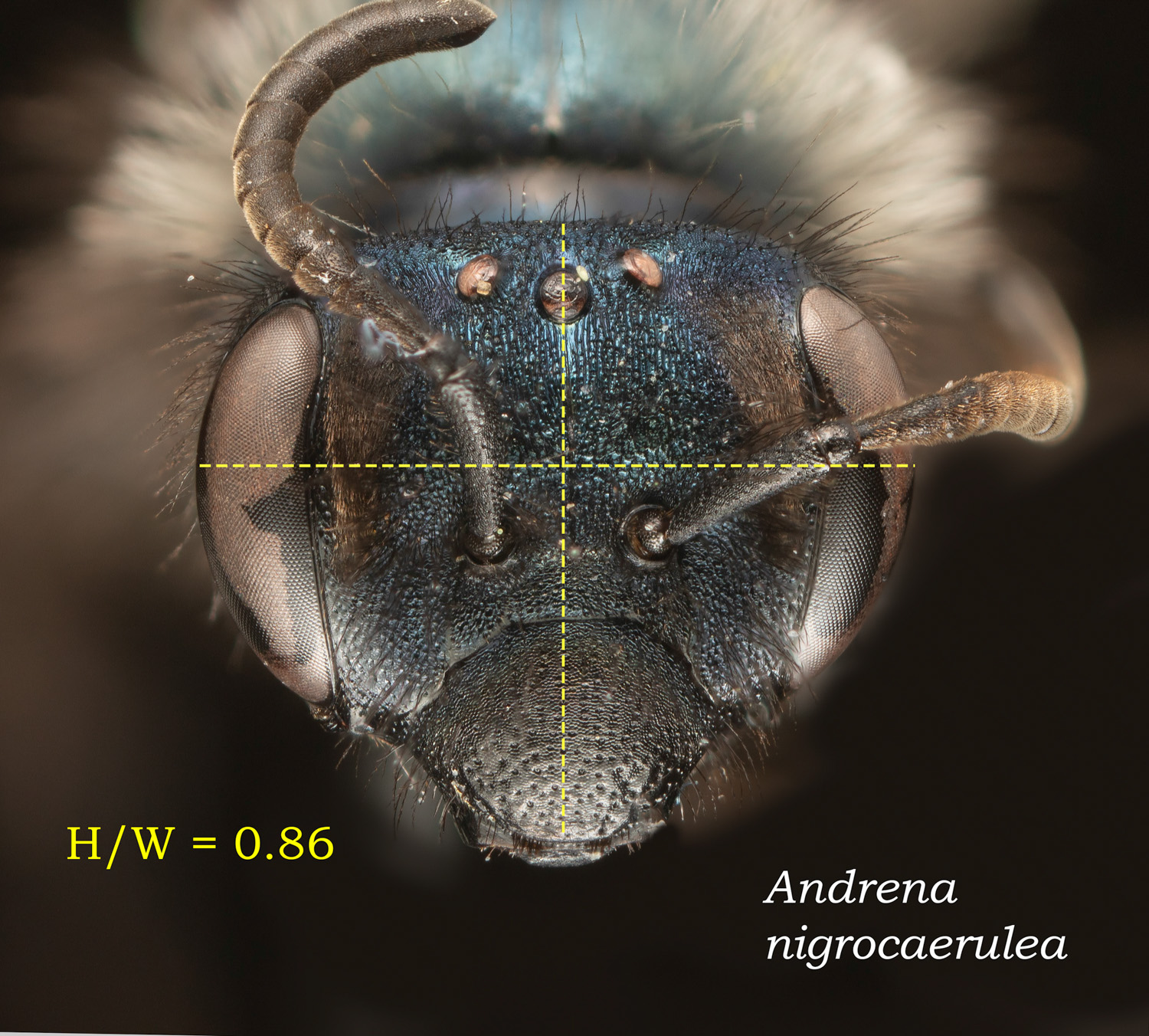
... yields A. nigrocaerulea in DiscoverLife. LaBerge: "The female of A. nigrocaerulea is readily distinguished from related species by the extensive dark body hairs, the complete lack of apical metasomal fasciae, the usually punctate and often shiny clypeus, and the metallic blue-black color of the integument." I assume here that "often shiny clypeus" does not preclude my specimens with a dull clypeus (which otherwise matches the image of the OSAC specimen below). |
|
![]() |
|
| Images at right: A. nigrocaerulea specimen from Oregon State Arthropod Collection, determined by LaBerge/Ribble. |
|
![]() |
|
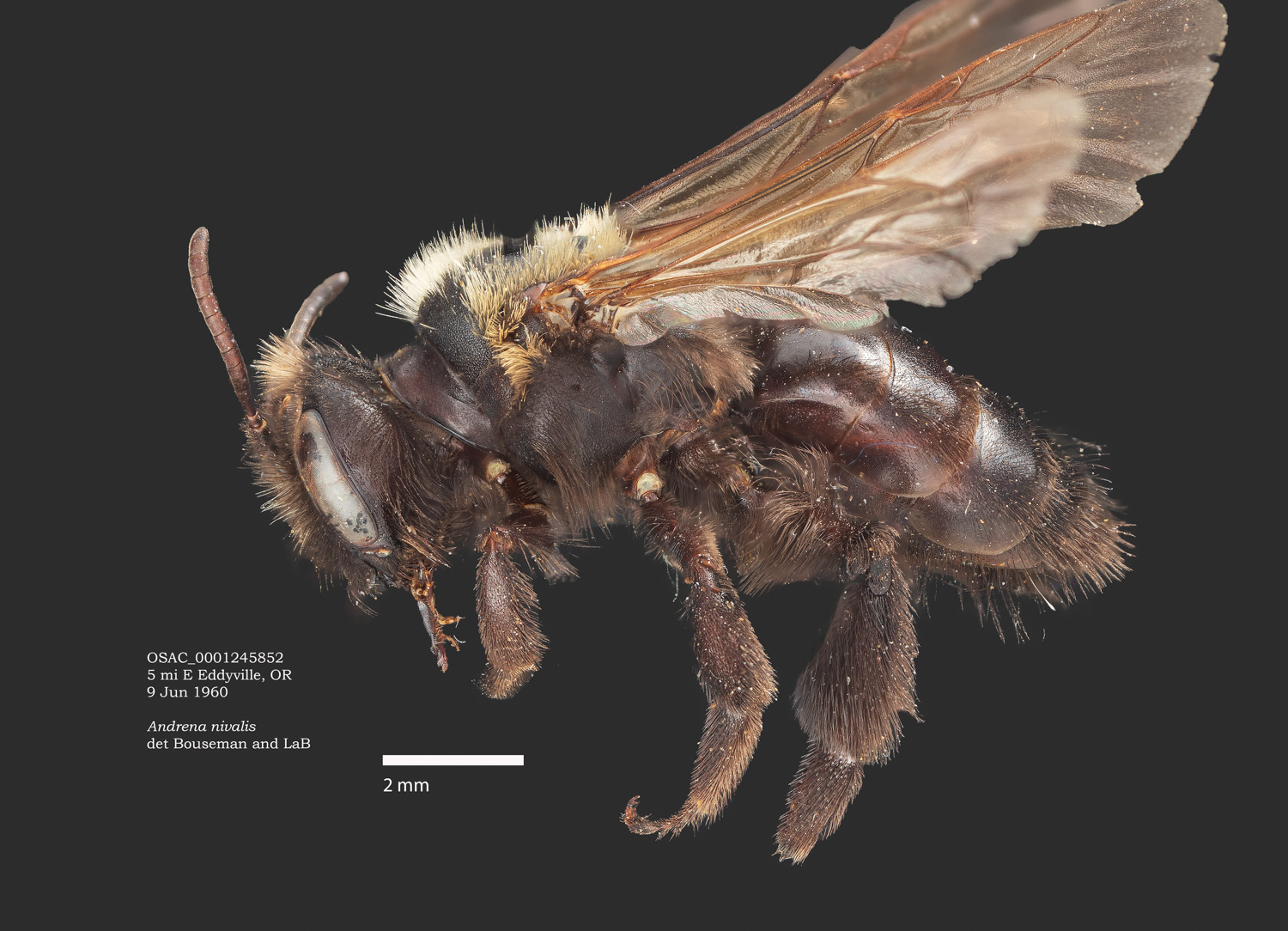
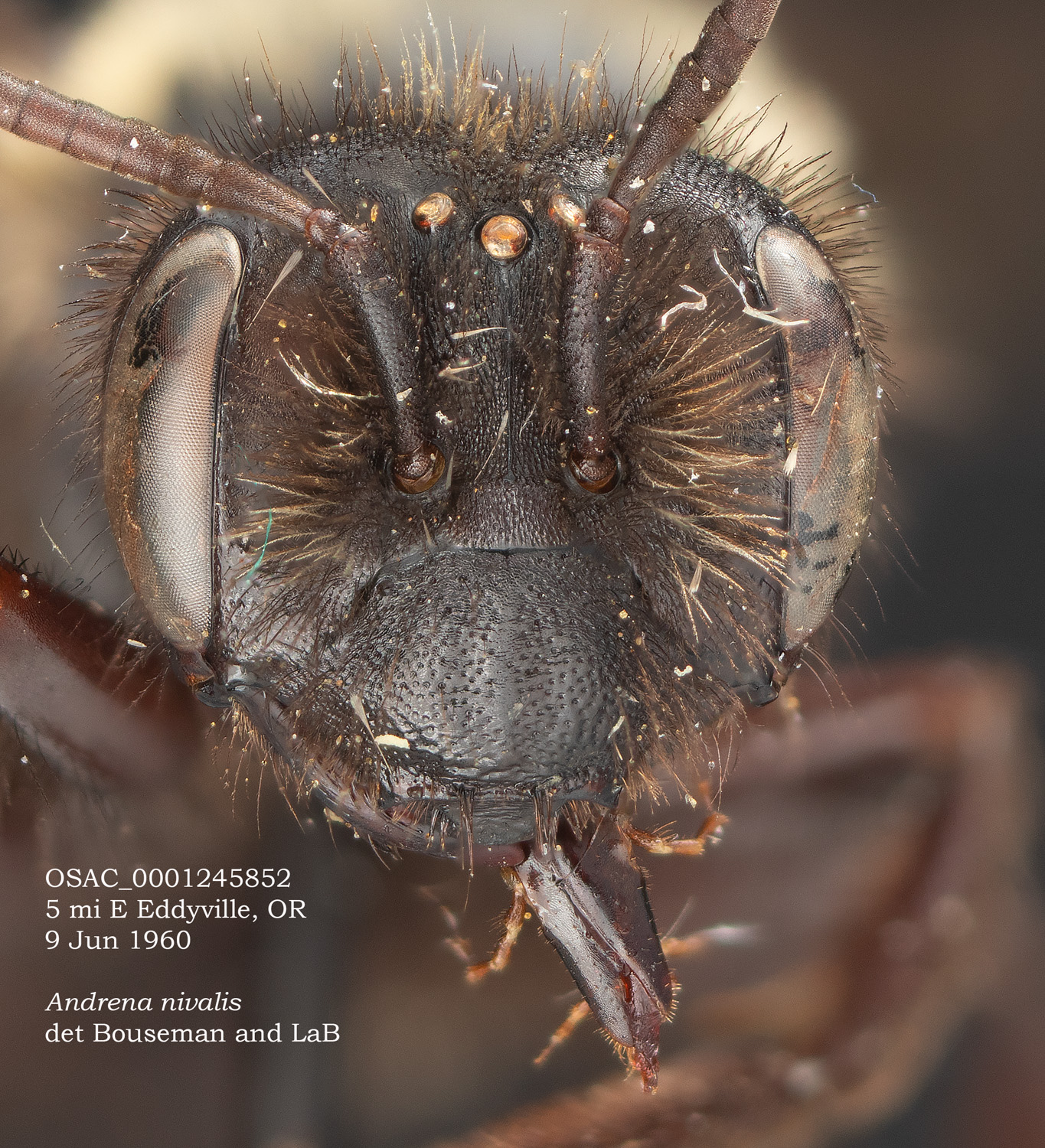
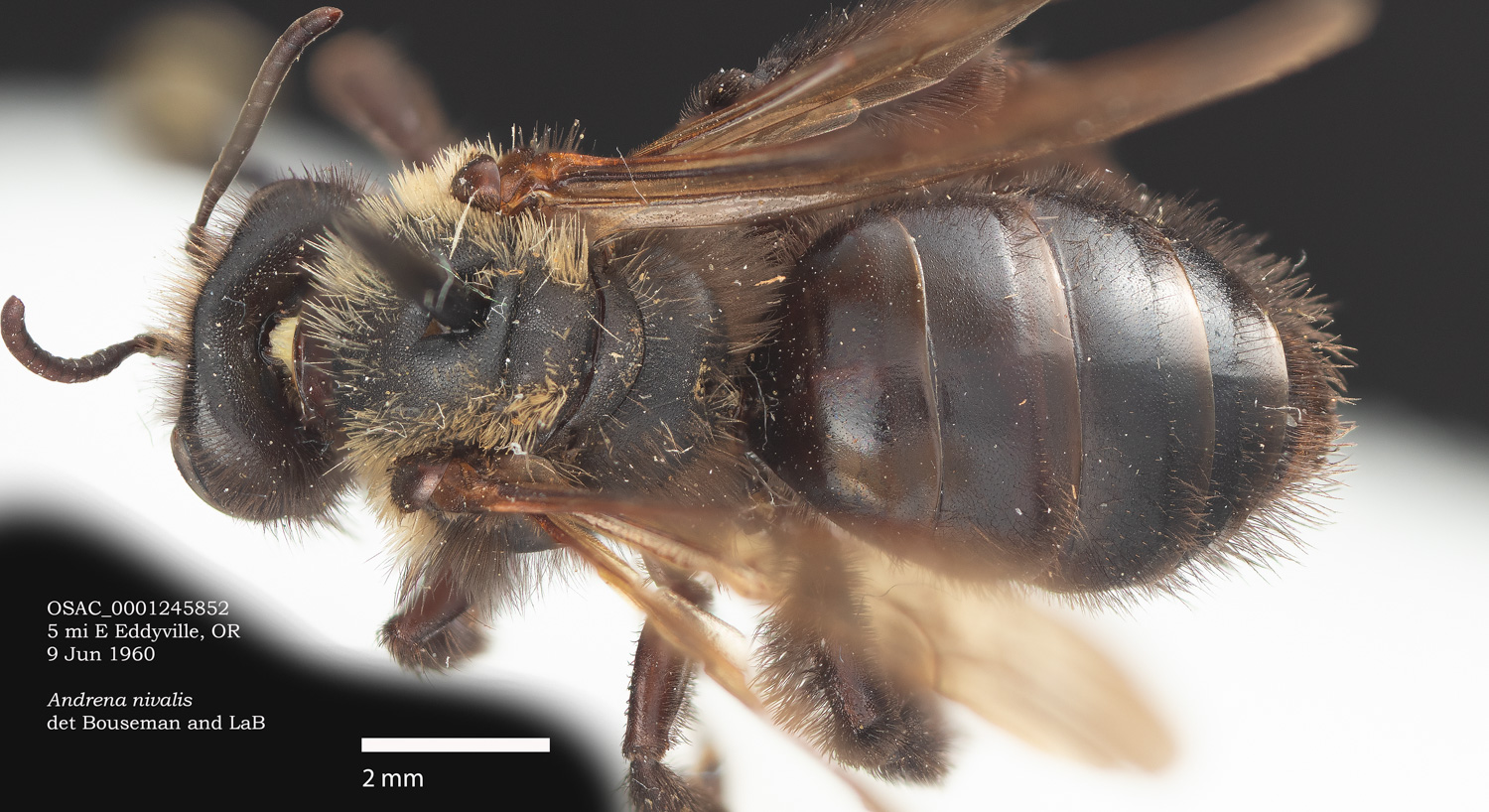
Reference: LeBerge specimenI happen to have images of a western Oregon State University specimen of A. nivalis, with a Bouseman/LeBerge determination. This would likely be part of the material for their Melandrena key. Are these consistent with my unknown Melandrena above?? |
|
|
|
Easy calls:
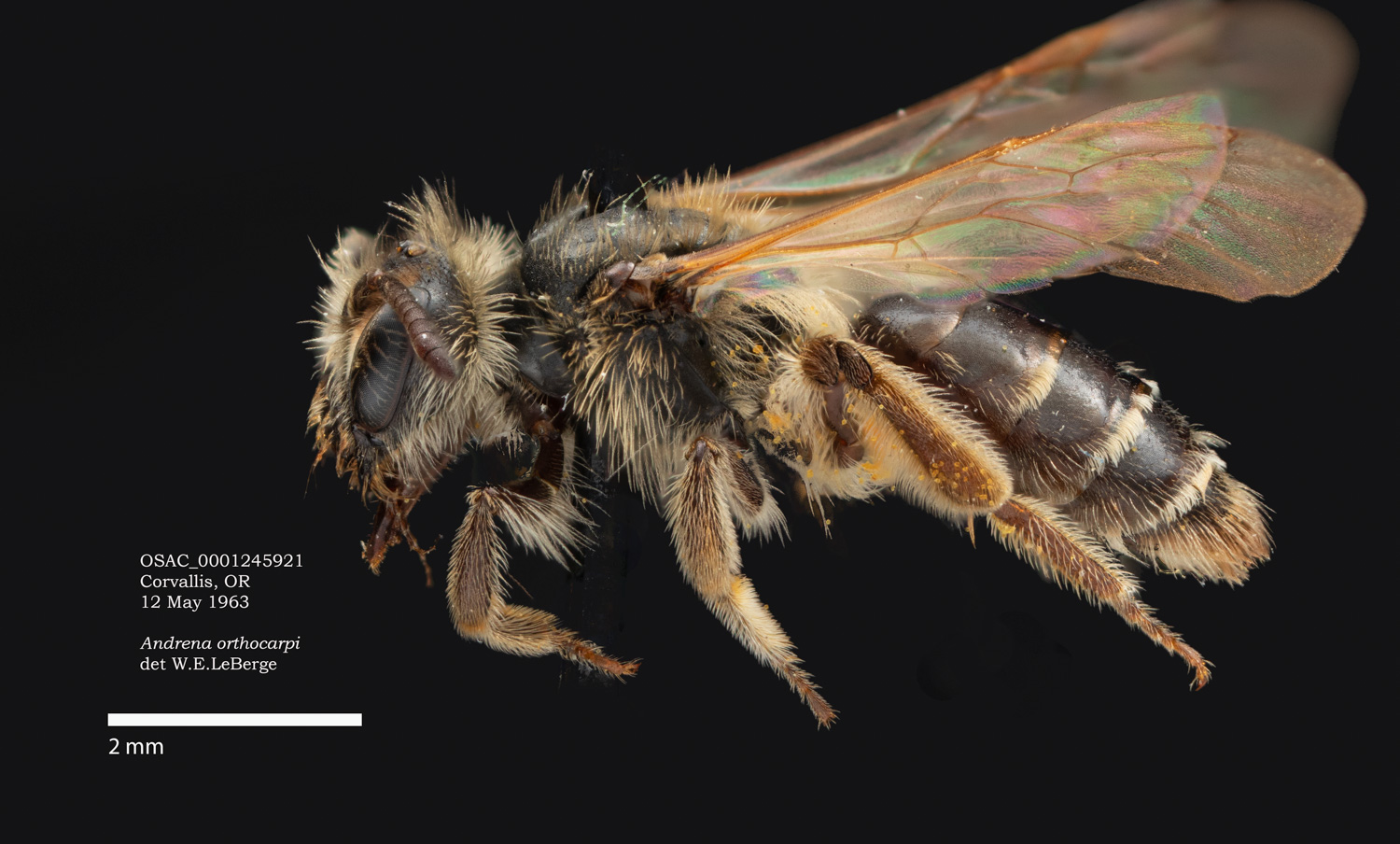
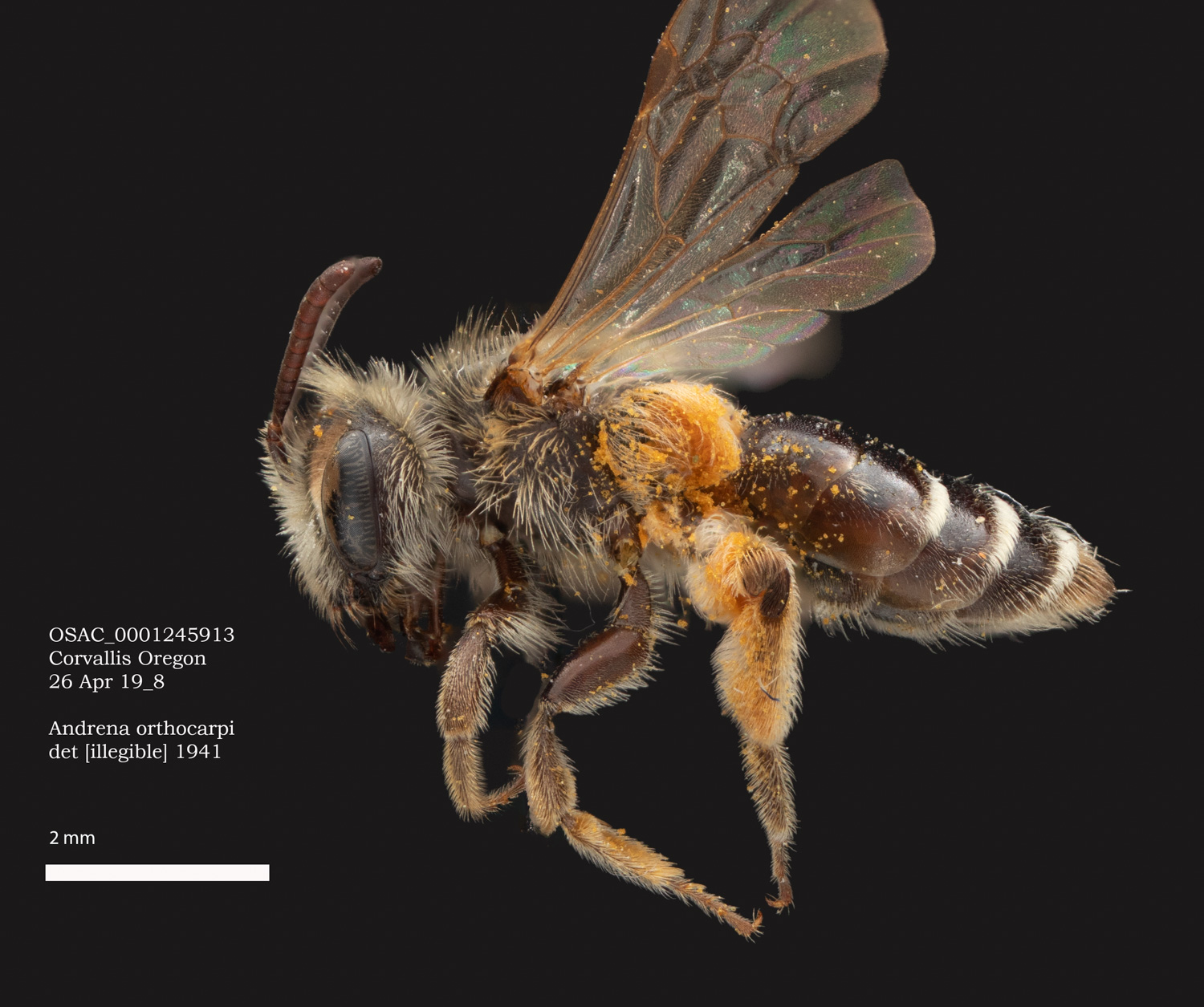
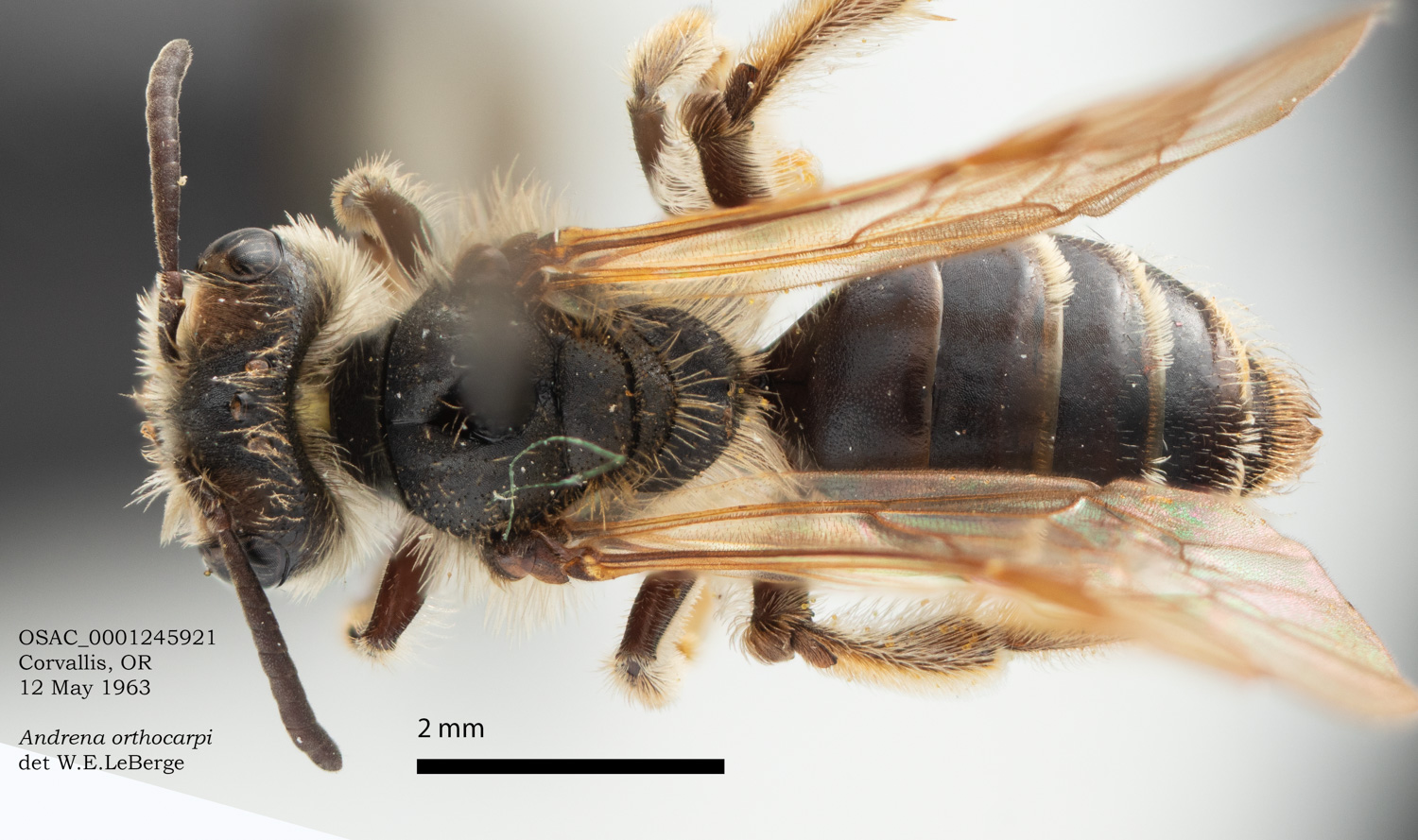
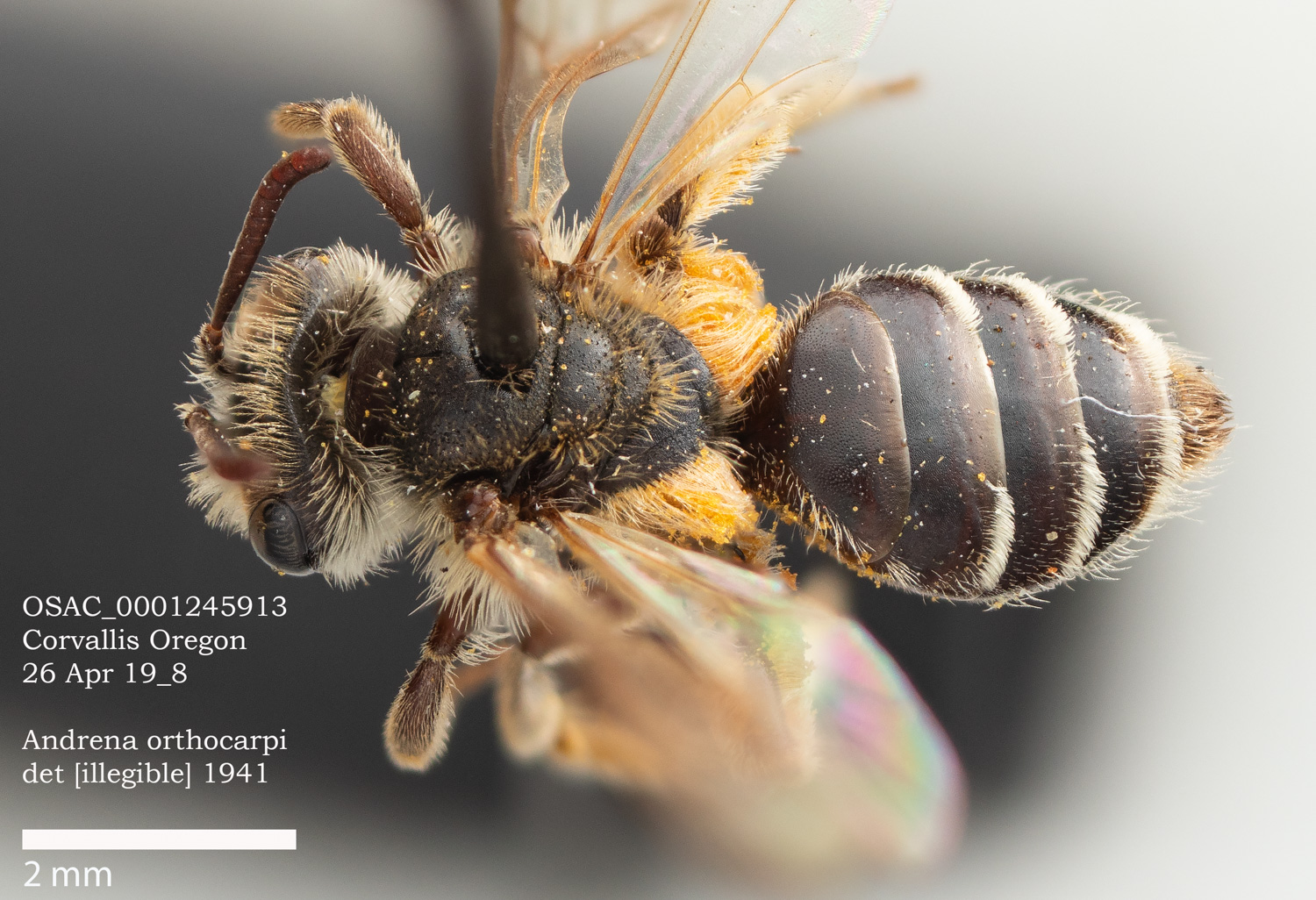
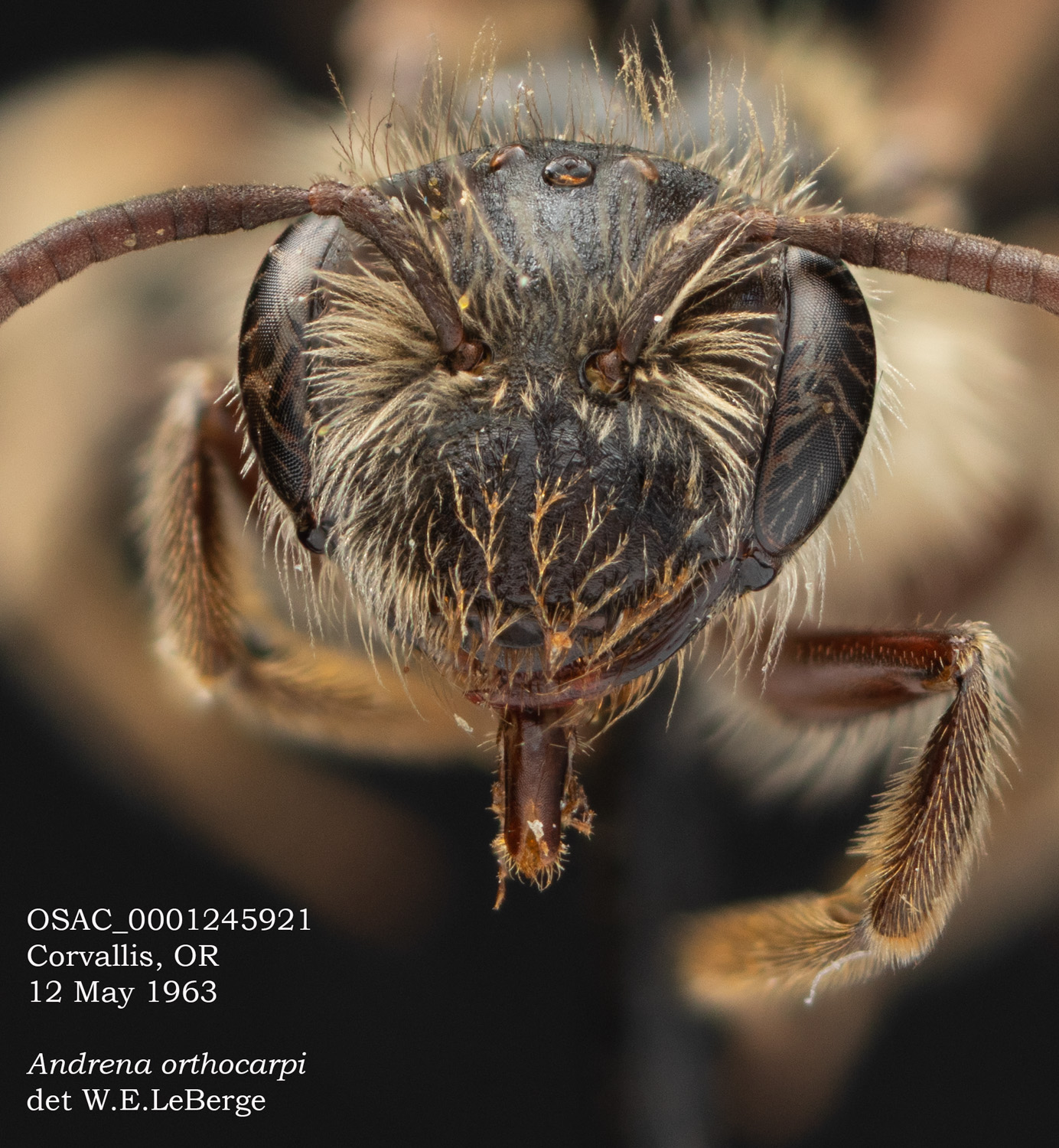
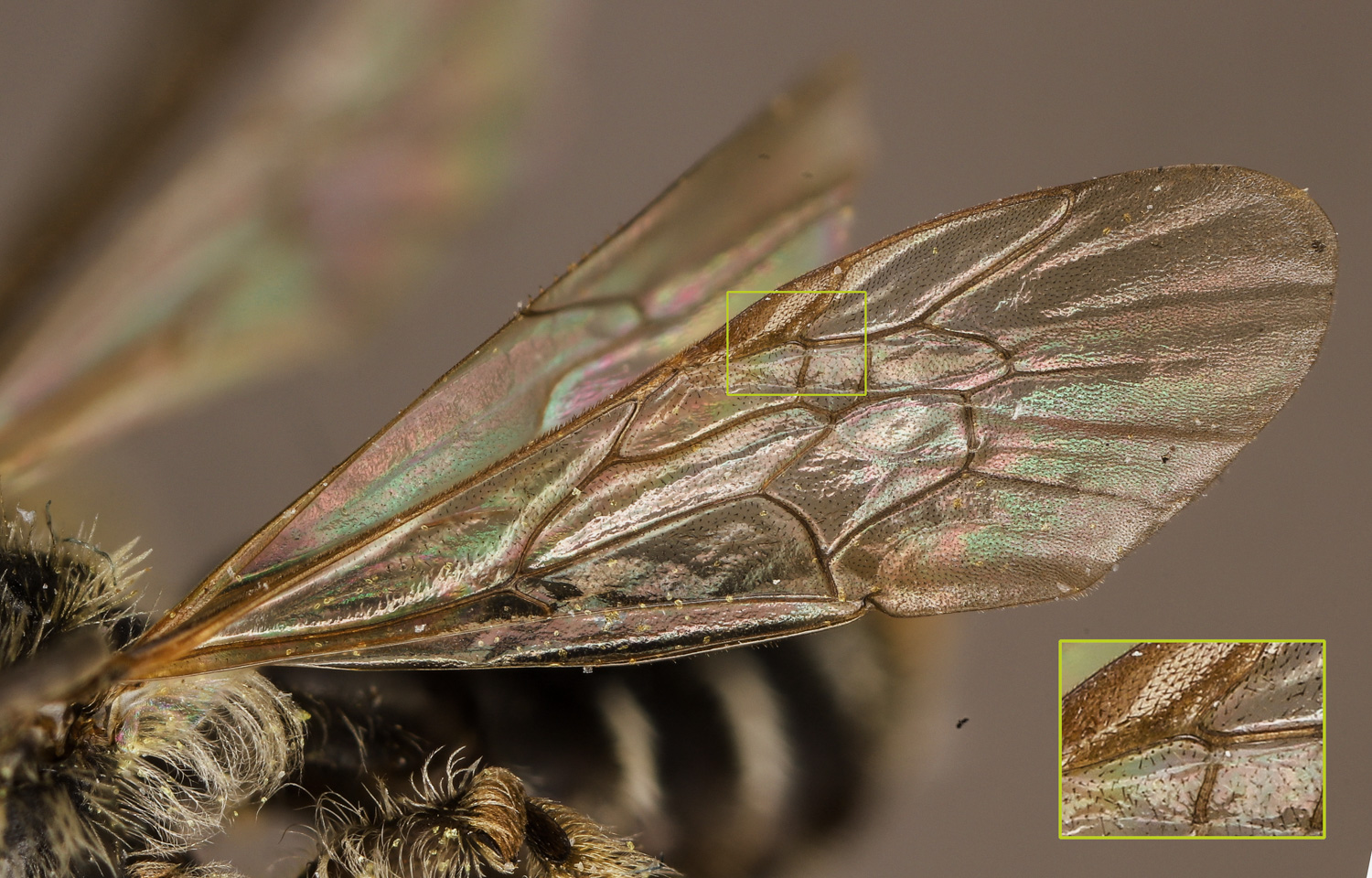
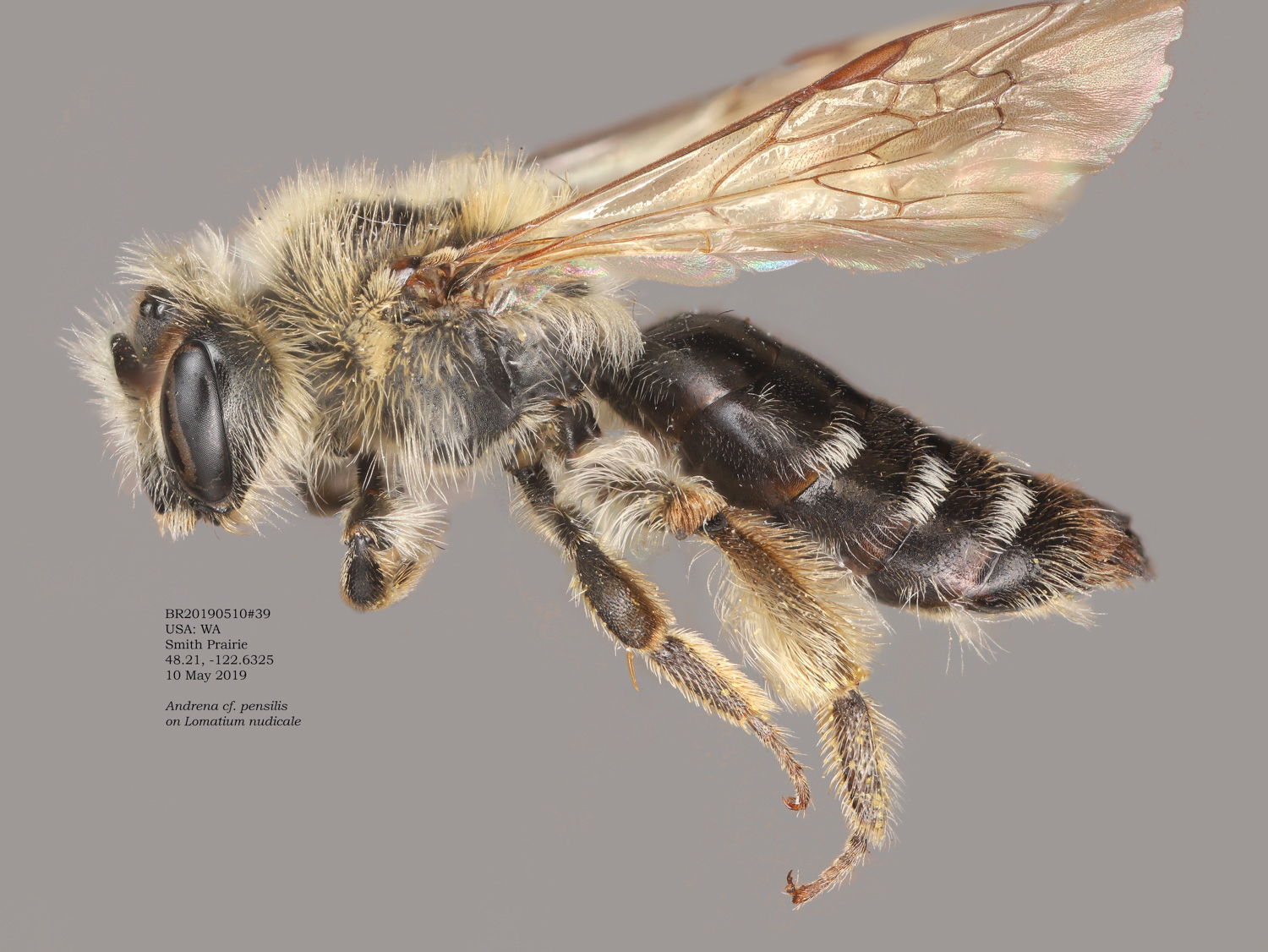
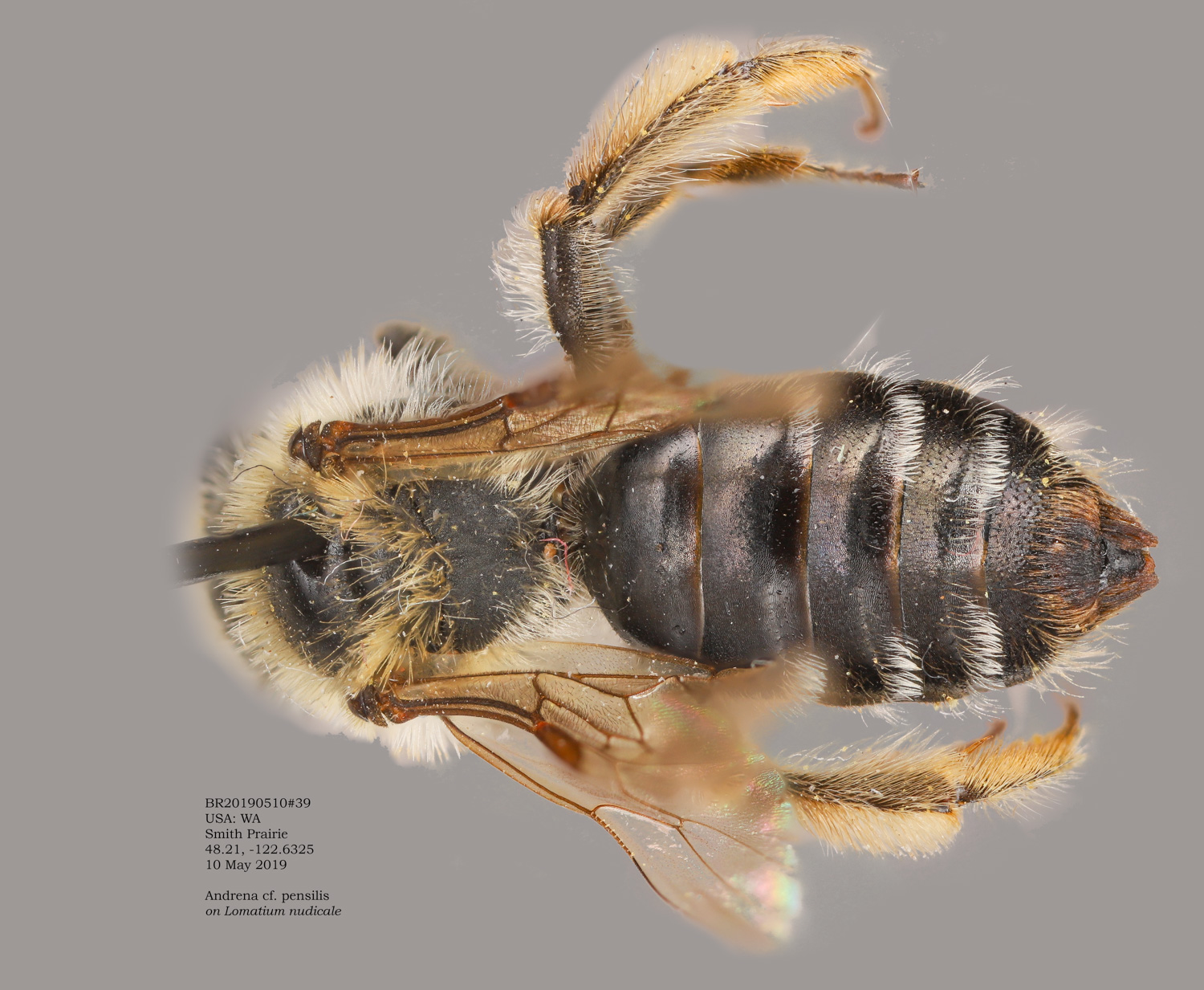
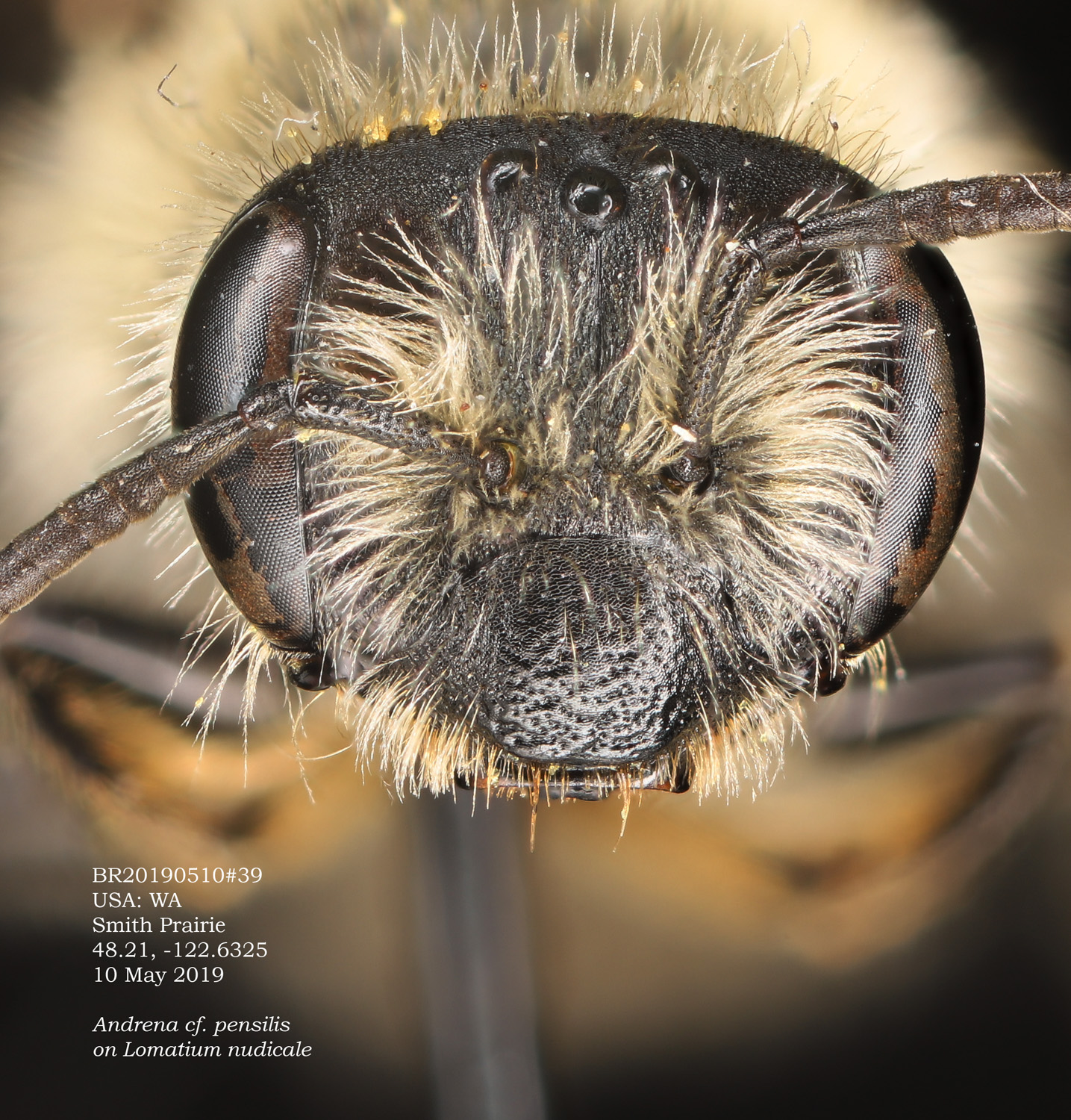
Result: Andrena orthocarpi or A. pensilis. Not pensilis, which has wavy clypeal hairs, and a long r vein. |
|
|
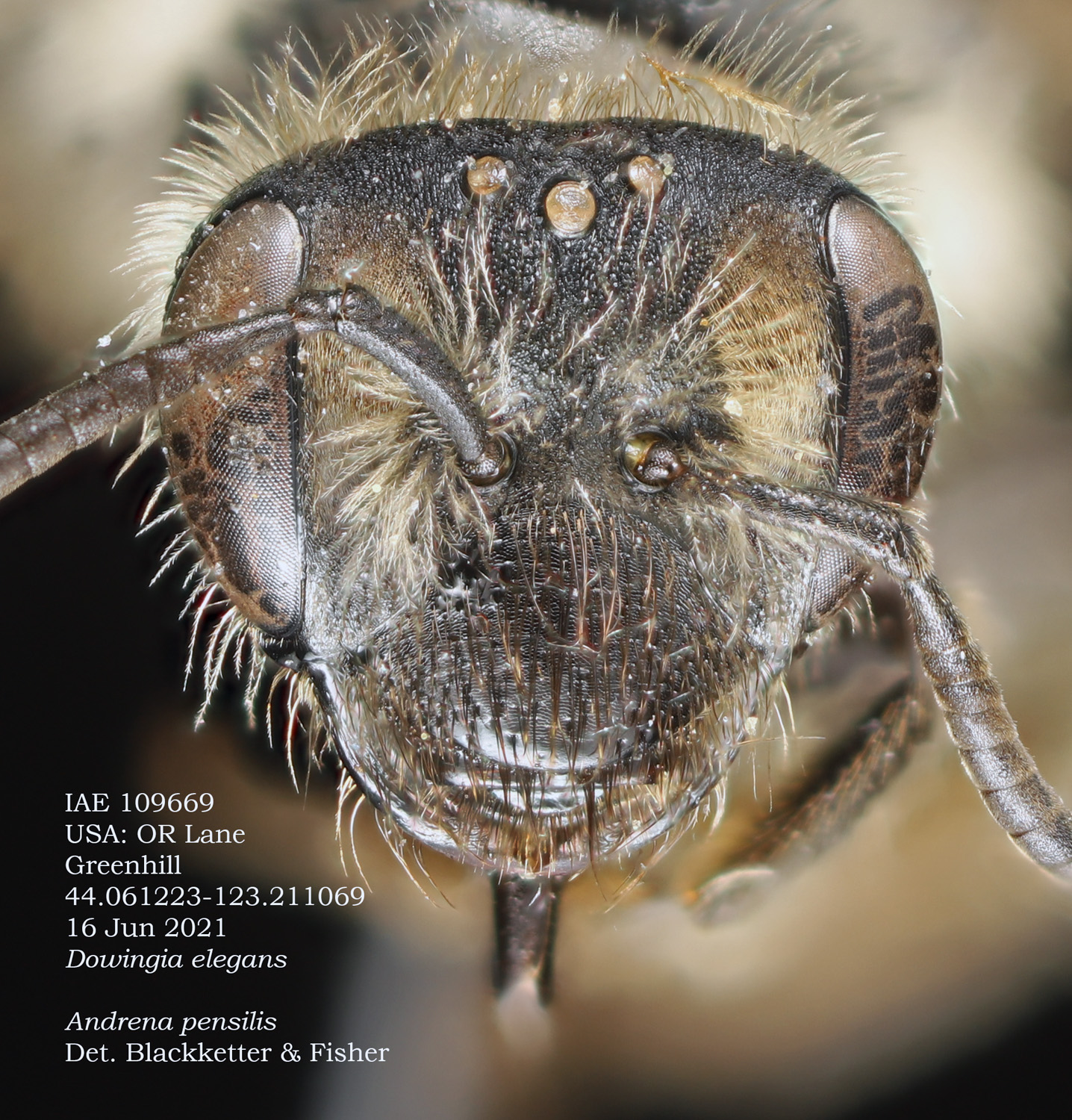
Below: Fovea long, malar space short, clypeal hairs plumose.
|
Easy calls:
|
|
|
Below: Fovea long, malar space short, clypeal hairs plumose.
|
Easy calls:
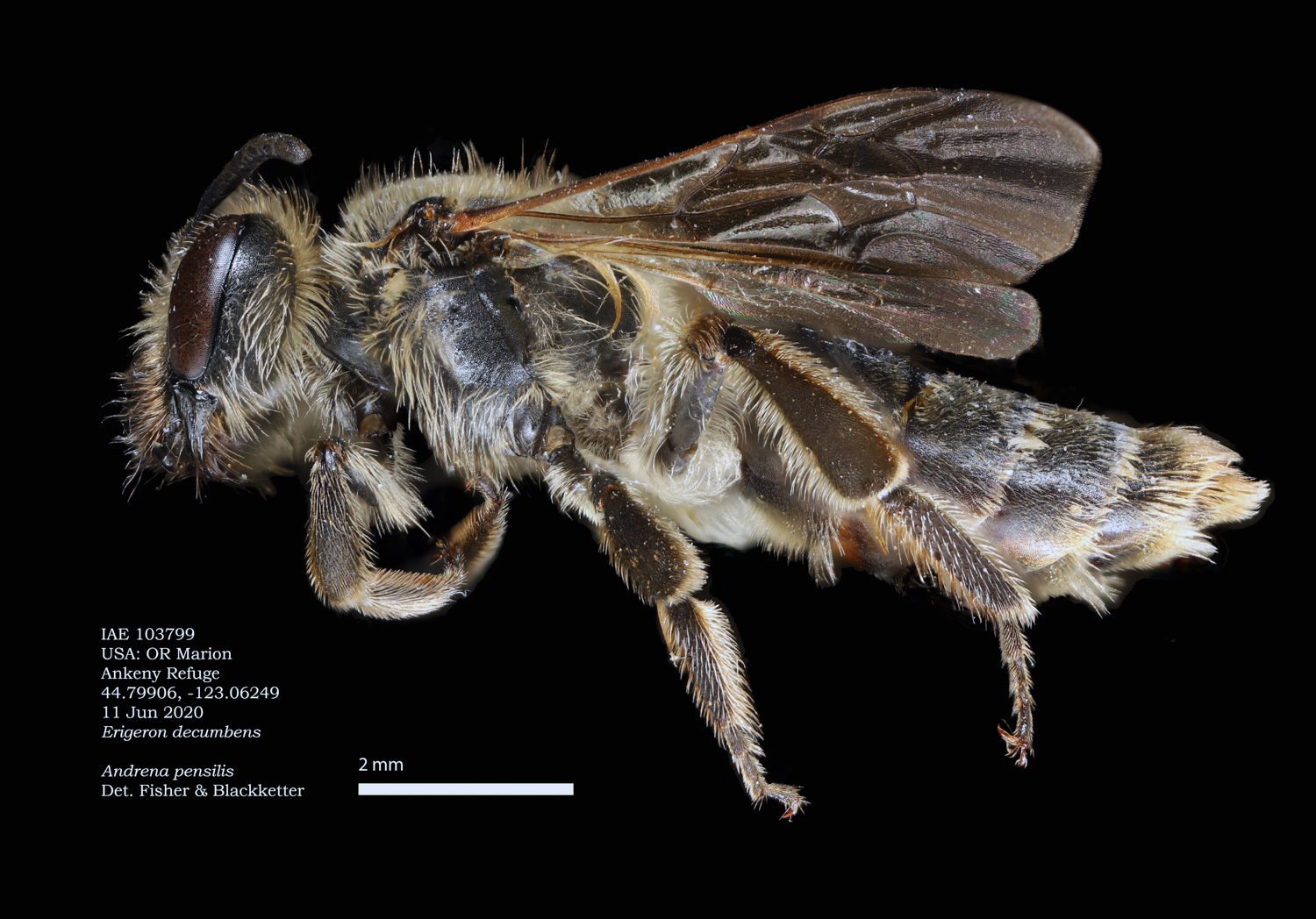
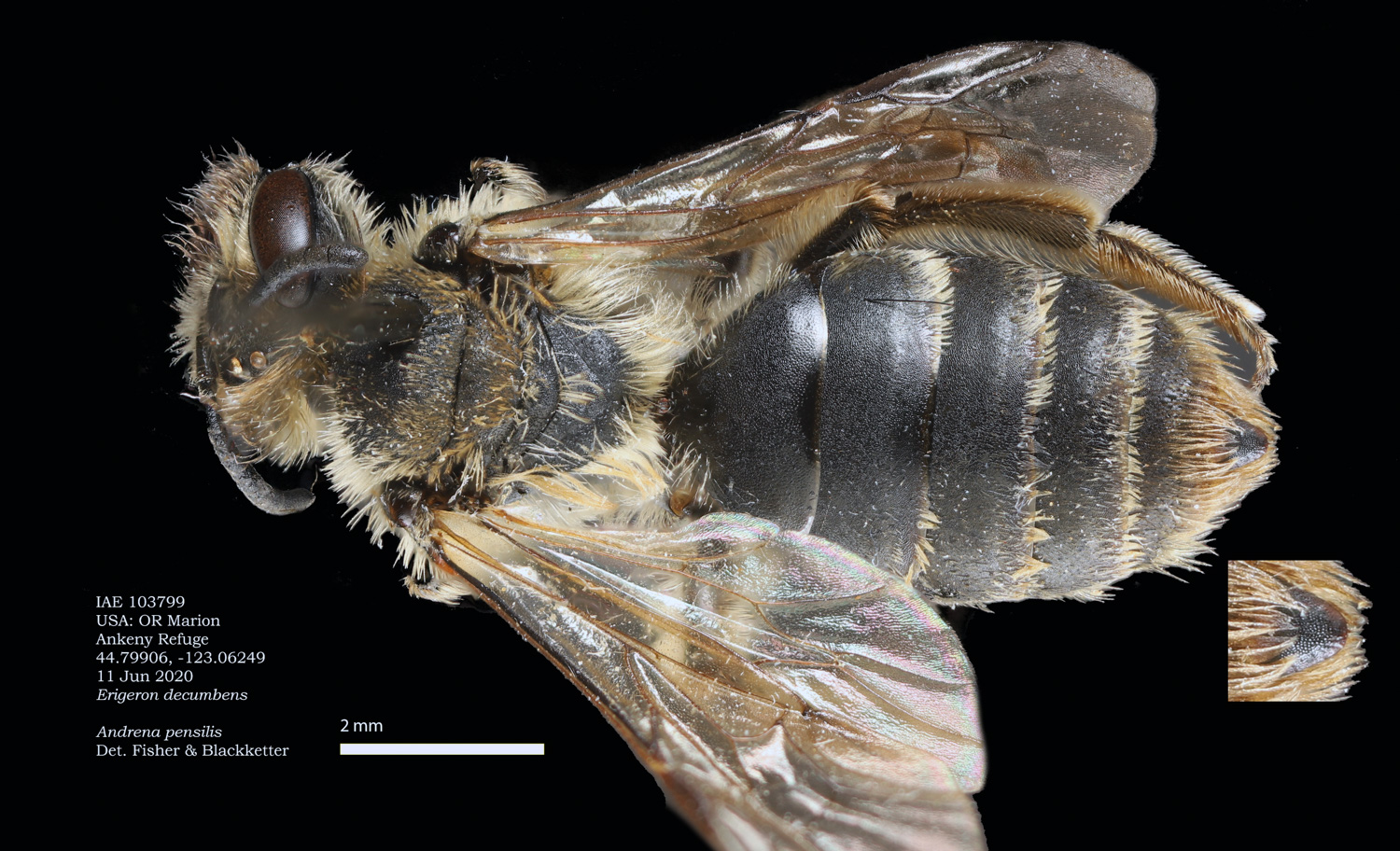
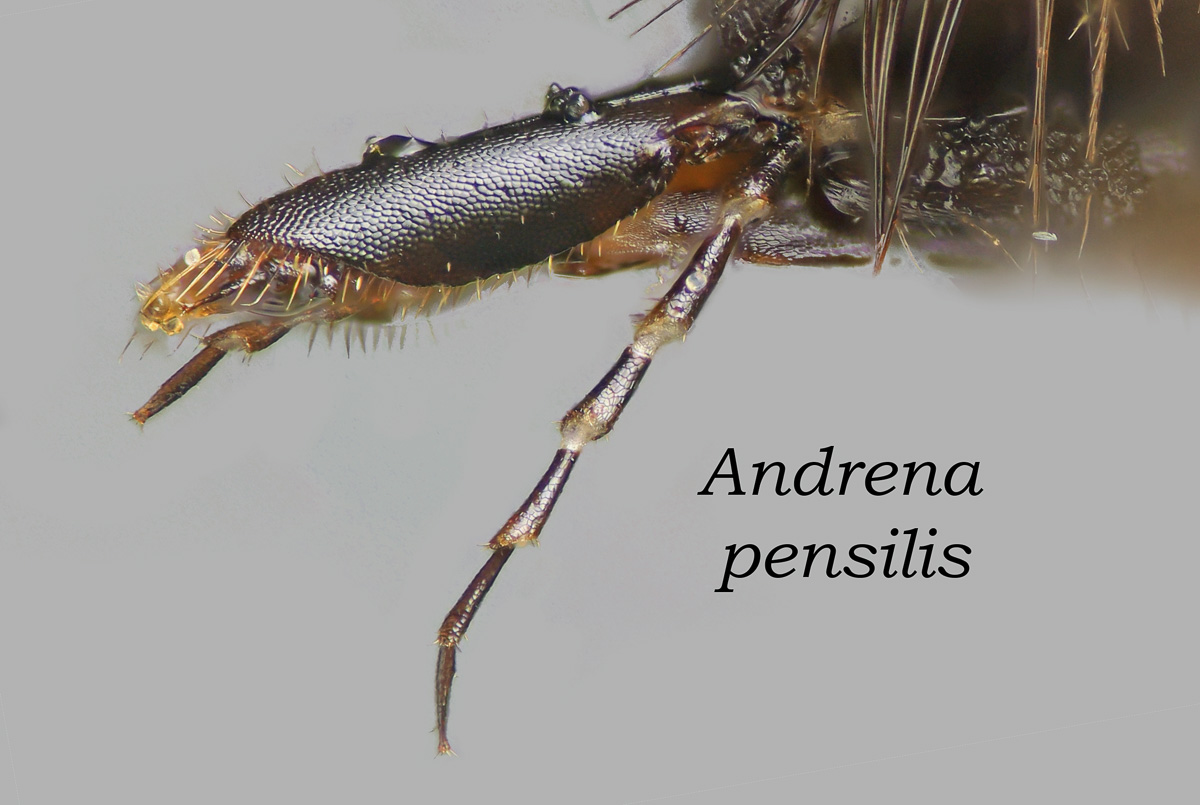
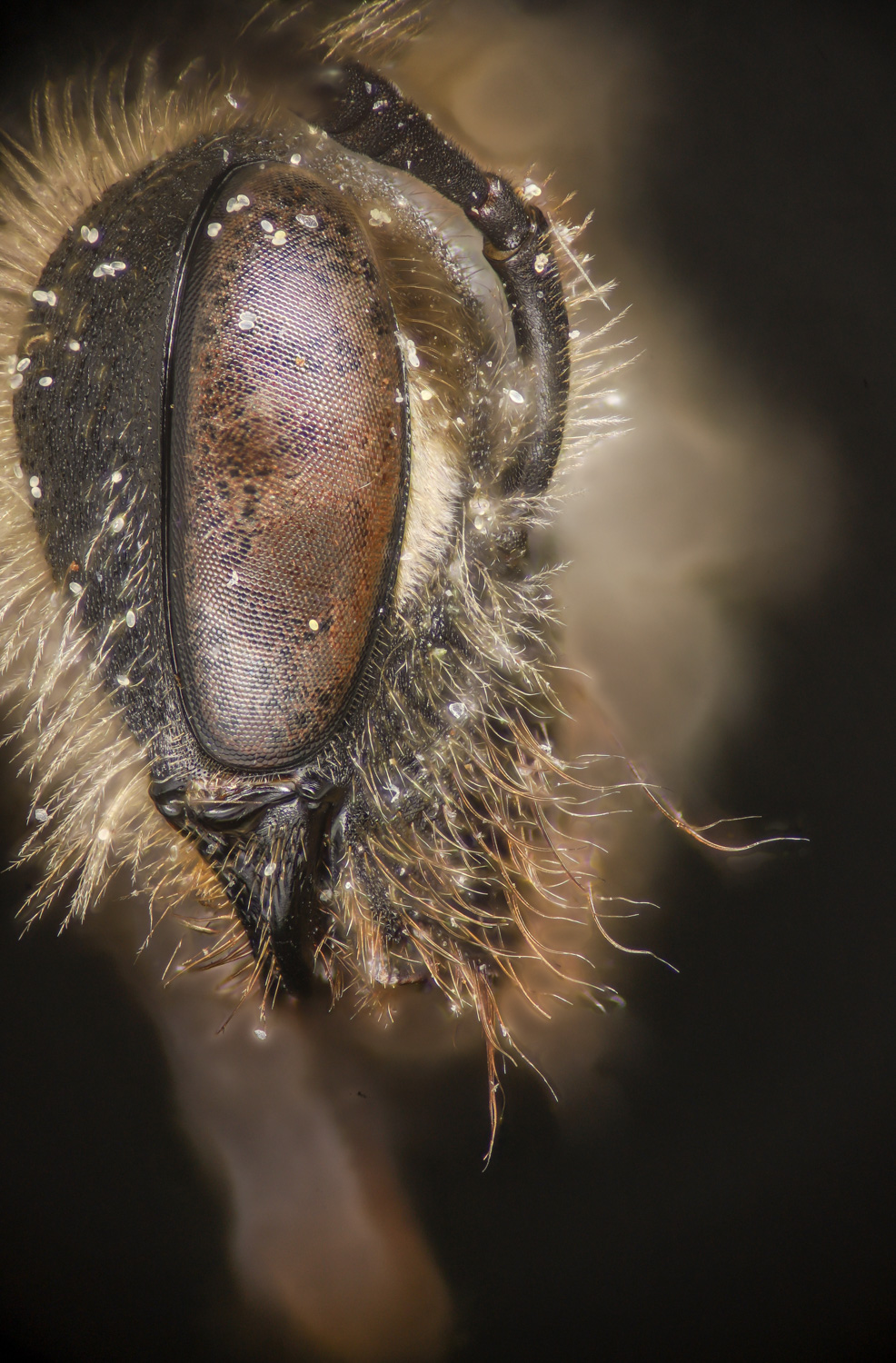
LaBerege: Andrena pensilis is a California species that is readily recognized in the female sex by the long, relative simple, tapering clypeal hairs, which are wavy distally (photo far right). This feature is evident in the half a dozen Oregon specimens I have. |
|
|
|
Easy calls:
A. lillooetensis appears as an artifact of limited scoring in DiscoverLife--it matches because potentially disqualifying traits are not recorded in the guide. Disqualifying for A. thaspii: "labral process bidentate with a basal transverse depression" and "malar space approximately ΒΌ width of mandible." |
Not pensilis: straight clypeal hairs, narrow hind tibia.
|
Not pensilis: emarginate labral process.
|
|
Easy calls:
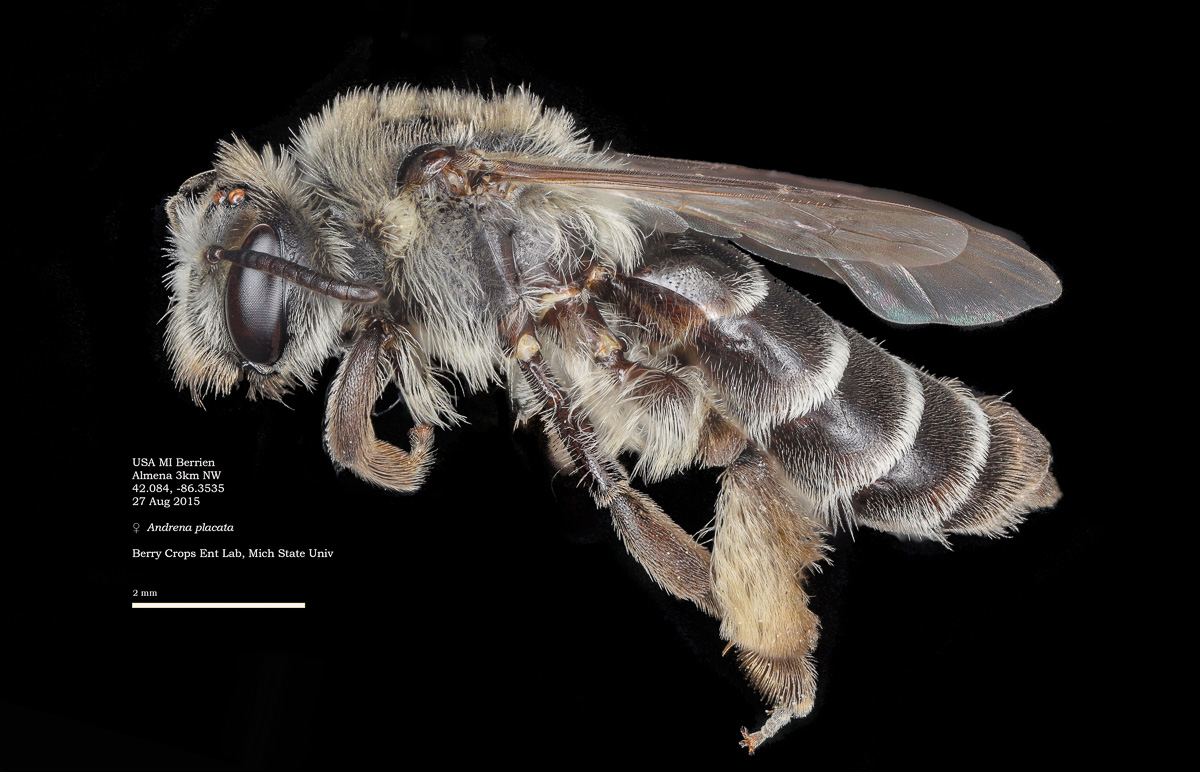
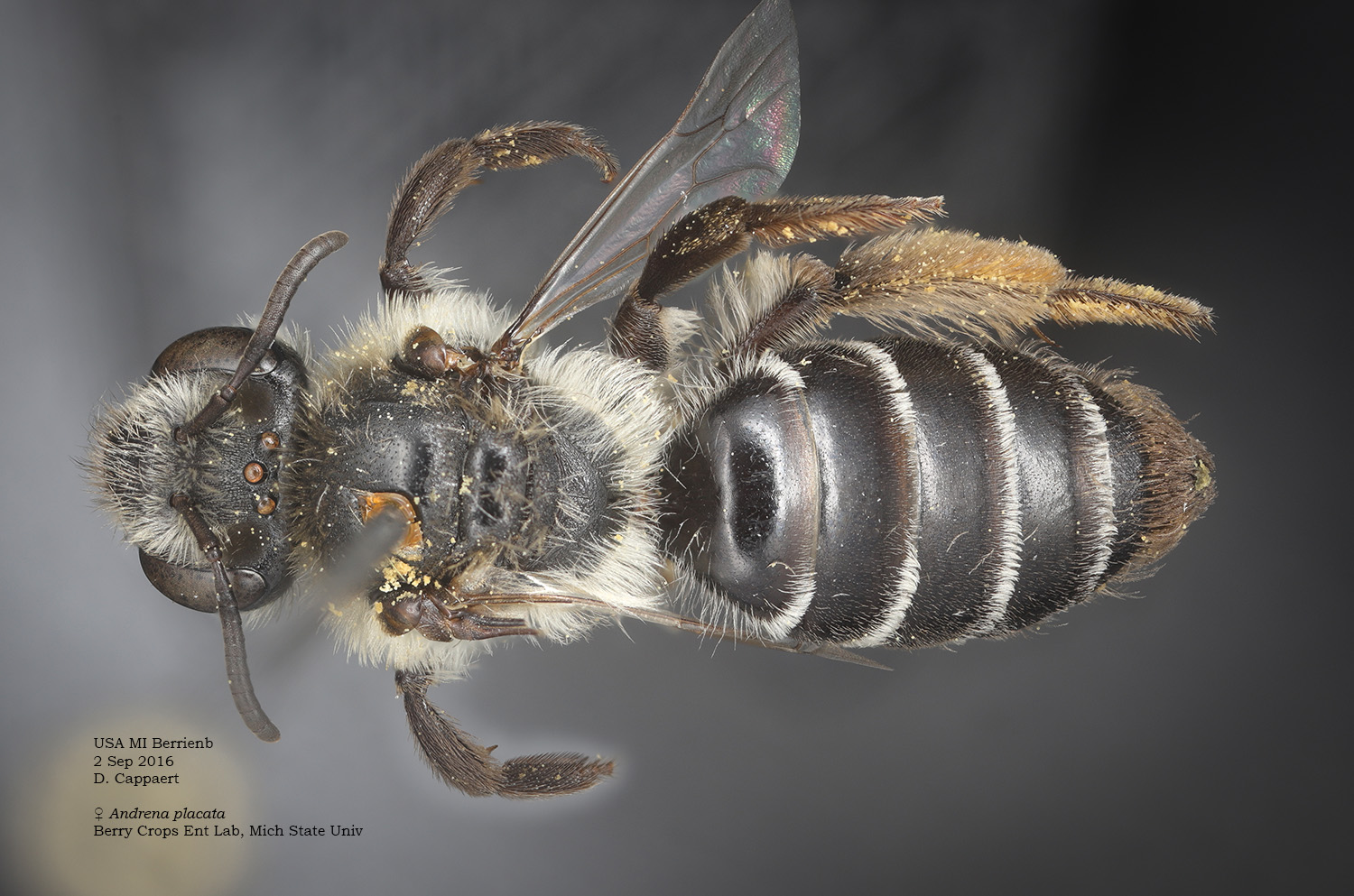
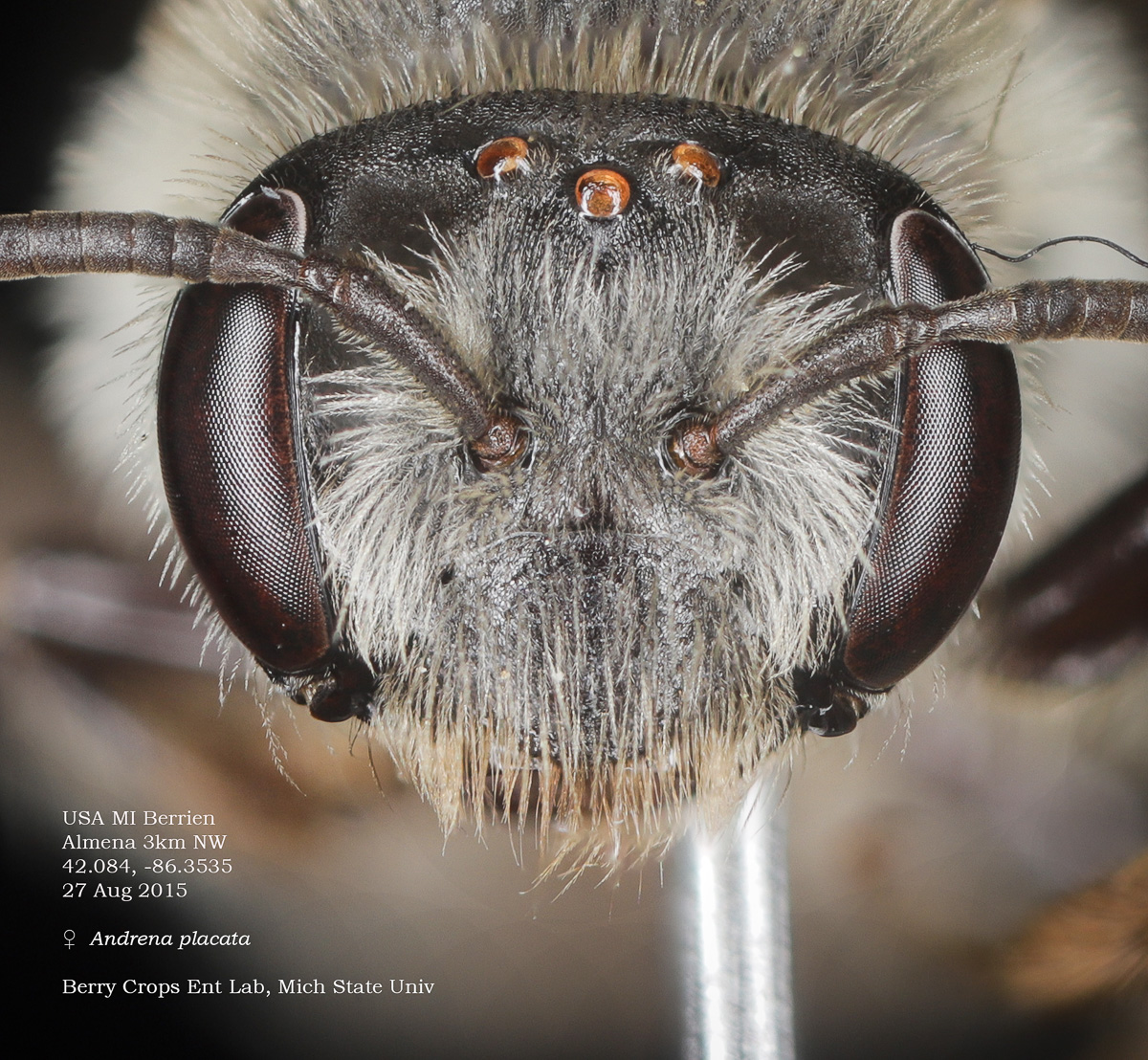
|
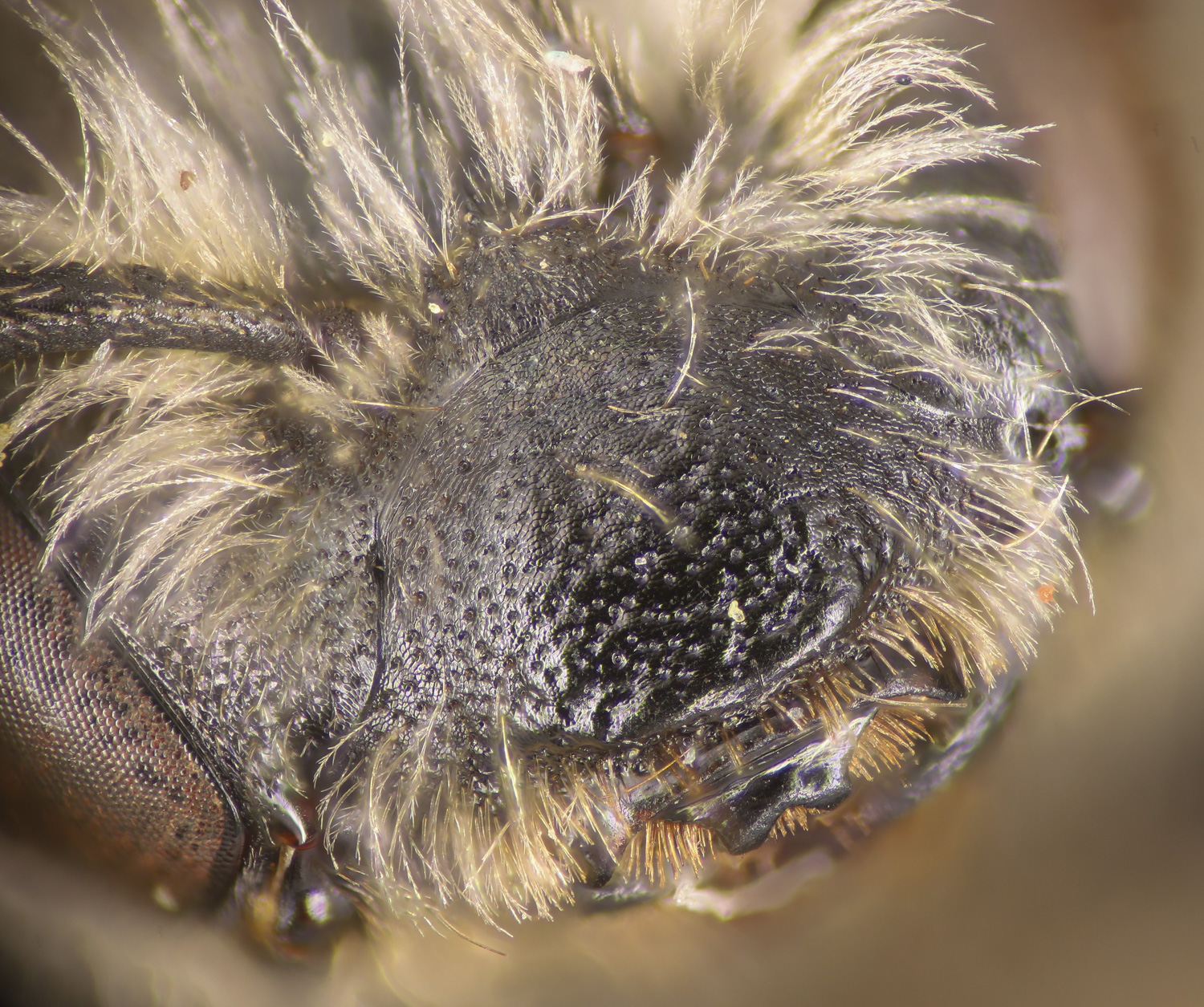
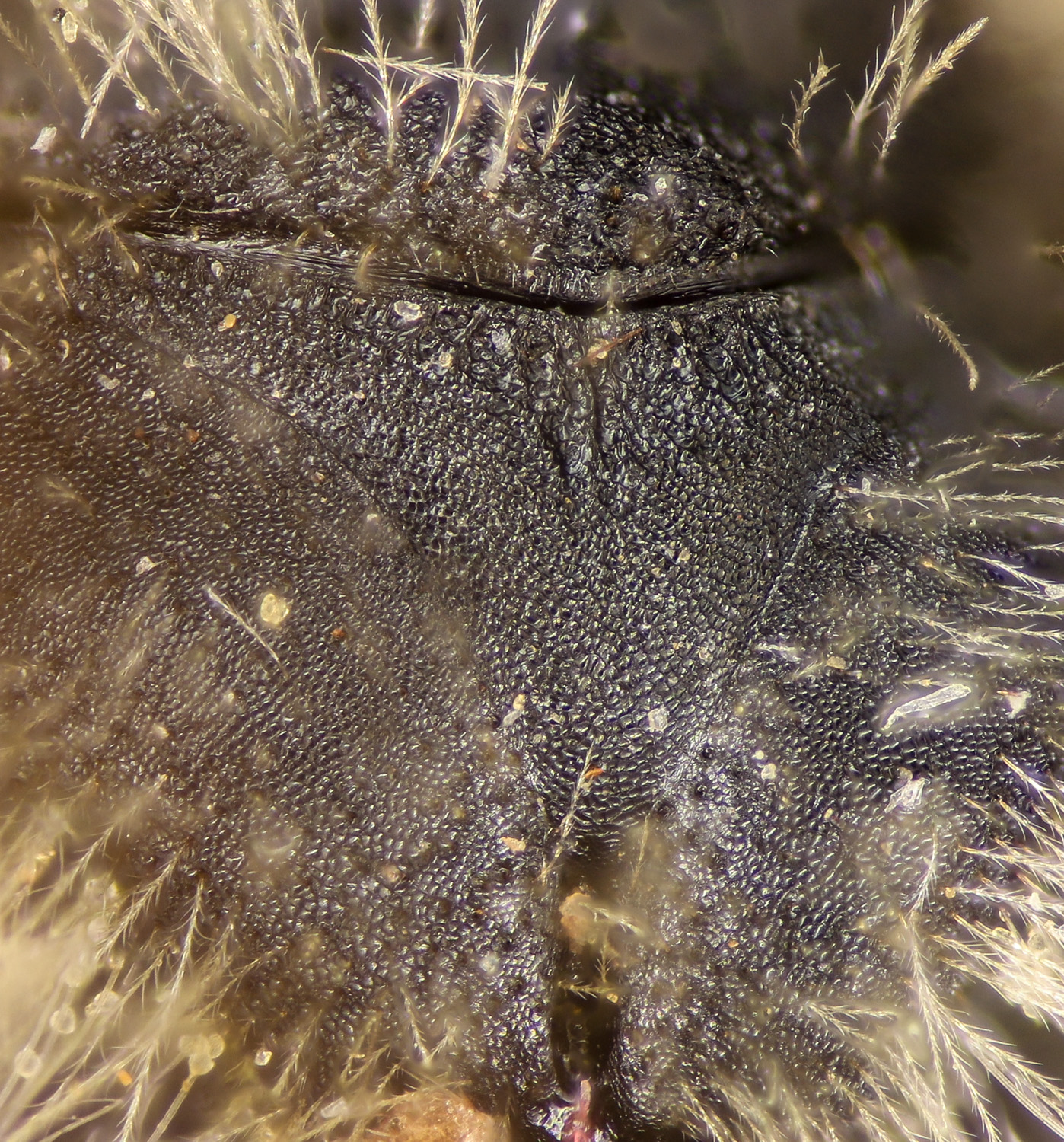
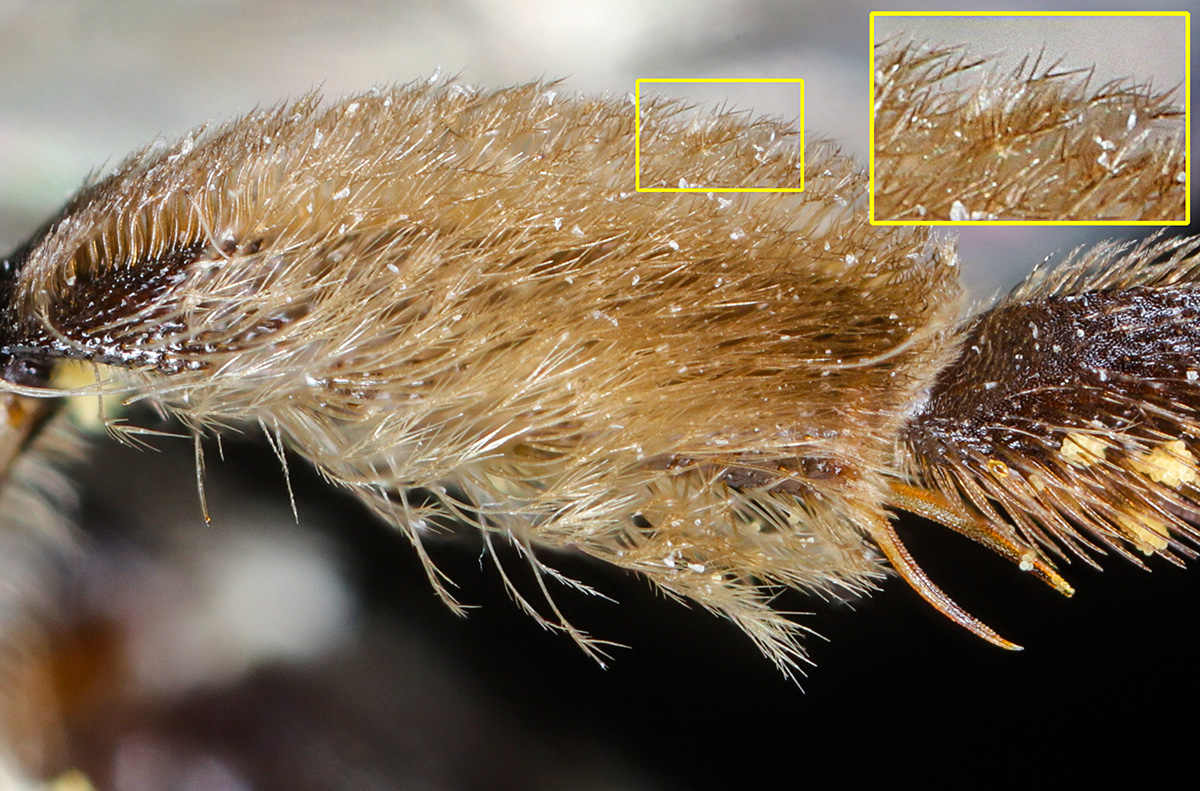
Evidence against A. wilkella: this specimen with plumose tibial scopa (simple in wilkella); absent impuncate center of clypeus (present in wilkella).
A. placata feature: "Terga 5 and 6 hairs usually dark brown." |
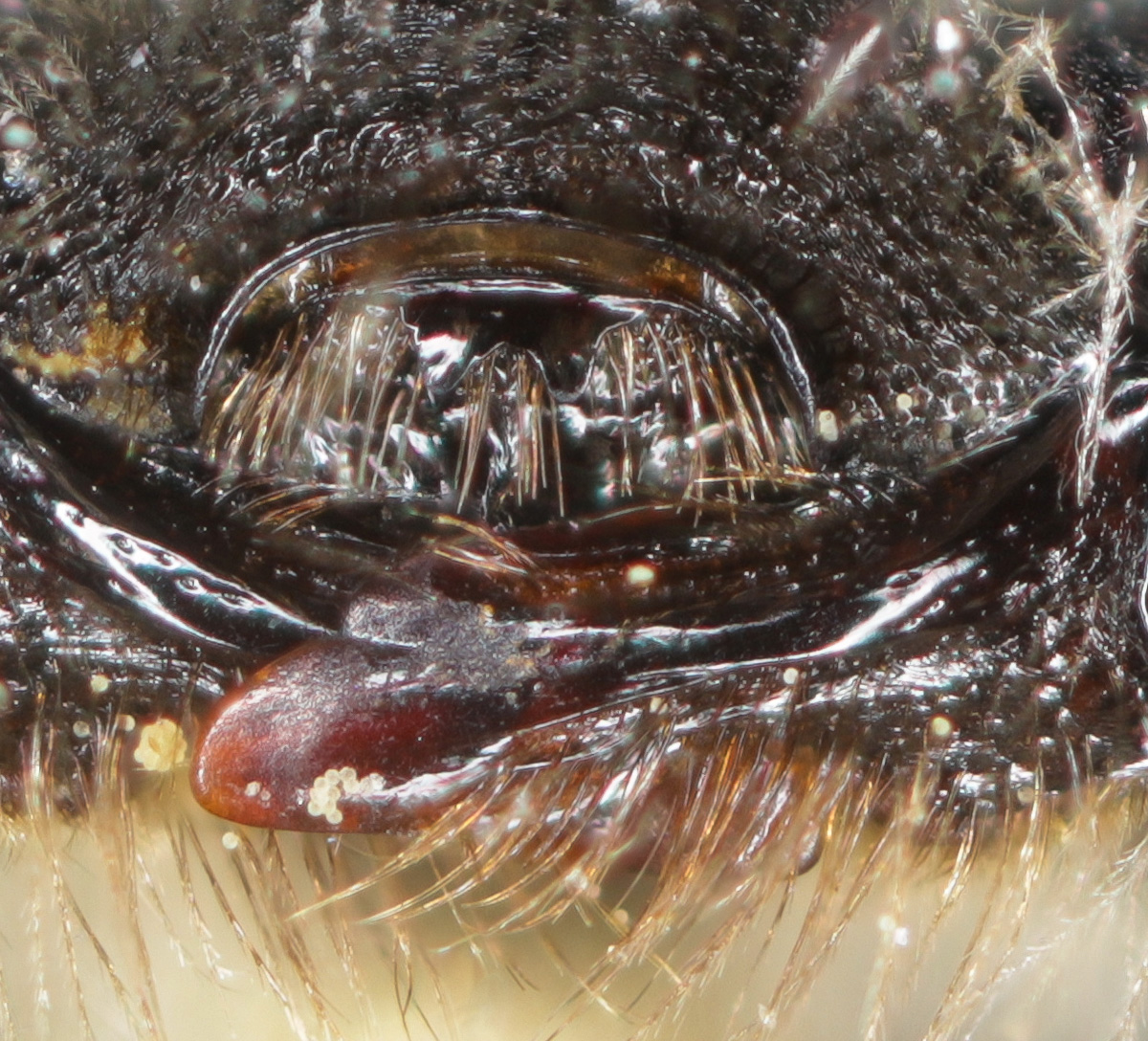
Above: Medial impunctate band of clypeus absent; A. wilkella would have this condition.
Below: Distinctly bidentate labral process. ![]() |
Above:Highly plumose tibial scopa; simple in wilkella.
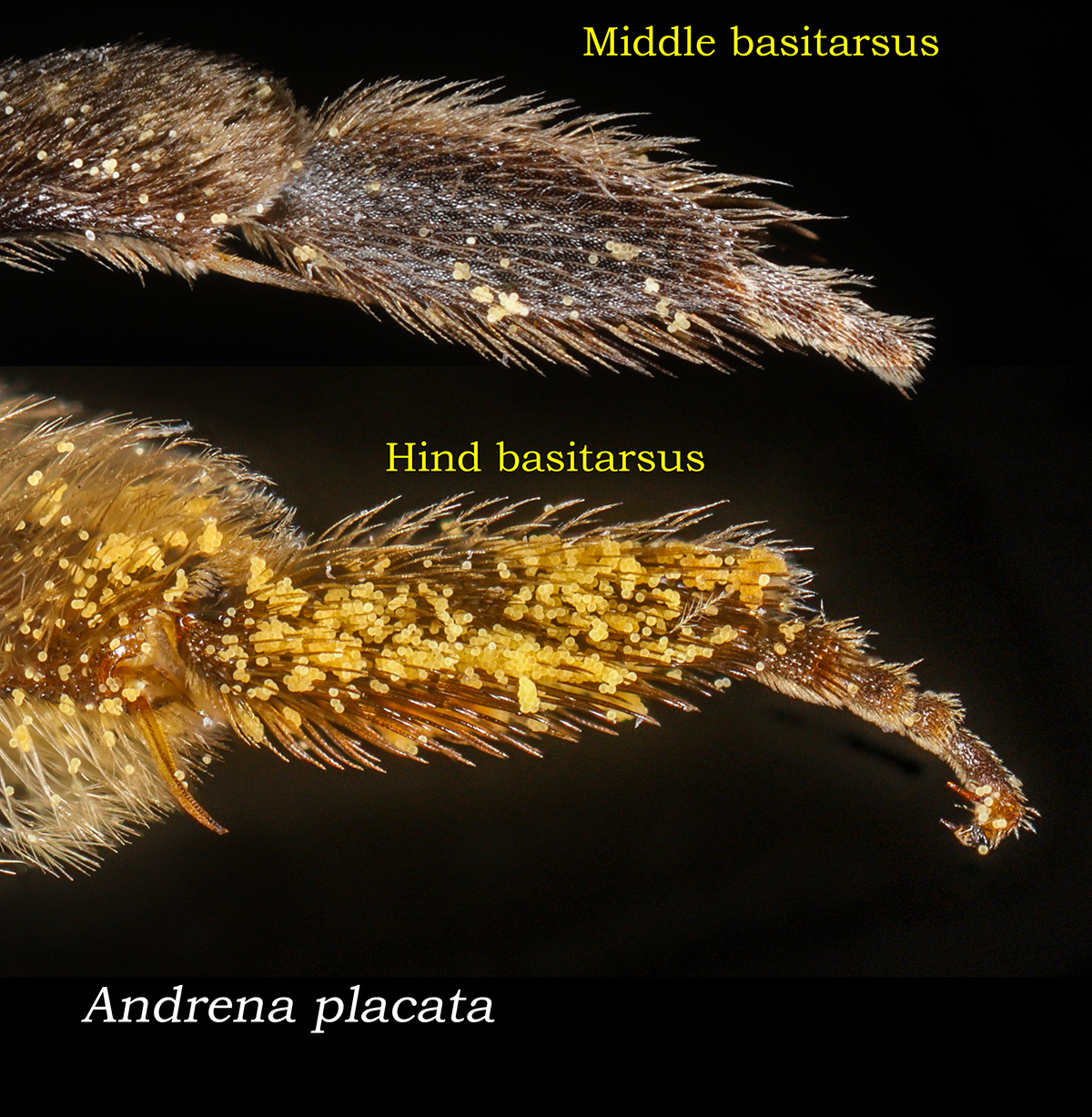
Below:Of the three options, only A. placata has the middle leg basitatsus "expanded medially, broader than hind basitarsus."" |
Easy calls, based on images at right:
|
A. dunningi traits that don't match: Moderate or broad fovea, "UNIQUE in this group for having tibial scopal hairs below basitibial plate washed with black or dark brown."
Issues: interpretation of the fovea. A. pruni is distinguished from dunningi (and others) as UNIQUE in this group for having facial fovea separated from inner eye margin by width of antennal pedicel or more, usually much more, the distance between the fovea and eye much wider in the center than the ends of the fovea." Not obviously the case here. |
|
|
Easy calls:
|
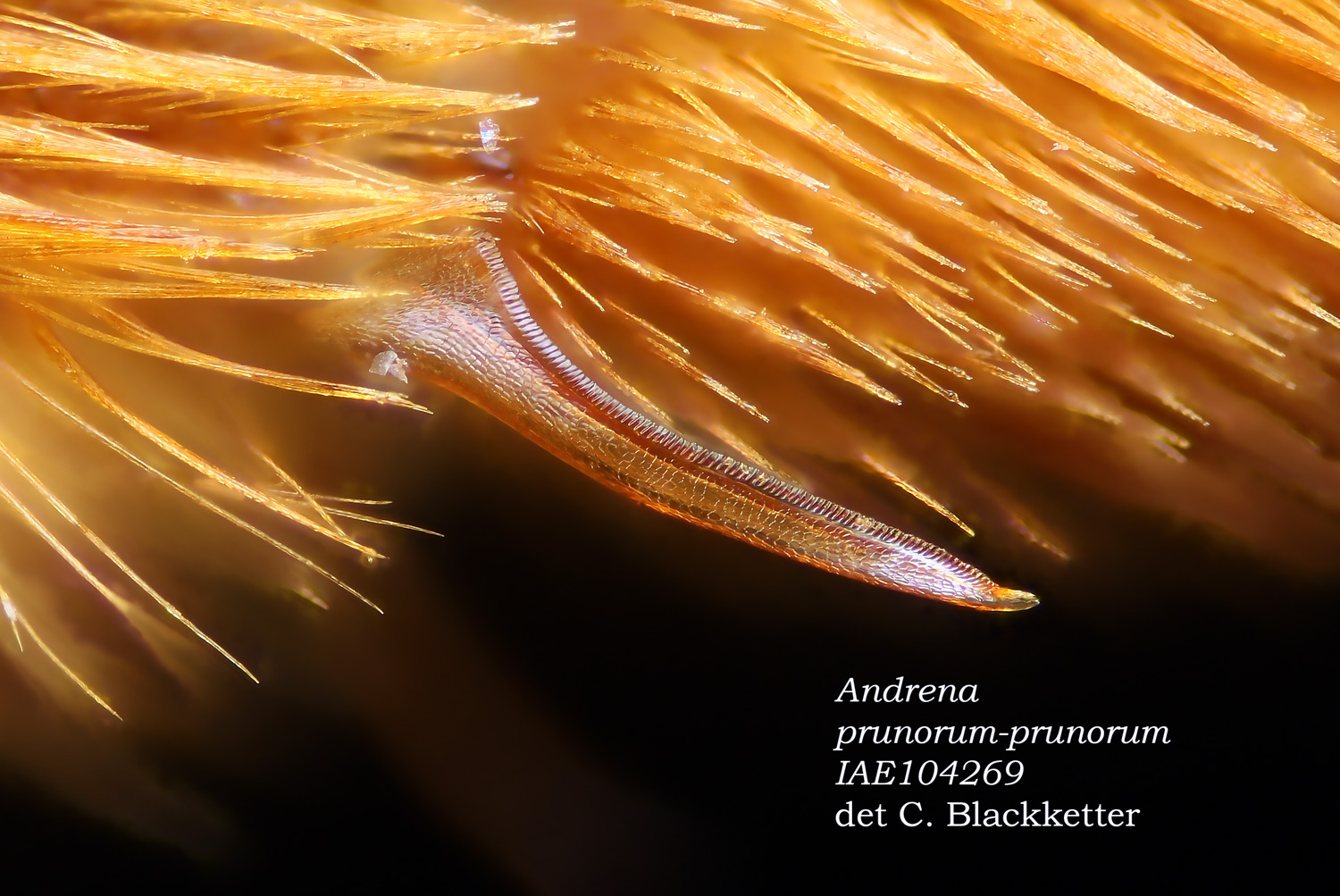
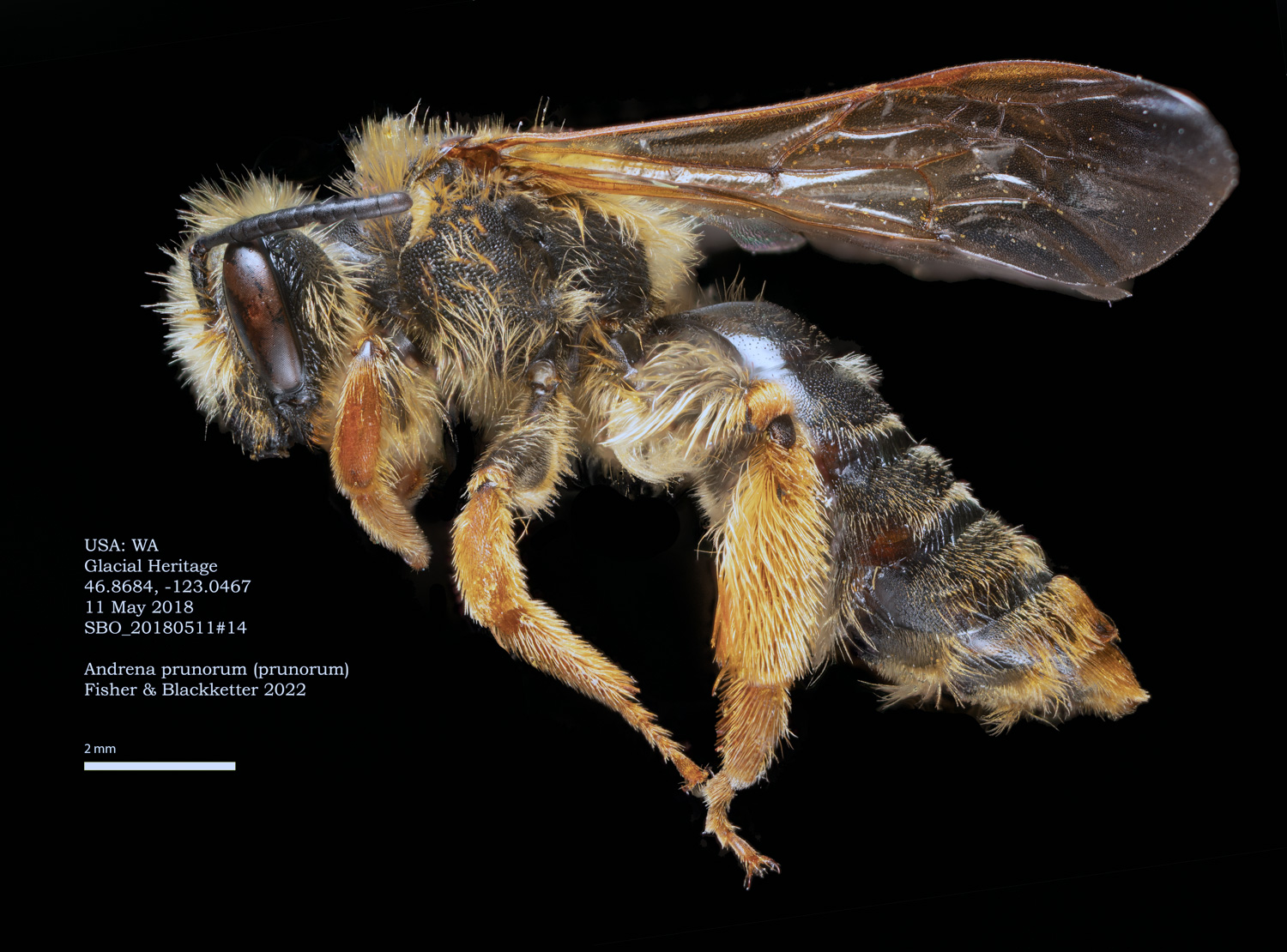
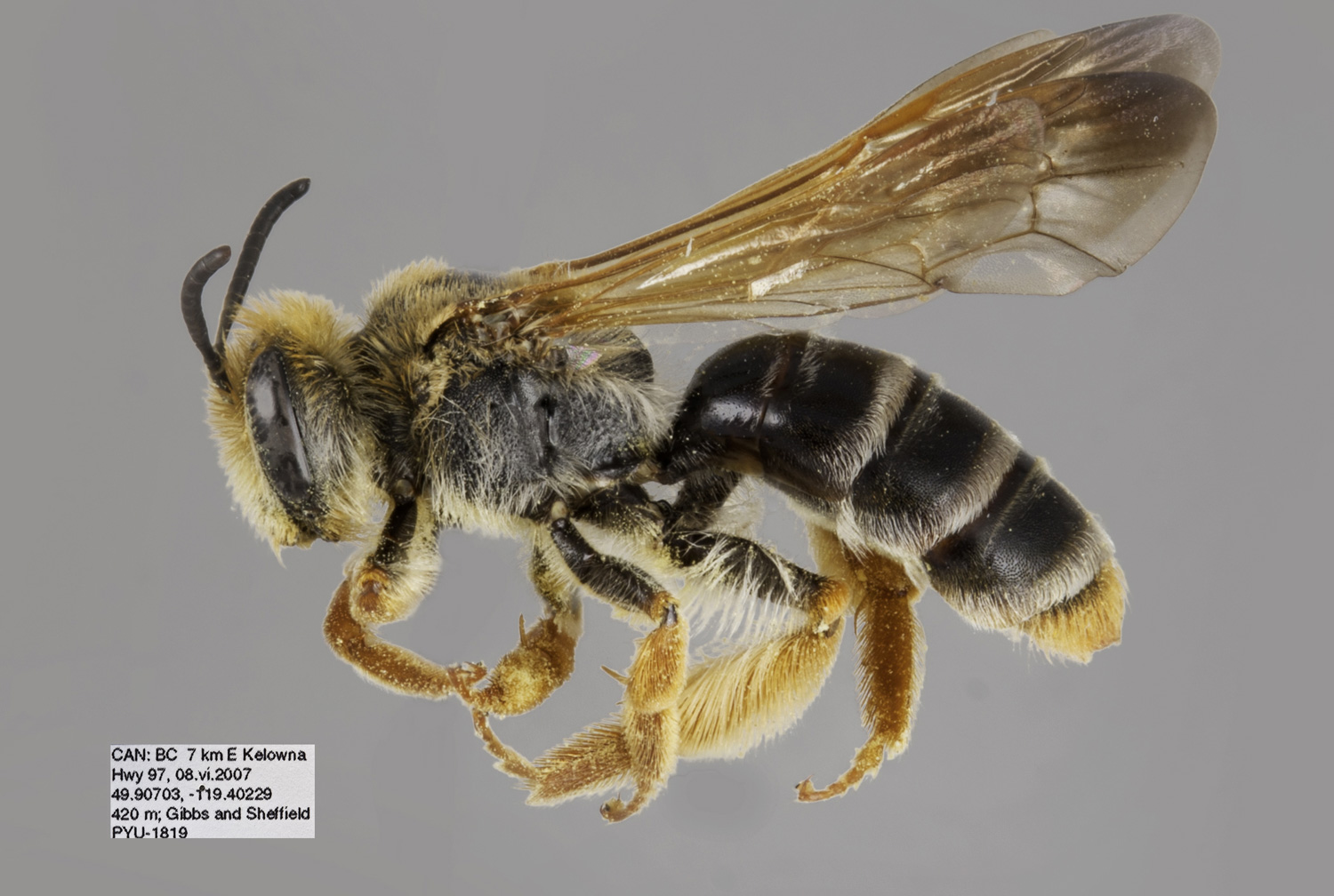
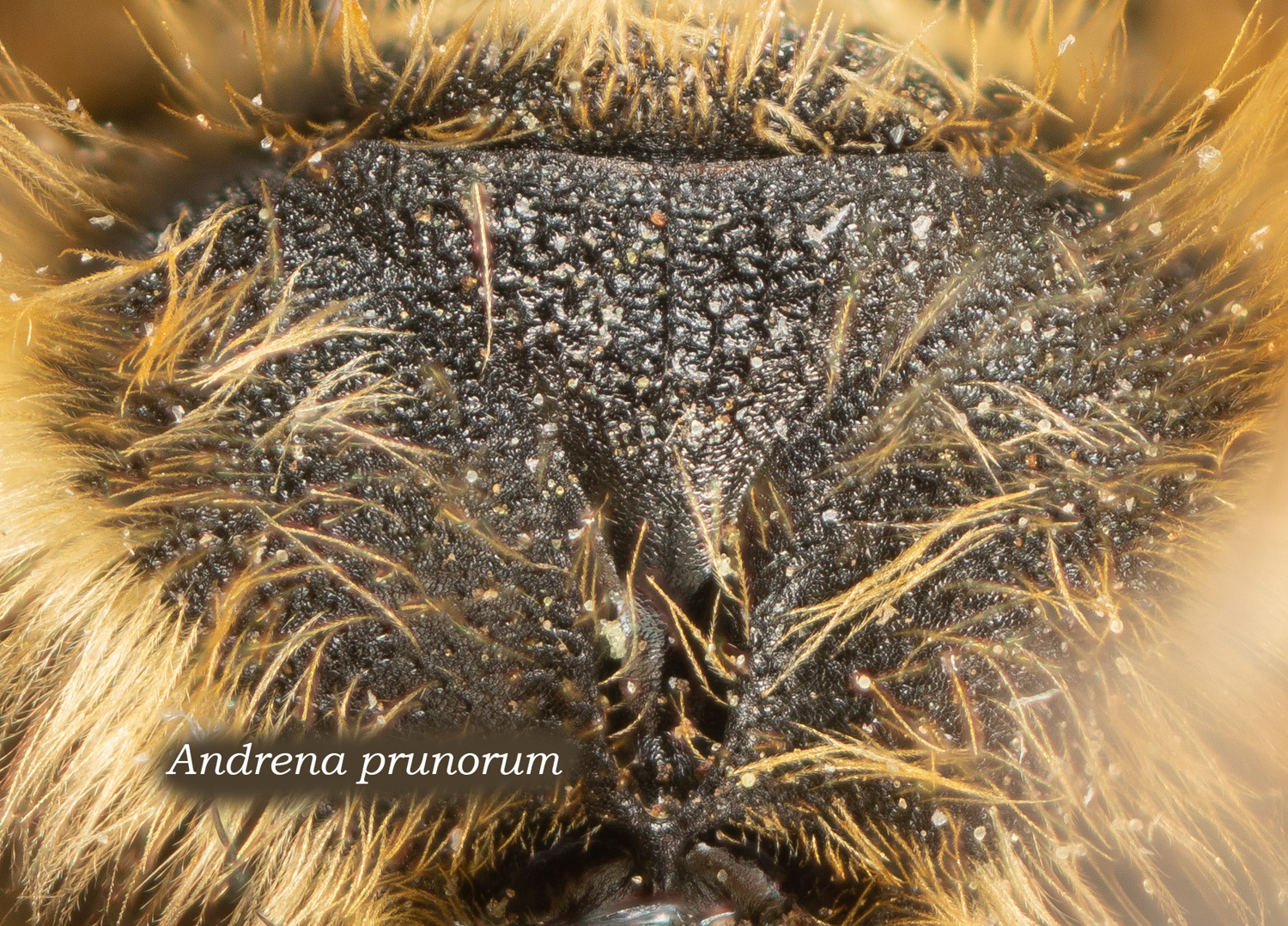
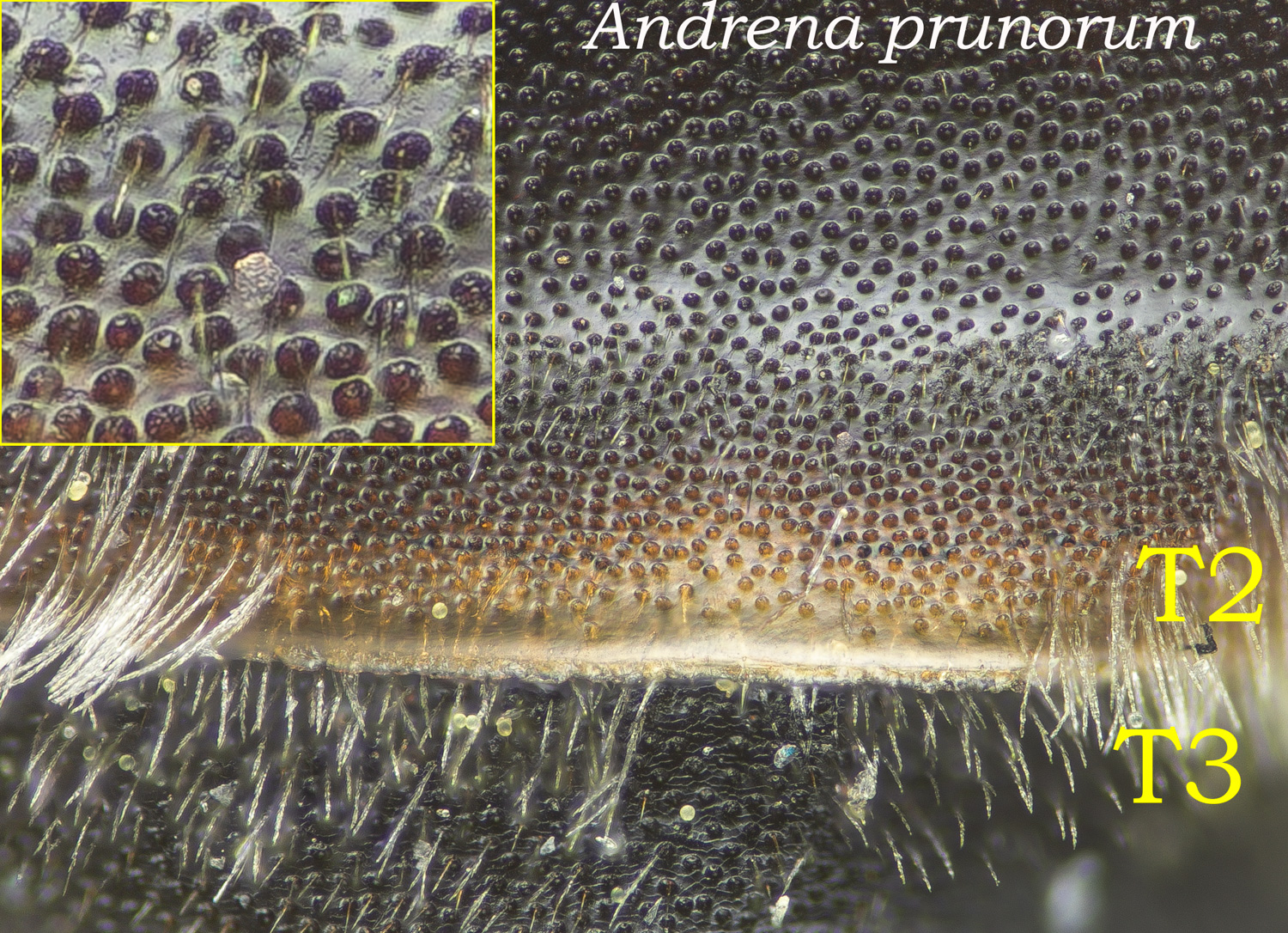
Unambiguous. The spur with broadened base is shared with only one other Washington species (A. crataegi). Add complete T2 hair band and only A. prunorum remains.
|
Image from Bees of Canada, Packer Lab.
Other hallmarks of the species: "the usually red legs of both sexes and the coarsely rugatulopunctate mesepisterna of both sexes." |
|
Easy calls:
All matches are subgenus Trachandrena, characterized coarse sculpturing, an entirely rugose, enclosed propodeum, and fovea narrowed at the level of the antennal socket. DL does not unamnbiguously resolve species. So I consulted A Revision of the Bees of the Genus Andrena of the Western Hemisphere. Part VI. Subgenus Trachandrena (LaBerge). A. fuscicauda doesn't match this specimen in several respects. Differentiating miranda and salicifloris is harder. |
|
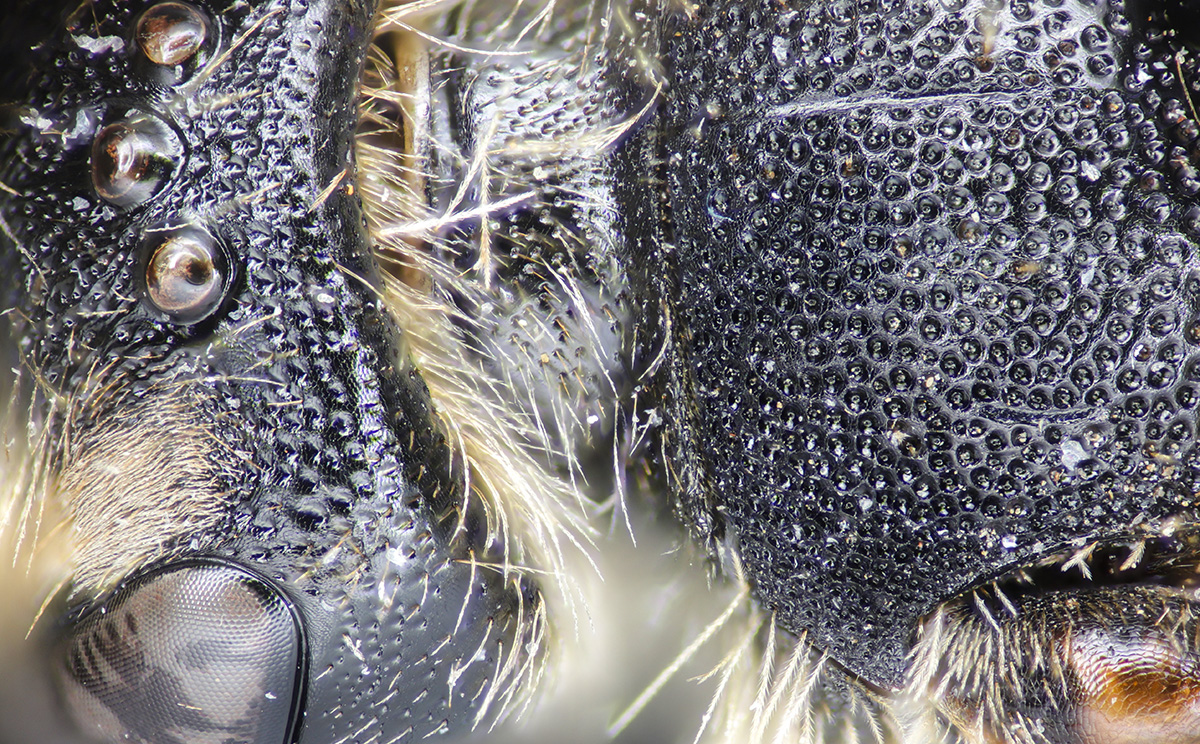
miranda vs salicifloris: A. salcifloris and A. miranda split on a final couplet. A. salicifloris: mesoscutum with anterior third with punctures crowded, separated
by mere ridges; vertex above lateral ocellus equals about one ocellar diameter.
A. miranda: Mesoscutum with anterior third with punctures discrete, separated by half to almost one puncture width; vertex above lateral ocellus usually distinctly longer than one ocellar diameter. My specimen appears to have crowded punctures AND a long vertex. To quote LaBerge: "There is no doubt that misidentification of such specimens will continue and, indeed, it is often impossible to place some in the correct species with any confidence." |
Above: Narrow lower fovea of Trachandrena.
Below: Scutum of another specimen. |
Easy calls, based on images at right:
|
Propodeal corbicula: tough call; vicina should have complete (not evident here), or nearly complete (perhaps) This one has a J. Ascher det. Others in the same specimen box exhibit some variability, would be hard to call as either "partial" or "incomplete". ,
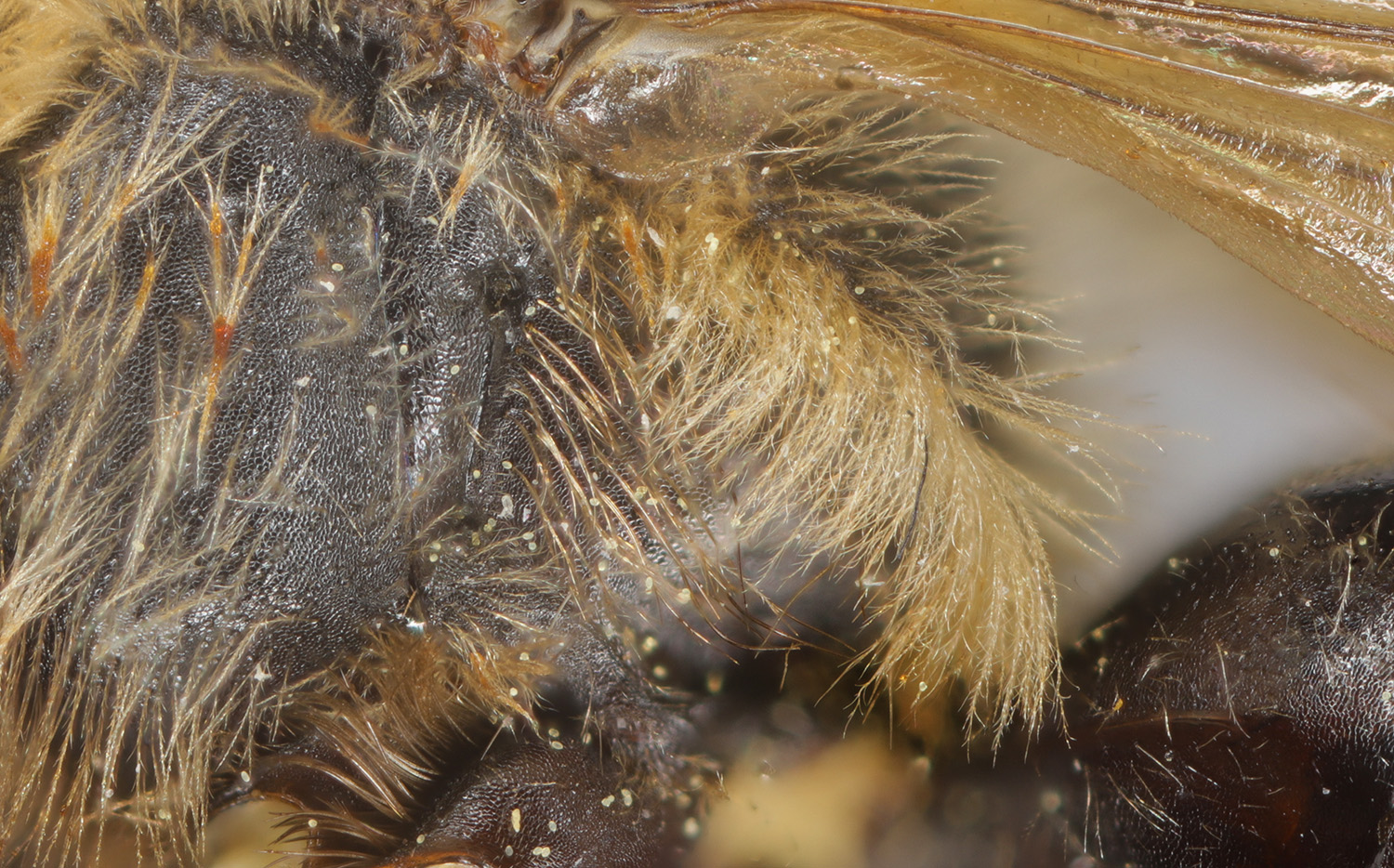
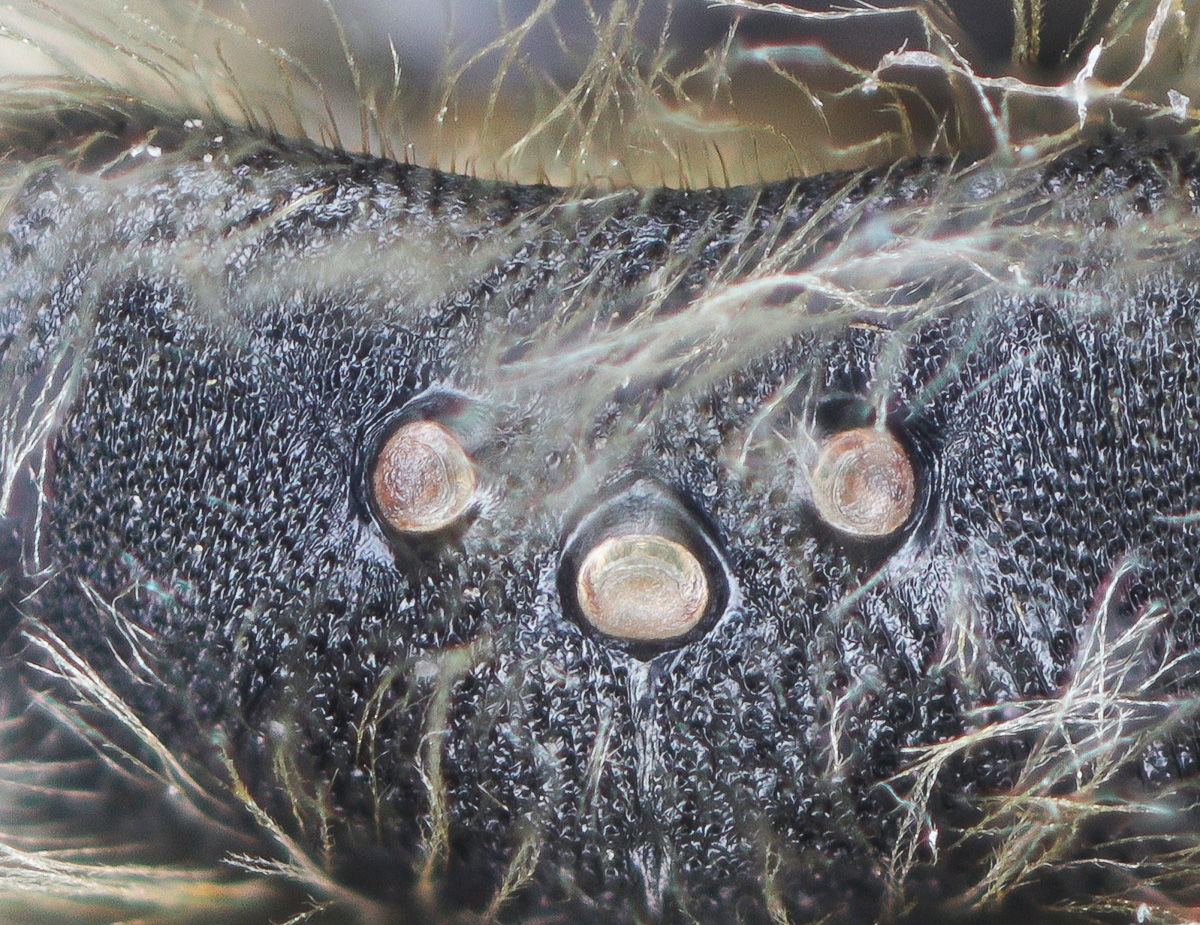
Assuming this is A. vicina, based on J.Ascher det, and the evidence. NOT A. regularis, which would have pale scopal hairs and uniform clypeal pitting. NOT A. carlini, which would have a modified pygidial plate, uniform trochanteral hairs, and a longer vertex. NOT A. nivalis: scopal hairs should be pale (in the east). Also, defintive if LeBerge is correct: "The female of nivalis can be separated from that of vicina by the lack of a median labral crista below the process, by the densely punctate scutellum ... Otherwise, the LeBerge nivalis description is frustratingly populated with statements of the form: "XXX as in vicina, except [subtle tiny difference]." |
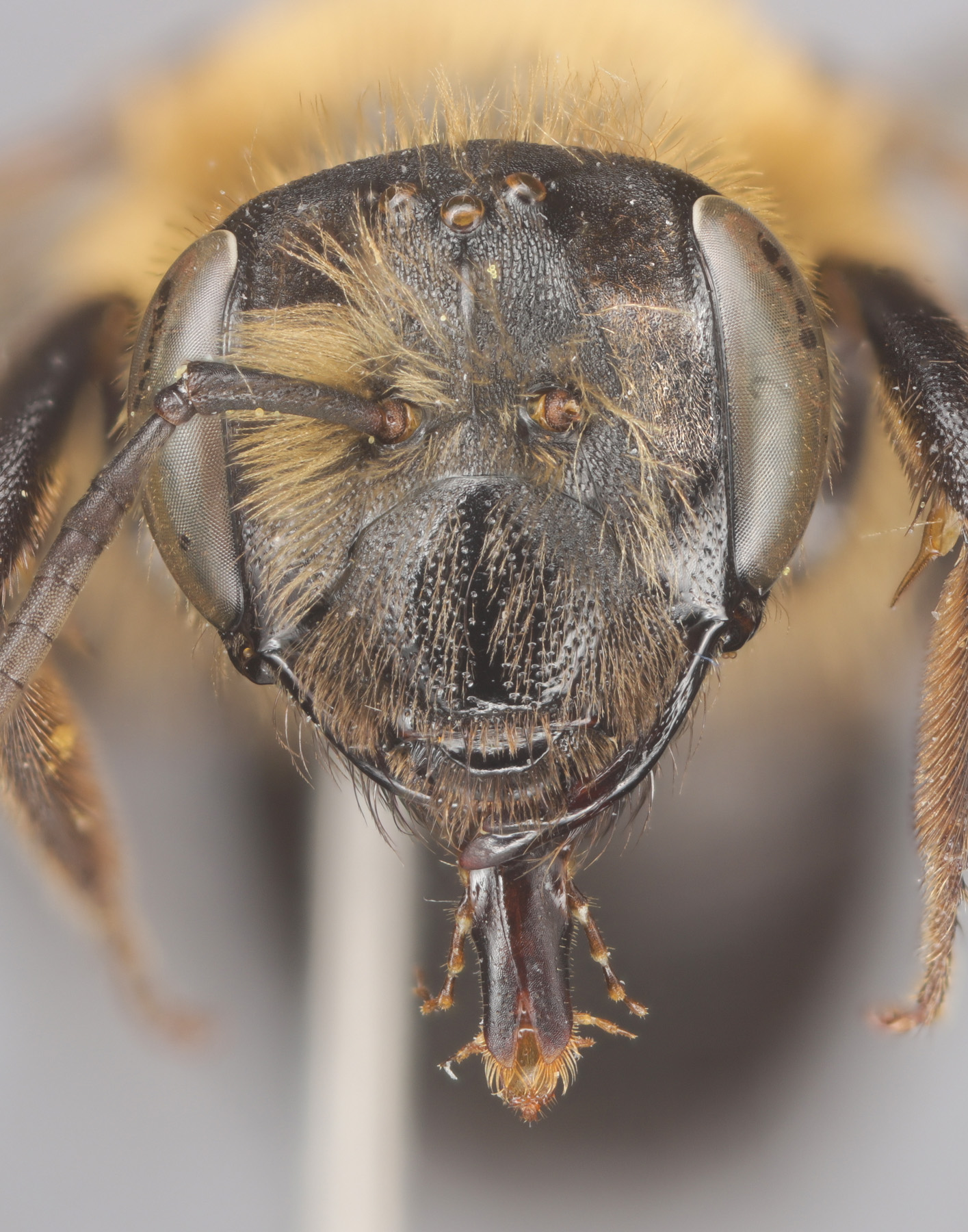
Notable: Shiny/dull clypeus, impunctate band. Fovea broad. Labral process entire. Malar space short. Frons rugose.
Scutum closely punctate, rough. Long vertex. Fovea moderately impressed.
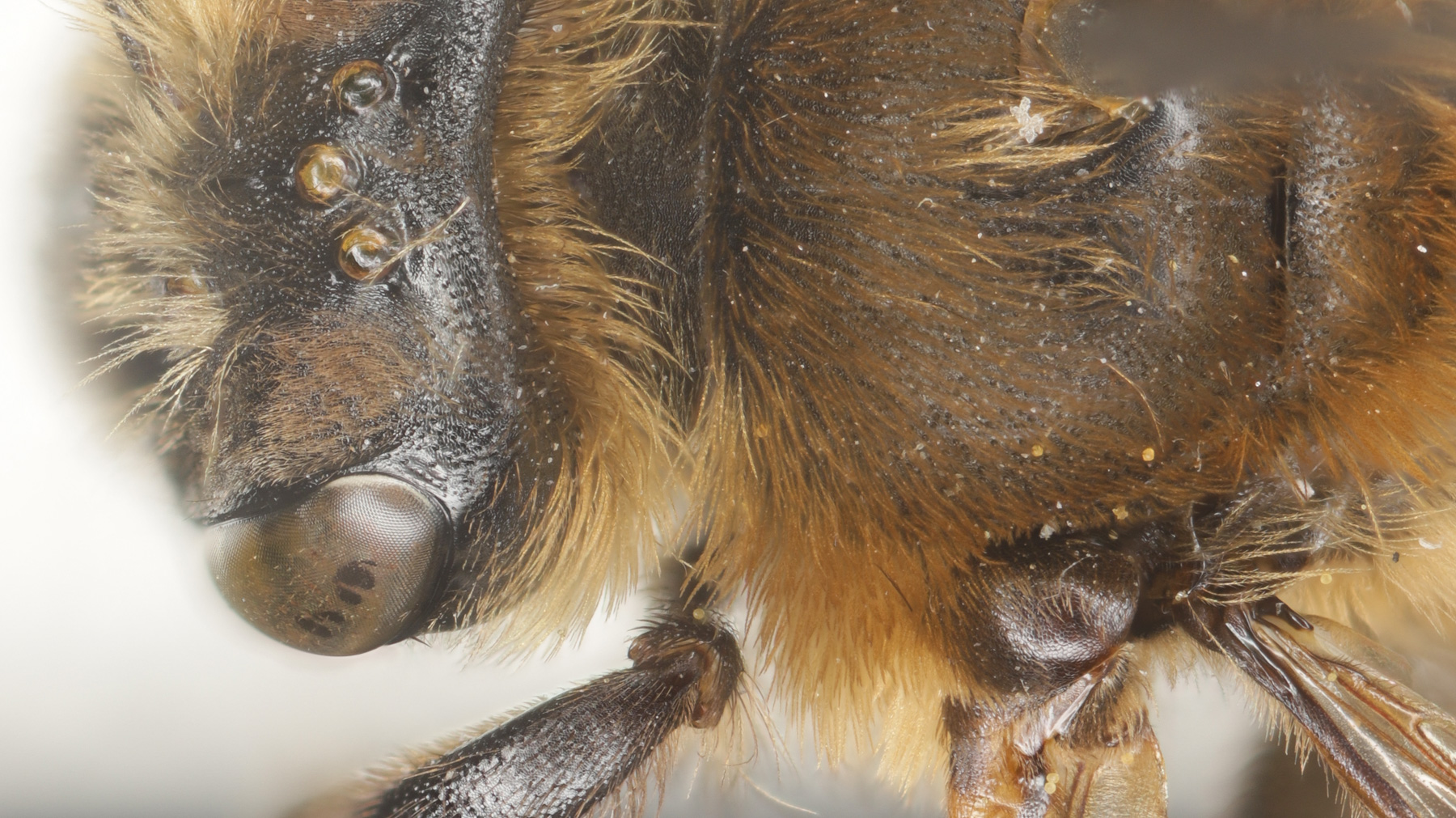
Labrum with distinct median crista. Sidebar: LaBerge, in nivalis description: "The female of nivalis can be separated from that of vicina by the lack of a median labral crista below the process." Yet in the description for vicina: "the labrum usually lacks the median crista below the process." And then later in the description: "strong median crista present or absent." |
T2 minutely, densely punctate, shiny (?). T2-5 tergal hairs dark.
Above: trochanter with straighter hairs proximally.
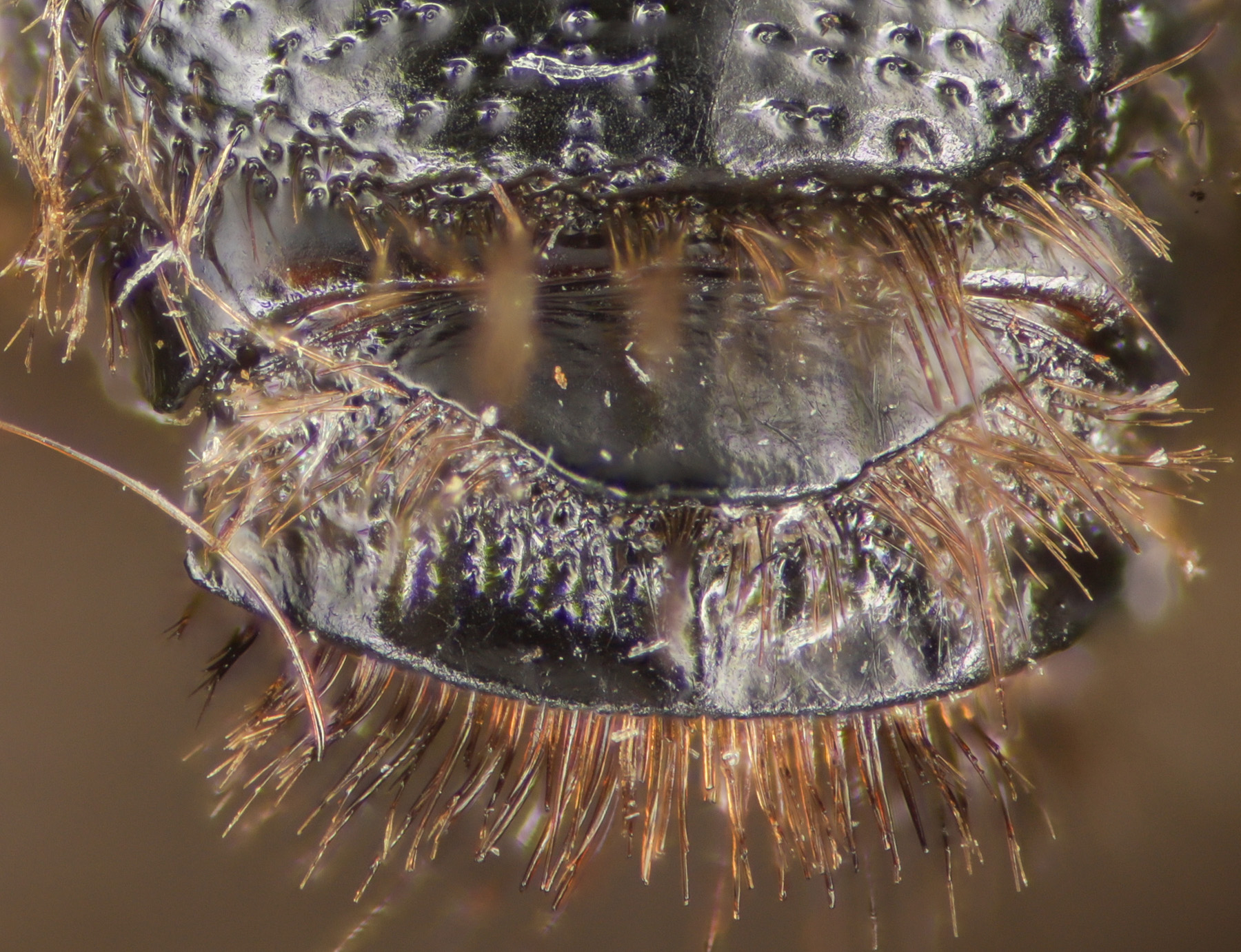
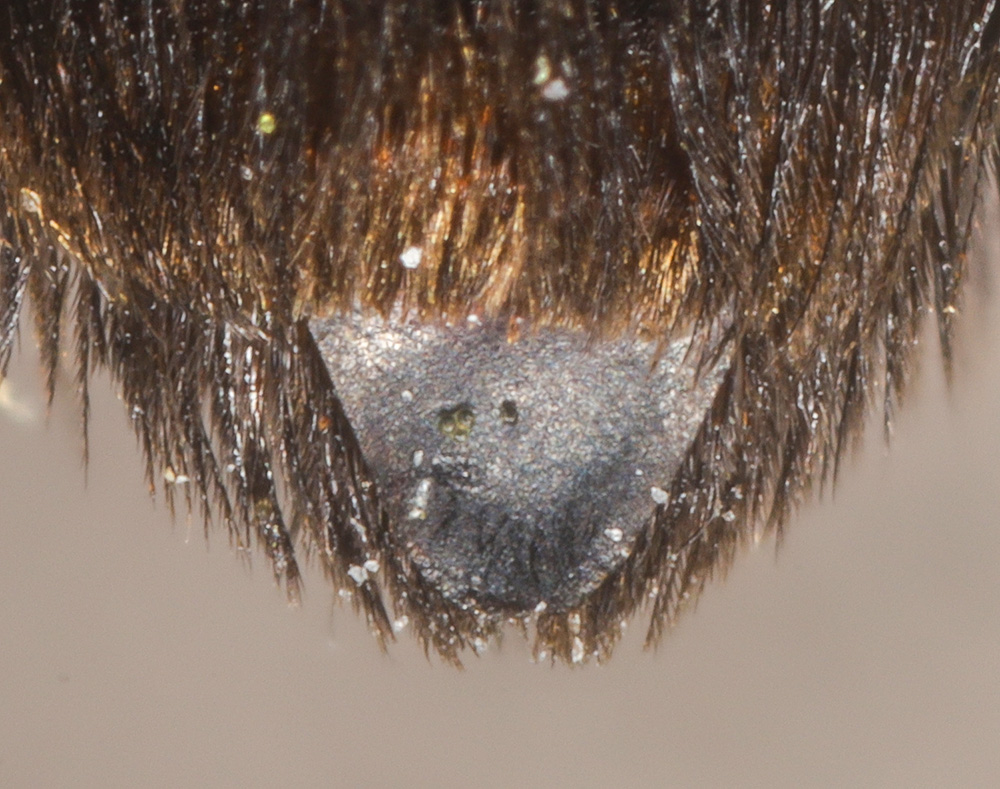
A. vicina: trochanter hair length DECREASES dramatically towards the base Below: pygidial plate unmodified, wide triangle.
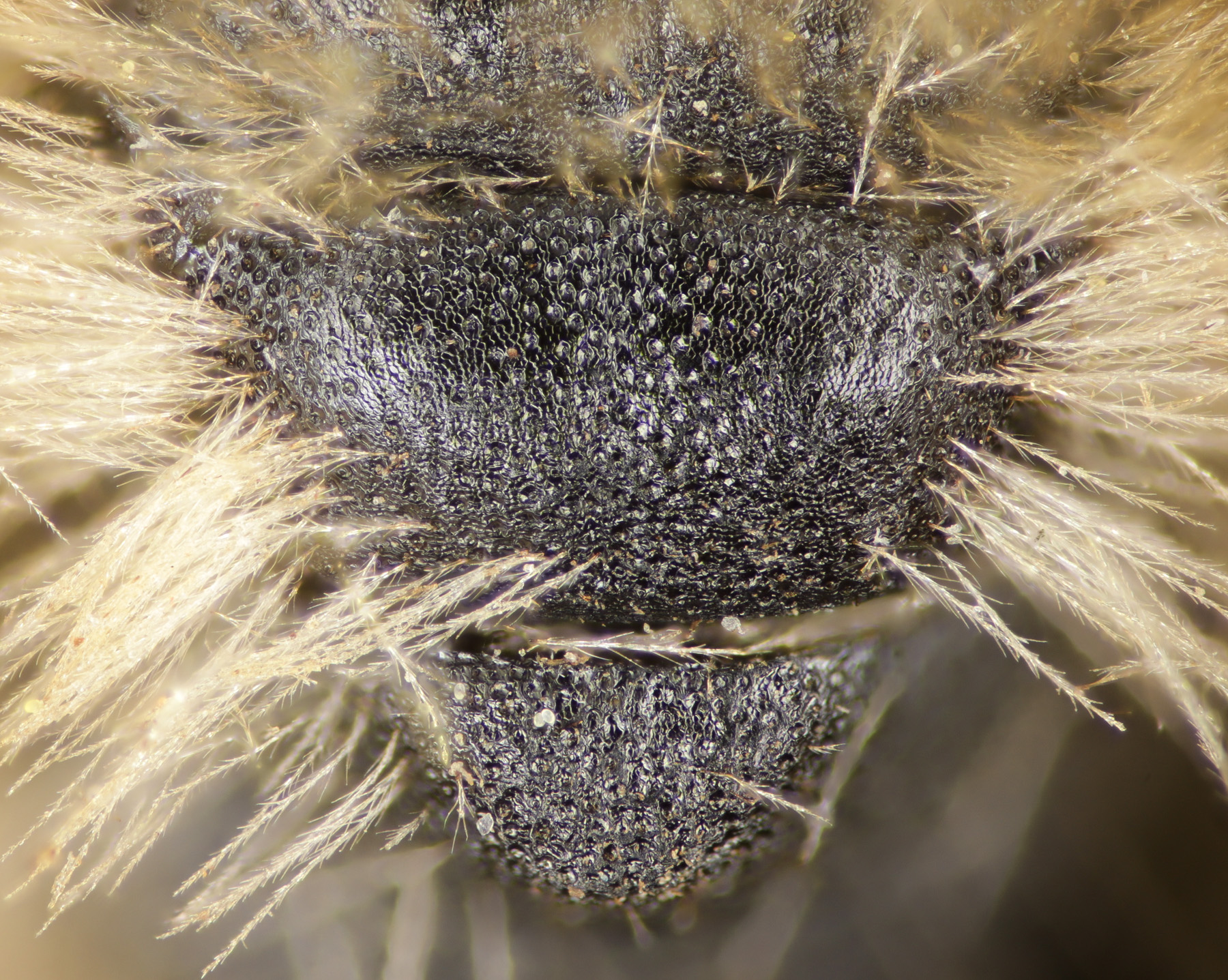
Below: Scutellar punctures: If A. nivalis, LeBerge says: "as in vicina except as follows: scutellum densely
punctate throughout, in least punctate areas punctures separated by half to one
puncture width." A difficult call; not obvious to me that these punctures are less dense.
|
| Two specimens from Protection Island, WA. I believe these are A. vicina, with overall impression and trait conditions mostly matching the Michigan specimen above. Each keys out to A. vicina in the LaBerge subgenus key. But some anomalies are interesting. Specimen #1, in images at right (specimen unavailable), vs Michigan example: T2 pits less distinct, propodeal corbicula with fringe of plumose hairs, dark fovea. DL scores A. vicina as having pale fovea; LaBerge contradicts this: "foveae broad above, occupying most of space between eyes and lateral ocelli, covered with brownish-ochraceous tomentum and with numerous longer, erect, more fuscous hairs." |
|
|
|
| The second Protection Island specimen at right. It would be surprising if this were not the same species as the first specimen. However it would be excluded in the DL guide, where A. vicina would have a complete, or nearly complete corbicula (From LaBerge: "propodeal corbicula well developed but rather short, with a distinct anterior fringe." I see no hint of an anterior fringe, and abundant, simple internal hairs. Is this vicina? If not, I don't have a better suggestion. |
Distinctly incomplete corbicula.
|
LaBerge, about vicina: "Propodeum with dorsal enclosure granular especially in basal half and often medially to apex." I guess ...
|
Above: Impunctate band not evident. Fovea dark.
Below: Incomplete flocculus, excludes carlini.
|
Easy calls, based on 1st 3 images at right:
|
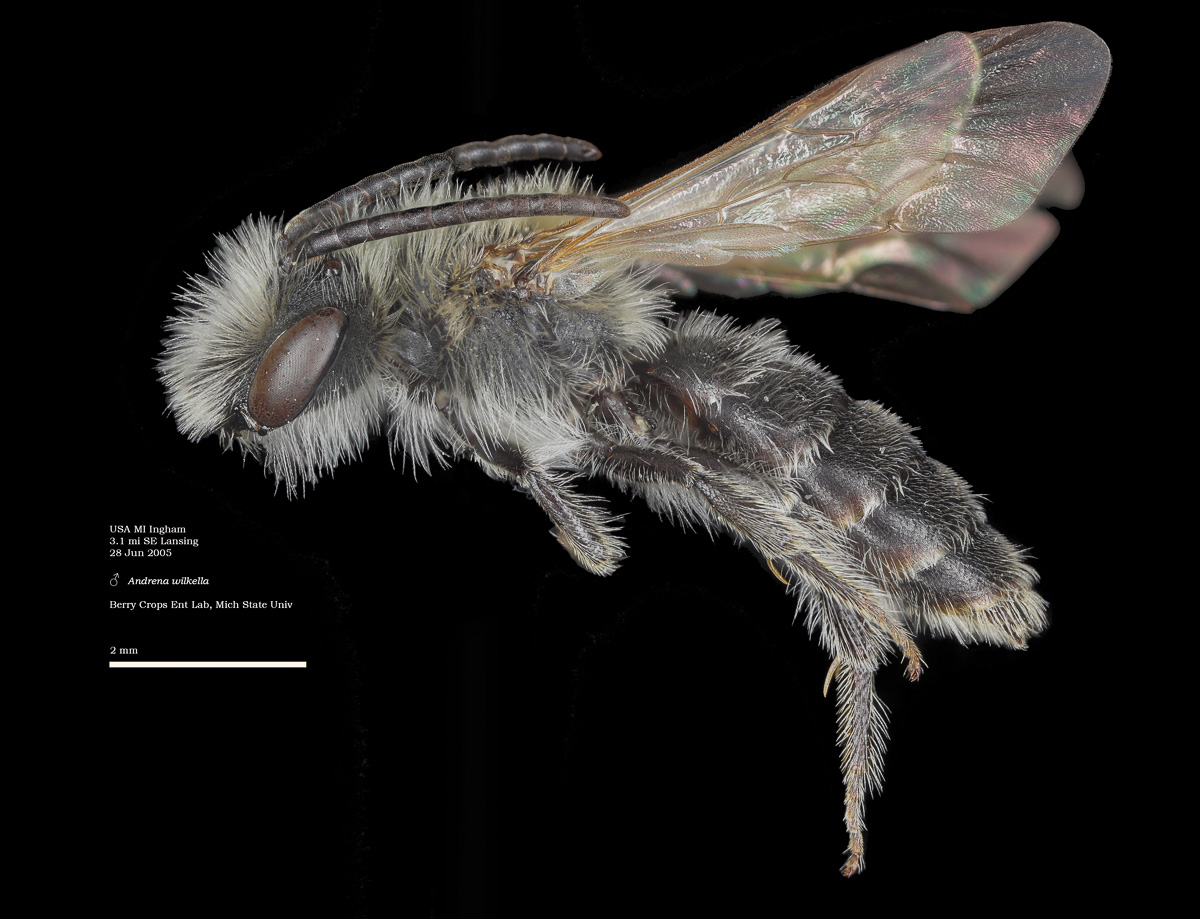
Notable: All light/tawny-orange hairs. Dense, orange scutal hairs. Malar area short. Gena narrow. Vertex> 1ocd. Long unbranched tibial hairs. Triangle roughened, not rugose.
|
There is no path in DL that clearly excludes species other than A. wilkella. So I looked at the primary literature: A Revision of the Bees of the Genus Andrena of the Western Hemisphere. Part XIII. Subgenera Simandrena and Taeniandrena (LaBerge, 1989)
"A large, readily recognized bee from North
eastern North America. The female has slightly elongated punctures
on the flattened clypeus, highly punctate metasomal terga, roug
ened but not rugulate propodeal enclosure ..." |
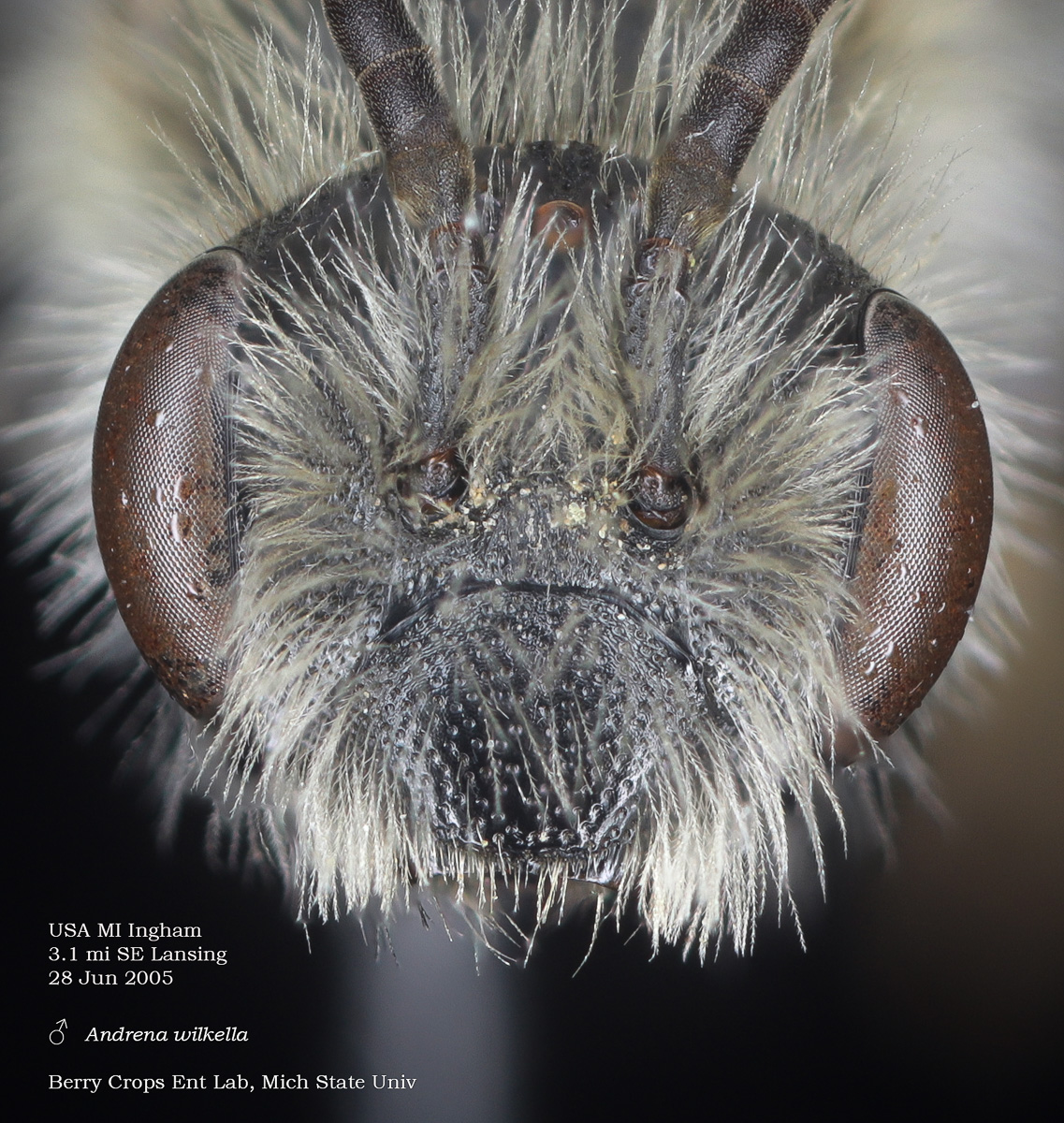
Clypeus notably flat. Punctures elongate (I think). Clincher: "Labral process tra
ezoidal, slightly constricted before apex, emarginate apically, surface basad of apical teeth with fine curved rugulae, shiny;" The latter - rugulae - is clear here.
|
Easy calls:
|
Notable: Tergae, scutum, head densely hairy.
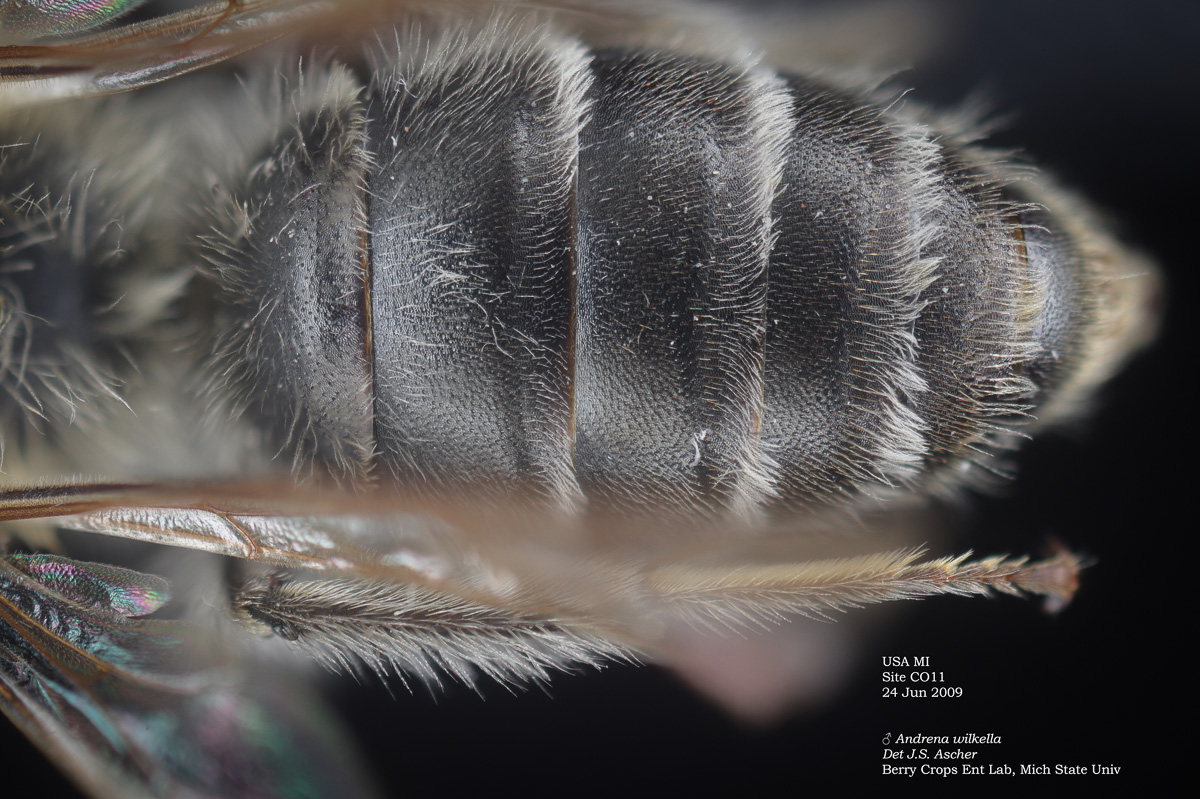
T2: A. wilkella is scored as having dense pits, separated by less than one pit diameter. I would have called the very shallow pits here "indistinct." |
Two specimens that strike me as having the same vibe. Except: one with clypeal hairs sparse. One denser.
![]() |
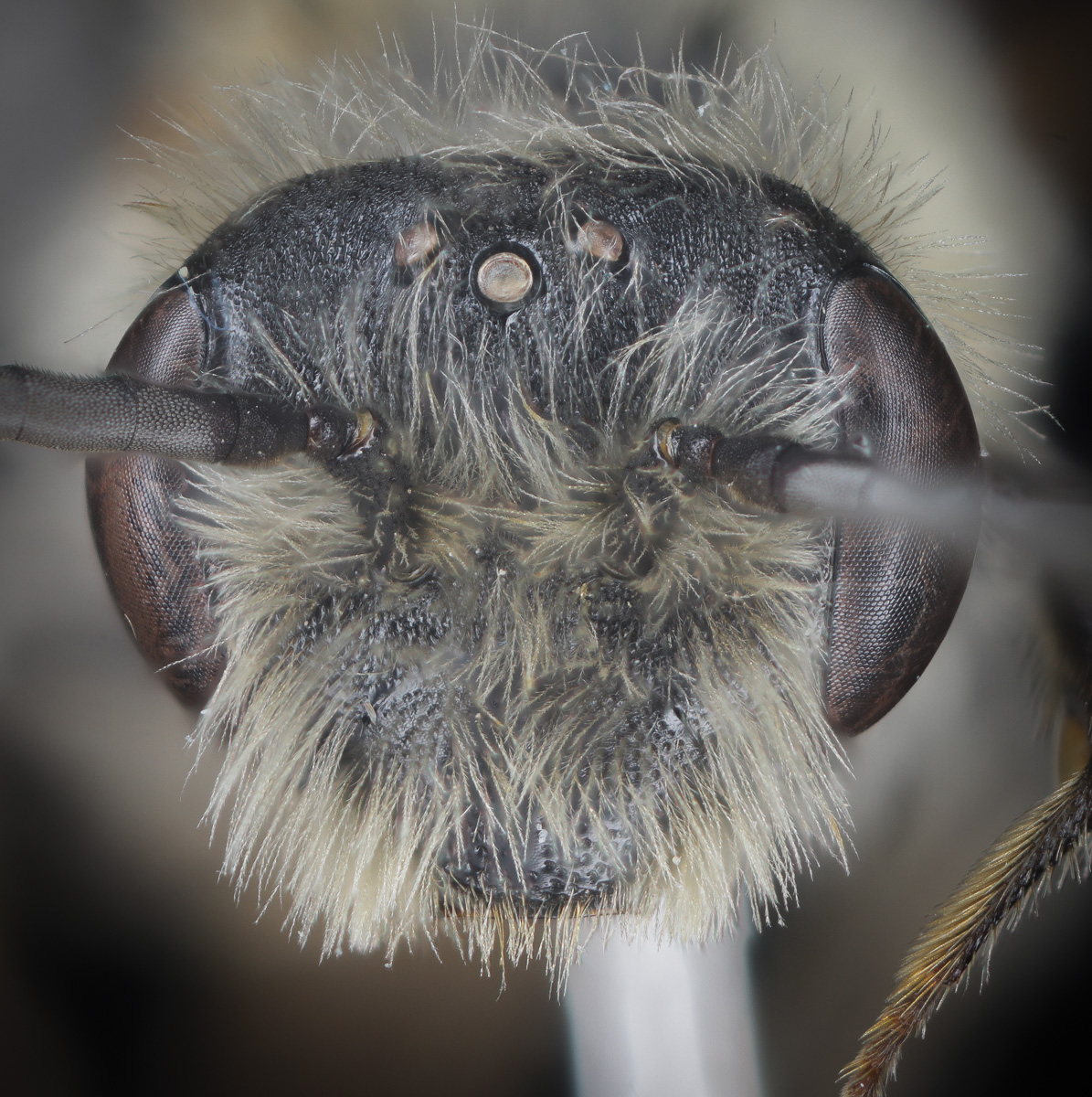
Vertex very tall. Frons distinctly punctate.
Discussion: I disagree with DL about this ID, based on examination of several specimens determined by J.S. Ascher. The DL scoring is accurate, but the matching algorithm is off. This kind of mistake is surprisingly uncommon in my experience, given the complexity of a key for 521 species. |